


Selective transvenous coil embolization of dural arteriovenous fistula. A report of three cases
- PMID: 20566089
- PMCID: PMC3345455
- DOI: 10.1177/15910199070130S118
Selective transvenous coil embolization of dural arteriovenous fistula. A report of three cases
Abstract
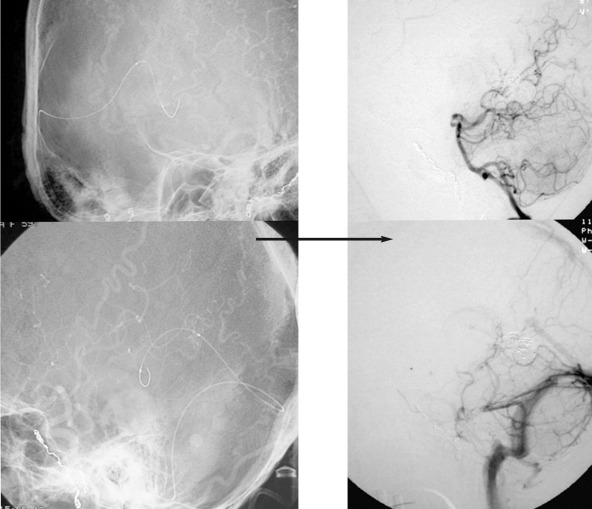
We herein report three cases of dural arteriovenous fistula (DAVF) in which the venous outlet immediately adjacent to the fistula was selectively embolized. Case 1: A 69-year-old man presented with a subarachnoid hemorrhage (SAH). Angiography demonstrated a DAVF in the left superior petrous sinus. Case 2: A 59-yearold woman presented with dizziness. Angiography demonstrated a DAVF adjacent to great vein of Galen. The DAVF drained through the great vein of Galen with retrograde leptomeningeal venous drainage (RLVD). The basal vein of Rosenthal was enhanced from the great vein of Galen. Case 3: A 51-year-old man presented with an occipital seizure. Angiography demonstrated a DAVF adjacent to the left side of the superior sagittal sinus with RLVD. All three cases were successfully treated by the selective embolization of the venous outlet immediately adjacent to the fistula. Therefore, selective embolization preserved normal venous return.
Figures




References
-
- Angiographic predictors of intracranial hemorrhage and clinical outcome in nonsurgical patients. J Neurosurg. 1994;81:531–538. - PubMed
-
- Davis MA, terBrugge K, et al. The validity of classification for the clinical presentation of intracranial arteriovenous fistulas. J Neurosurg. 1996;85:830–837. - PubMed
-
- Lasjaunias P, Chiu M, et al. Neurosurgical manifestations of intracranial arteriovenous malformations. J Neurosurg. 1986;64:724–730. - PubMed
-
- Malik GM, Pearce JE, et al. Dural arteriovenous malformations and intracranial hemorrhage. Neurosurgery. 1984;15:332–339. - PubMed
-
- Colloce M, Dí Aliberti G, et al. Surgical treatment of intracranial dural arteriovenous fistulae: role of venous drainage. Neurosurgery. 2000;47:56–67. - PubMed
LinkOut - more resources
Full Text Sources
