


Historical and contemporary gene dispersal in wild carrot (Daucus carota ssp. carota) populations
- PMID: 20566679
- PMCID: PMC2908163
- DOI: 10.1093/aob/mcq108
Historical and contemporary gene dispersal in wild carrot (Daucus carota ssp. carota) populations
Abstract
Background and aims: Wild carrot is the ancestor of cultivated carrot and is the most important gene pool for carrot breeding. Transgenic carrot may be released into the environment in the future. The aim of the present study was to determine how far a gene can disperse in wild carrot populations, facilitating risk assessment and management of transgene introgression from cultivated to wild carrots and helping to design sampling strategies for germplasm collections.
Methods: Wild carrots were sampled from Meijendel and Alkmaar in The Netherlands and genotyped with 12 microsatellite markers. Spatial autocorrelation analyses were used to detect spatial genetic structures (SGSs). Historical gene dispersal estimates were based on an isolation by distance model. Mating system and contemporary pollen dispersal were estimated using 437 offspring of 20 mothers with different spatial distances and a correlated paternity analysis in the Meijendel population.
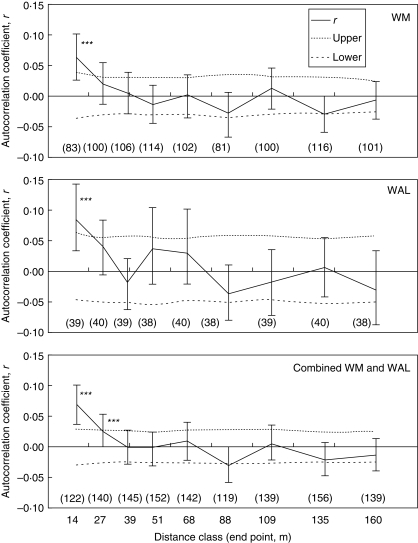
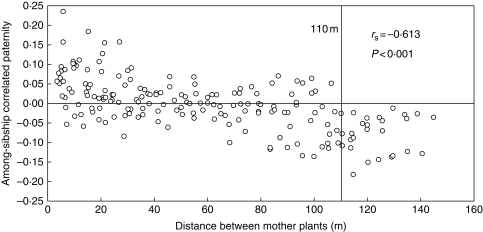
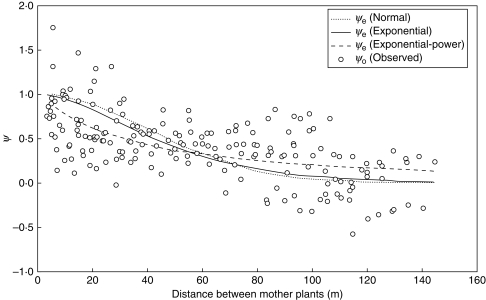
Key results: Significant SGSs are found in both populations and they are not significantly different from each other. Combined SGS analysis indicated significant positive genetic correlations up to 27 m. Historical gene dispersal sigma(g) and neighbourhood size N(b) were estimated to be 4-12 m [95 % confidence interval (CI): 3-25] and 42-73 plants (95 % CI: 28-322) in Meijendel and 10-31 m (95 % CI: 7-infinity) and 57-198 plants (95 % CI: 28-infinity) in Alkmaar with longer gene dispersal in lower density populations. Contemporary pollen dispersal follows a fat-tailed exponential-power distribution, implying pollen of wild carrots could be dispersed by insects over long distance. The estimated outcrossing rate was 96 %.
Conclusions: SGSs in wild carrots may be the result of high outcrossing, restricted seed dispersal and long-distance pollen dispersal. High outcrossing and long-distance pollen dispersal suggest high frequency of transgene flow might occur from cultivated to wild carrots and that they could easily spread within and between populations.
Figures

References
-
- Austerlitz F, Dick CW, Dutech C, et al. Using genetic markers to estimate the pollen dispersal curve. Molecular Ecology. 2004;13:937–954. - PubMed
-
- Boutin-Ganache I, Raposo M, Raymond M, Deschepper CF. M13-tailed primers improve the readability and usability of microsatellite analyses performed with two different allele-sizing methods. BioTechniques. 2001;31(24–26):28. - PubMed
-
- Chen WP, Punja ZK. Transgenic herbicide- and disease-tolerant carrot (Daucus carota L.) plants obtained through Agrobacterium-mediated transformation. Plant Cell Reports. 2002;20:929–935.
-
- Ellstrand NC, Prentice HC, Hancock JF. Gene flow and introgression from domesticated plants into their wild relatives. Annual Review of Ecology and Systematics. 1999;30:539–563.
