. 2010 Jul 6;107(27):12369-74.
doi: 10.1073/pnas.0913667107. Epub 2010 Jun 21.

Paradoxical glomerular filtration of carbon nanotubes

Affiliations

Paradoxical glomerular filtration of carbon nanotubes

Alessandro Ruggiero et al. Proc Natl Acad Sci U S A. .

Abstract

The molecular weight cutoff for glomerular filtration is thought to be 30-50 kDa. Here we report rapid and efficient filtration of molecules 10-20 times that mass and a model for the mechanism of this filtration. We conducted multimodal imaging studies in mice to investigate renal clearance of a single-walled carbon nanotube (SWCNT) construct covalently appended with ligands allowing simultaneous dynamic positron emission tomography, near-infrared fluorescence imaging, and microscopy. These SWCNTs have a length distribution ranging from 100 to 500 nm. The average length was determined to be 200-300 nm, which would yield a functionalized construct with a molecular weight of approximately 350-500 kDa. The construct was rapidly (t(1/2) approximately 6 min) renally cleared intact by glomerular filtration, with partial tubular reabsorption and transient translocation into the proximal tubular cell nuclei. Directional absorption was confirmed in vitro using polarized renal cells. Active secretion via transporters was not involved. Mathematical modeling of the rotational diffusivity showed the tendency of flow to orient SWCNTs of this size to allow clearance via the glomerular pores. Surprisingly, these results raise questions about the rules for renal filtration, given that these large molecules (with aspect ratios ranging from 100:1 to 500:1) were cleared similarly to small molecules. SWCNTs and other novel nanomaterials are being actively investigated for potential biomedical applications, and these observations-that high aspect ratio as well as large molecular size have an impact on glomerular filtration-will allow the design of novel nanoscale-based therapeutics with unusual pharmacologic characteristics.


Conflict of interest statement

Conflict of interest statement: D.A.S. is a consultant for Enscyce.

Figures
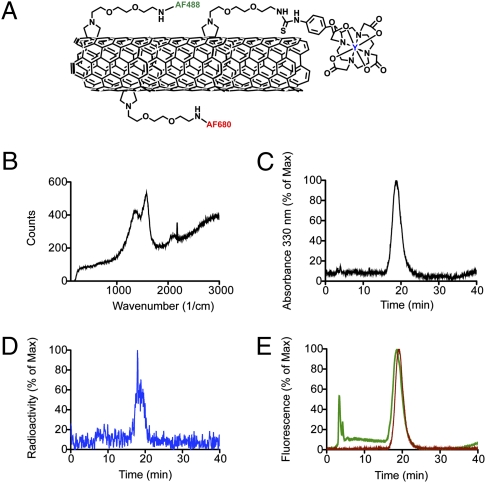
Fig. 1.
Fig. 1.
Water-soluble CNT covalently functionalized with DOTA, AF488, and AF680. (A) Schematic representation of the key appended moieties of the SWCNT-[([86Y]DOTA)(AF488)(AF680)] construct. (B) Raman spectrum of the purified SWCNT-NH2 starting material. (C–E) Reverse-phase HPLC chromatographs of SWCNT-[([86Y]DOTA)(AF488)(AF680)] showing a UV-Vis trace of the absorbance at 330 nm (CNT signature) (C), a radioactivity trace of the 86Y (D), and superimposed fluorescence traces of the AF488 (green) and AF680 (red) dye moieties (E).
Fig. 2.
Fig. 2.
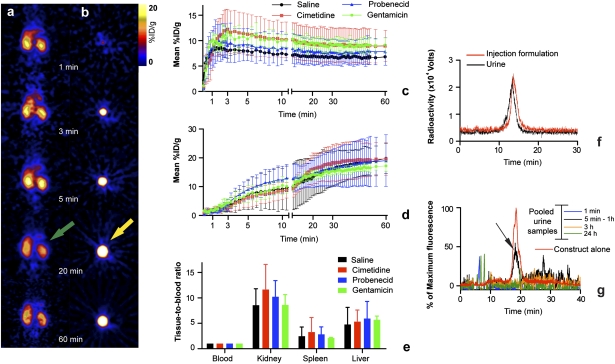
Renal clearance data for SWCNT-[([86Y]DOTA)(AF488)(AF680)] in mice. (A and B) Dynamic PET images of a representative animal showing rapid renal clearance in kidney coronal sections (green arrow) (A) and transverse bladder sections (yellow arrow) (B) at different time points. (C and D) Time activity curve %ID/g data (mean ± SD) obtained from VOI analysis of PET images of the kidneys (C) and bladders (D) of mice in the three groups receiving the inhibitors of active secretion and a saline control group. The 3 min kidney accumulation values (mean ± SD) were saline, 8.0 ± 1.4%ID/g; cimetidine, 12.1 ± 3.9%ID/g; probenecid, 9.1 ± 3.3%ID/g; and gentamicin, 11.6 ± 0.9%ID/g. Bladder accumulated activity at 20 min were saline, 13.3 ± 6.5%ID/g; cimetidine, 16.0 ± 5.6%ID/g; probenecid, 14.4 ± 4.6%ID/g; and gentamicin, 14.2 ± 1.2%ID/g. (E) Tissue-to-blood data from the tissue harvest data of the mice in the active secretion study. (F) Radioactivity chromatograph of urine sample (black trace) from a mouse that received SWCNT-[([86Y]DOTA)(AF488)(AF680)] overlaid with a sample of the injected construct (red trace). (G) Fluorescence chromatograph (black trace) of urine samples collected at 1 min, 5–60 min, 3 h, and 24 h from mice given SWCNT-[(DOTA)(AF488)(AF680)] overlaid with a sample of the injected construct (red trace).
Fig. 3.
Fig. 3.
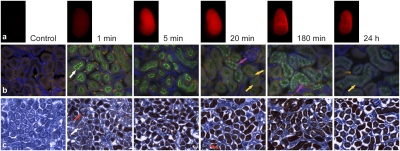
NIR images of harvested kidneys and corresponding IF and IHC microscopic sections of the kidneys of mice injected with SWCNT-[(DOTA)(AF488)(AF680)]. Time course imaging of kidneys of animals injected with SWCNT-[(DOTA)(AF488)(AF680)] using NIR imaging (A), IF (composite image: DAPI+AF488+TRITC) (B), and IHC (C). Reported is construct accumulation in the proximal tubule brush border (white arrows) and glomerulus (red arrows) in the first minutes and progressively cytoplasmic (yellow arrows) and nuclear accumulation (magenta arrows) in tubular cells.
Fig. 4.
Fig. 4.
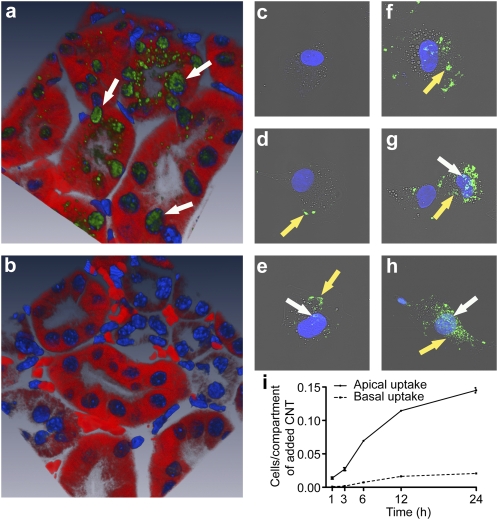
In vivo and in vitro kidney cell uptake of SWCNT-[(DOTA)(AF488)(AF680)]. (A and B) Confocal microscopic 3D-reconstructed IF image of the kidney cortex in mice injected with SWCNT-[(DOTA)(AF488)(AF680)] at 1 h postadministration, showing both punctate cytoplasmic and nuclear accumulation (A), and control (not-injected) mice (B). (C–H) Composite [AF488, DAPI, and differential interference contrast (DIC)] confocal images of HK-2 cells not exposed (C) and exposed to SWCNT-[(DOTA)(AF488)(AF680)] for 30 min (D), 60 min (E), 6 h (F), 12 h (G), and 24 h (H). Progressive accumulation of the construct in the cytoplasm (yellow arrow) and nuclei (white arrow). (I) Differential uptake of SWCNT-[([111In]DOTA)(AF488)(AF680)] by polarized HK-2 cells exposed on either the apical (brush border) side or the basal side using the Transwell chamber. Construct uptake was higher from the apical side than from the basolateral side (P < 0.05).
Fig. 5.
Fig. 5.
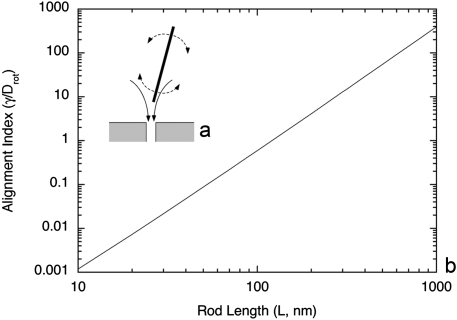
Mathematical modeling of the rotational diffusivity showed the tendency of flow to orient SWCNT of this size to allow clearance via the glomerular pores. (A) Schematic of a long, rod-like molecule approaching the entrance of a pore in a filtration process. The converging flow (solid curves) tends to align the major axis of the rod with the pore. This is opposed by rotational diffusion (dashed curves), which tends to randomize the rod orientations. If the rod length greatly exceeds the pore diameter (as shown), entry into the pore is probable only if the rotational Brownian motion is sufficiently weak to permit a high degree of alignment. (B) Predicted effect of molecular length on the tendency of a rod-like molecule to align end-on at a glomerular pore. The rod diameter is assumed to be 1 nm, and the other inputs are as described in the text. Values of γ/Drot much larger than unity, as for the SWCNT studied, suggest high degrees of alignment and a greatly increased probability of entering pores in the capillary wall.

References

    1. Kostarelos K, Bianco A, Prato M. Promises, facts and challenges for carbon nanotubes in imaging and therapeutics. Nat Nanotechnol. 2009;4:627–633. - PubMed
    1. Georgakilas V, et al. Amino acid functionalisation of water-soluble carbon nanotubes. Chem Commun (Camb) 2002;5:3050–3051. - PubMed
    1. Tasis D, Tagmatarchis N, Bianco A, Prato M. Chemistry of carbon nanotubes. Chem Rev. 2006;106:1105–1136. - PubMed
    1. Singh P, et al. Organic functionalisation and characterisation of single-walled carbon nanotubes. Chem Soc Rev. 2009;38:2214–2230. - PubMed
    1. Wang H, et al. Biodistribution of carbon single-wall carbon nanotubes in mice. J Nanosci Nanotechnol. 2004;4:1019–1024. - PubMed

Publication types

MeSH terms

Substances

LinkOut - more resources