. 2010 Mar;6(3):185-96.

Hereditary hamartomatous polyposis syndromes: understanding the disease risks as children reach adulthood

Affiliations

Hereditary hamartomatous polyposis syndromes: understanding the disease risks as children reach adulthood

Michael Manfredi. Gastroenterol Hepatol (N Y). 2010 Mar.

Abstract

Hamartomatous polyposis syndromes are a rare group of hereditary autosomal dominant disorders that comprise less than 1% of all hereditary colorectal cancers. Hamartomatous polyps, in and of themselves, are benign entities; however, these hamartomatous polyposis syndromes have a malignant potential for the development of colorectal cancer as well as extracolonic cancers. Early detection and proper surveillance are vital to minimizing the risk of carcinoma. This article provides a critical review of the clinical presentation, pathology, genetics, and screening and surveillance guidelines of juvenile polyposis syndrome, PTEN hamartoma tumor syndrome, and Peutz-Jeghers syndrome.

Keywords: Hamartomatous polyposis syndromes; PTEN hamartoma tumor syndrome; Peutz-Jeghers syndrome; juvenile polyposis syndrome.


Figures

Figure 1
Figure 1
Resection of a colon from a patient with juvenile polyposis syndrome containing multiple juvenile polyps (A). Reproduced from Demetris AJ, Finkelstein SD, Nalensnik MA, et al. Slide carousel of GI pathology course for medical students. Available at: http://itchforum.net/content/index_eng.html. © Department of Pathology, University of Pittsburgh School of Medicine. Histologic image of a juvenile polyp showing its characteristic large cystic spaces and a lamina propria with an inflammatory cell component (B). Reproduced from Mulholland M, Lillemoe K, Doherty G, Maier R, Upchurch G. Greenfield's Surgery: Scientific Principles and Practice. 4th ed. Philadelphia, Pennsylvania: Lippincott Williams & Wilkins; 2006.
Figure 2
Figure 2
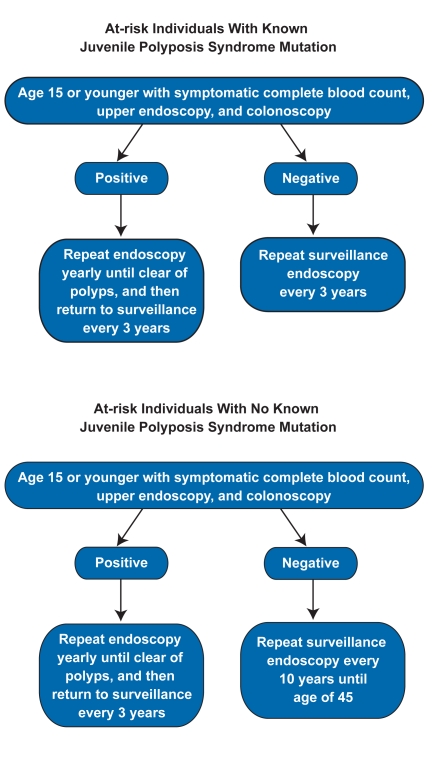
Proposed algorithm for endoscopic surveillance of juvenile polyposis syndrome.
Figure 3
Figure 3
Multiple skin-colored facial warty papules representing tricholemmonas (A). Multiple reddish confluent papules on the oral mucosa revealing a cobblestone appearance (B). Both figures are reproduced from Wolff K, Johnson RA, Fitzpatrick TB. Fitzpatrick's Color Atlas and Synopsis of Clinical Dermatology. 6th ed. New York, New York: McGraw-Hill Medical; 2009.
Figure 4
Figure 4
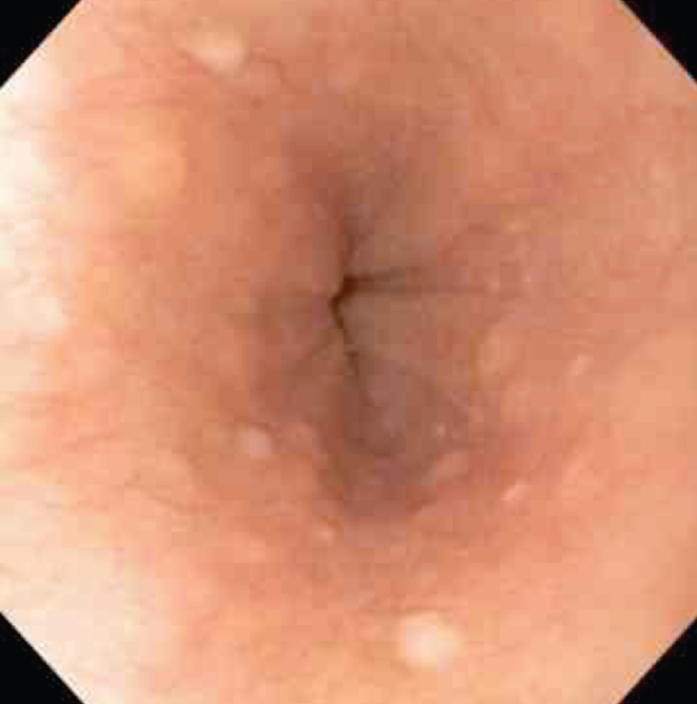
Glycogenic acanthosis Table 1. Extraintestinal Manifestations of Cowden Syndrome of the esophagus in a patient With Their Diagnostic Criteria with Cowden syndrome.
Figure 5
Figure 5
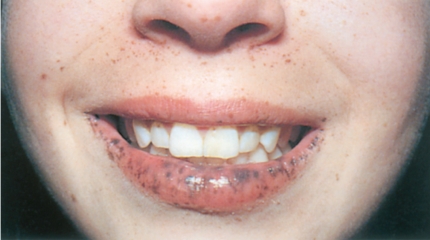
Multiple dark-brown lentigines on the vermillion border of the lip and buccal mucosa in a patient with Peutz-Jeghers syndrome. Reproduced from Swartz MH. Textbook of Physical Diagnosis: History and Examination. 4th ed. Philadelphia, Pennsylvania: WB Saunders; 2002:295.
Figure 6
Figure 6
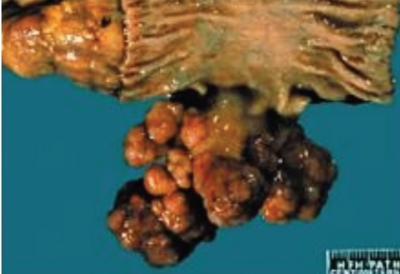
Polyps from a patient with Peutz-Jeghers syndrome are pedunculated and tend to be large and multilobulated. Reproduced from Mulholland M, Lillemoe K, Doherty G, Maier R, Upchurch G. Greenfield's Surgery: Scientific Principles and Practice. 4th ed. Philadelphia, Pennsylvania: Lippincott Williams & Wilkins; 2006.
Figure 7
Figure 7
Histologic image of a Peutz-Jeghers po lyp showing its characteristic histologic appearance, which consists of smooth (a process that is called arborization) (A). Enlargement of a Peutz-Jeghers polyp showing smooth muscle proliferation (B). Both images reproduced from Boland CR. The colon, rectum, and anus. In: Feldman M, ed. Gastroenterology and Hepatology: The Comprehensive Visual Reference. Philadelphia, Pennsylvania: Churchill Livingstone; 1996.

References

    1. Attard TM, Young RJ. Diagnosis and management of gastrointestinal polyps: pediatric considerations. Gastroenterol Nurs. 2006;29:16–22. quiz 3-4. - PubMed
    1. Nagy R, Sweet K, Eng C. Highly penetrant hereditary cancer syndromes. Oncogene. 2004;23:6445–6470. - PubMed
    1. Wirtzfeld DA, Petrelli NJ, Rodriguez-Bigas MA. Hamartomatous polyposis syndromes: molecular genetics, neoplastic risk, and surveillance recommendations. Ann Surg Oncol. 2001;8:319–327. - PubMed
    1. Kinzler KW, Vogelstein B. Landscaping the cancer terrain. Science. 1998;280:1036–1037. - PubMed
    1. Burt RW, Bishop DT, Lynch HT, Rozen P, Winawer SJ. Risk and surveillance of individuals with heritable factors for colorectal cancer. WHO Collaborating Centre for the Prevention of Colorectal Cancer. Bull World Health Organ. 1990;68:655–665. - PMC - PubMed

LinkOut - more resources