. 2010 Aug 3;49(30):6358-64.
doi: 10.1021/bi100773g.

Mechanistic investigation of the inhibition of Abeta42 assembly and neurotoxicity by Abeta42 C-terminal fragments

Affiliations

Mechanistic investigation of the inhibition of Abeta42 assembly and neurotoxicity by Abeta42 C-terminal fragments

Huiyuan Li et al. Biochemistry. .

Abstract

Oligomeric forms of amyloid beta-protein (Abeta) are key neurotoxins in Alzheimer's disease (AD). Previously, we found that C-terminal fragments (CTFs) of Abeta42 interfered with assembly of full-length Abeta42 and inhibited Abeta42-induced toxicity. To decipher the mechanism(s) by which CTFs affect Abeta42 assembly and neurotoxicity, here, we investigated the interaction between Abeta42 and CTFs using photoinduced cross-linking and dynamic light scattering. The results demonstrate that distinct parameters control CTF inhibition of Abeta42 assembly and Abeta42-induced toxicity. Inhibition of Abeta42-induced toxicity was found to correlate with stabilization of oligomers with a hydrodynamic radius (R(H)) of 8-12 nm and attenuation of formation of oligomers with an R(H) of 20-60 nm. In contrast, inhibition of Abeta42 paranucleus formation correlated with CTF solubility and the degree to which CTFs formed amyloid fibrils themselves but did not correlate with inhibition of Abeta42-induced toxicity. Our findings provide important insight into the mechanisms by which different CTFs inhibit the toxic effect of Abeta42 and suggest that stabilization of nontoxic Abeta42 oligomers is a promising strategy for designing inhibitors of Abeta42 neurotoxicity.


Figures
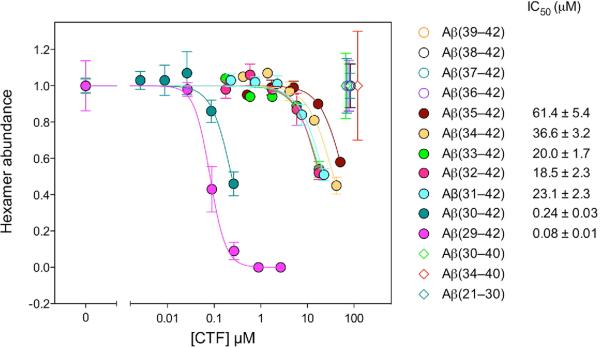
Figure 1
Figure 1
Inhibition of Aβ42 hexamer formation. Aβ42 was cross-linked in the absence or presence of increasing concentrations of each CTF and analyzed by SDS-PAGE and silver staining. The amount of Aβ42 hexamer was determined densitometrically and normalized to the protein content in the entire lane. IC50 values are the CTF concentration required for 50% inhibition of Aβ42 hexamer formation.
Figure 2
Figure 2
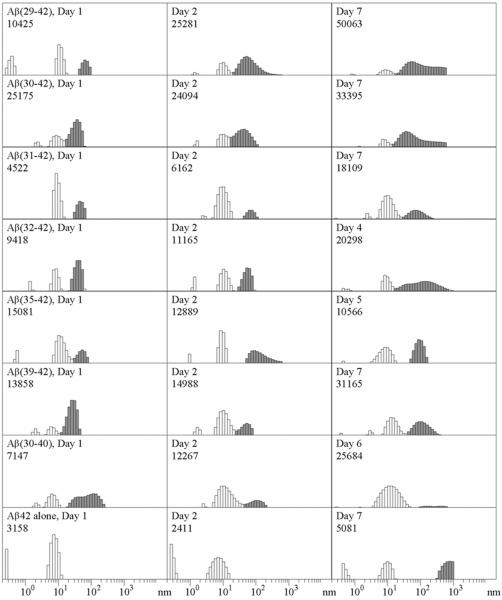
CTF effect on Aβ42 particle size distribution. Representative distributions of Aβ42 in the absence or presence of CTFs immediately after preparation (Left), on the next day (Center), and after 4–7 days (Right). White bars represent P1 particles. Gray bars represent P2 or larger particles (in the case of Aβ42 alone). Days of measurement and the total scattering intensities in counts per second are shown in the upper left corner of each panel. Only intensities within the same row are directly comparable with each other.
Figure 3
Figure 3
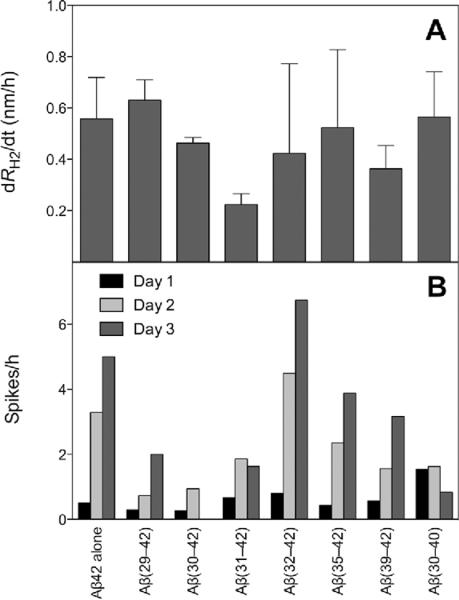
DLS monitoring of Aβ42 aggregation in the absence or presence of CTFs. A) Growth rates (dRH2/dt) of particles with initial RH2 = 20–60 nm. The data for Aβ42 alone could not be obtained consistently (see text). B) Intensity spikes per hour indicating fibril development.
Figure 4
Figure 4
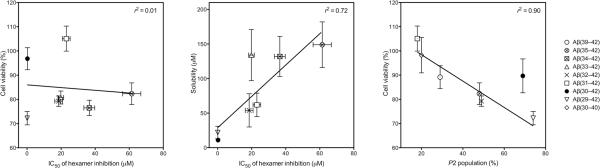
Correlation analysis. A) Linear regression analysis correlating inhibition of paranucleus formation for Aβ(29–42)–Aβ(35–42) with inhibition of Aβ42-induced toxicity (19) (r2 = 0.01, p = 0.8). B) Linear regression analysis correlating inhibition of paranucleus formation for Aβ(29–42)–Aβ(35–42) with CTFs solubility (19) (r2 = 0.72, p = 0.02). C) Linear regression analysis correlating the population of P2 on day 2 for Aβ(29–42)–Aβ(32–42), Aβ(35–42), Aβ(39–42), and Aβ(30–40) with inhibition of Aβ42-induced toxicity (r2 = 0.90, p = 0.004). Aβ(30–40) is an outlier in this correlation, which is not included in the calculation.
Figure 5
Figure 5
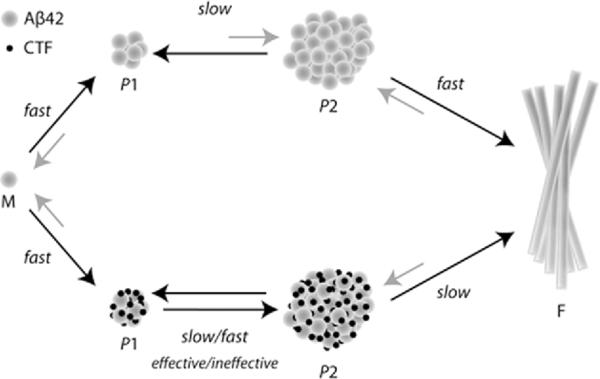
Schematic representation of a putative mechanism by which CTFs affect Aβ42 assembly. Monomer (M) assembly into P1 particles is a fast process in the absence (top path) or presence (bottom path) of CTFs. CTFs may accelerate the conversion of P1 into P2 oligomers, but effective inhibitors of Aβ42-induced toxicity induce slower acceleration than ineffective ones, shifting the population towards P1. All CTFs slow down the maturation of P2 assemblies into fibrils (F).

References

    1. Prince M, Jackson J, editors. Alzheimer's Disease International World Alzheimer Report 2009. Alzheimer's Disease International; London: 2009.
    1. Hardy J, Selkoe DJ. The amyloid hypothesis of Alzheimer's disease: progress and problems on the road to therapeutics. Science. 2002;297:353–356. - PubMed
    1. Ferreira ST, Vieira MN, De Felice FG. Soluble protein oligomers as emerging toxins in Alzheimer's and other amyloid diseases. IUBMB Life. 2007;59:332–345. - PubMed
    1. Dahlgren KN, Manelli AM, Stine WB, Jr., Baker LK, Krafft GA, LaDu MJ. Oligomeric and fibrillar species of amyloid-β peptides differentially affect neuronal viability. J. Biol. Chem. 2002;277:32046–32053. - PubMed
    1. Roher AE, Lowenson JD, Clarke S, Woods AS, Cotter RJ, Gowing E, Ball MJ. β-Amyloid-(1–42) is a major component of cerebrovascular amyloid deposits: implications for the pathology of Alzheimer disease. Proc. Natl. Acad. Sci. USA. 1993;90:10836–10840. - PMC - PubMed

Publication types

MeSH terms