


Virion-associated cofactor high-mobility group DNA-binding protein-1 facilitates transposition from the herpes simplex virus/Sleeping Beauty amplicon vector platform
- PMID: 20568967
- PMCID: PMC2978546
- DOI: 10.1089/hum.2010.022
Virion-associated cofactor high-mobility group DNA-binding protein-1 facilitates transposition from the herpes simplex virus/Sleeping Beauty amplicon vector platform
Abstract
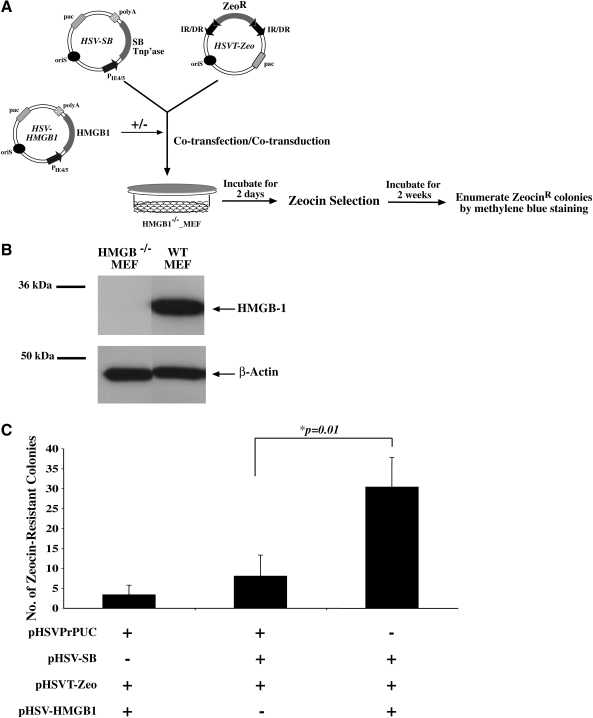
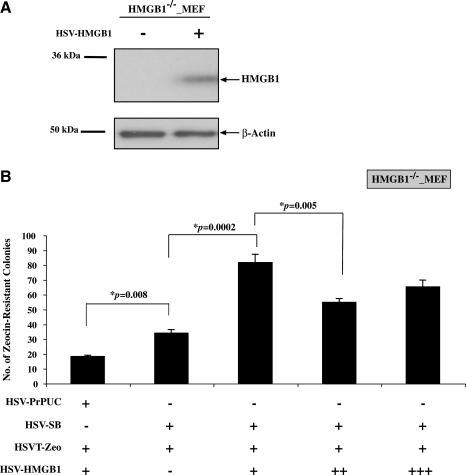
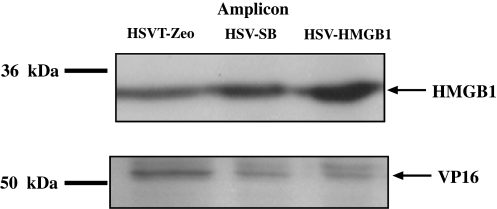
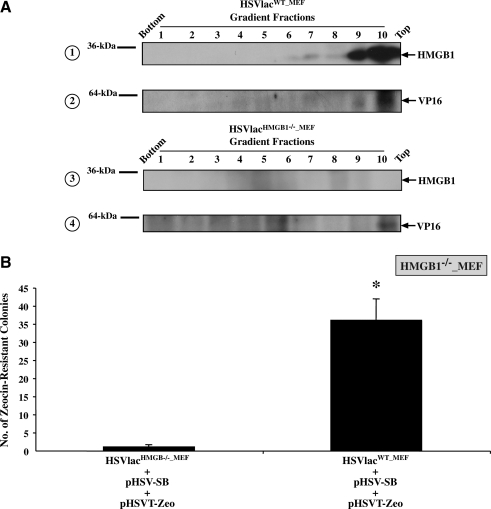
The development of the integration-competent, herpes simplex virus/Sleeping Beauty (HSV/SB) amplicon vector platform has created a means to efficiently and stably deliver therapeutic transcription units (termed "transgenons") to neurons within the mammalian brain. Furthermore, an investigation into the transposition capacity of the HSV/SB vector system revealed that the amplicon genome provides an optimal substrate for the transposition of transgenons at least 12 kb in length [de Silva, S., Mastrangelo, M.A., Lotta, L.T., Jr., Burris, C.A., Federoff, H.J., and Bowers, W.J. ( 2010 ). Gene Ther. 17, 424-431]. These results prompted an investigation into the factors that may contribute toward efficient transposition from the HSV/SB amplicon. One of the cellular cofactors known to play a key role during SB-mediated transposition is the high-mobility group DNA-binding protein-1 (HMGB1). Our present investigation into the role of HMGB1 during amplicon-based transposition revealed that transposition is not strictly dependent on the presence of cellular HMGB1, contrary to what had been previously demonstrated with plasmid-based SB transposition. We have shown for the first time that during amplicon preparation, biologically active HMGB1 derived from the packaging cell line is copackaged into amplicon vector particles. As a result, HSV/SB amplicon virions arrive prearmed with HMGB1 protein at levels sufficient for facilitating SB-mediated transposition in the transduced mammalian cell.
Figures
References
-
- Bakowska J.C. Di Maria M.V. Camp S.M. Wang Y. Allen P.D. Breakefield X.O. Targeted transgene integration into transgenic mouse fibroblasts carrying the full-length human AAVS1 locus mediated by HSV/AAV rep+ hybrid amplicon vector. Gene Ther. 2003;10:1691–1702. - PubMed
-
- Bowers W.J. Federoff H.J. Herpes simplex virus type 1-derived amplicon vectors. In Gene Transfer: Delivery and Expression of DNA and RNA, A Laboratory Manual. In: Rossi J., editor; Friedmann T., editor. Cold Spring Harbor Press; Cold Spring Harbor, NY: 2006. pp. 227–254.
-
- Bowers W.J. Howard D.F. Brooks A.I. Halterman M.W. Federoff H.J. Expression of vhs and VP16 during HSV-1 helper virus-free amplicon packaging enhances titers. Gene Ther. 2001;8:111–120. - PubMed
-
- Bowers W.J. Mastrangelo M.A. Howard D.F. Southerland H.A. Maguire-Zeiss K.A. Federoff H.J. Neuronal precursor-restricted transduction via in utero CNS gene delivery of a novel bipartite HSV amplicon/transposase hybrid vector. Mol. Ther. 2006;13:580–588. - PubMed
Publication types
MeSH terms
Substances
Grants and funding
LinkOut - more resources
Full Text Sources
Other Literature Sources
Research Materials
