


Randomized trial of Tapas Acupressure Technique for weight loss maintenance: rationale and study design
- PMID: 20569037
- PMCID: PMC2922972
- DOI: 10.1089/acm.2009.0454
Randomized trial of Tapas Acupressure Technique for weight loss maintenance: rationale and study design
Abstract
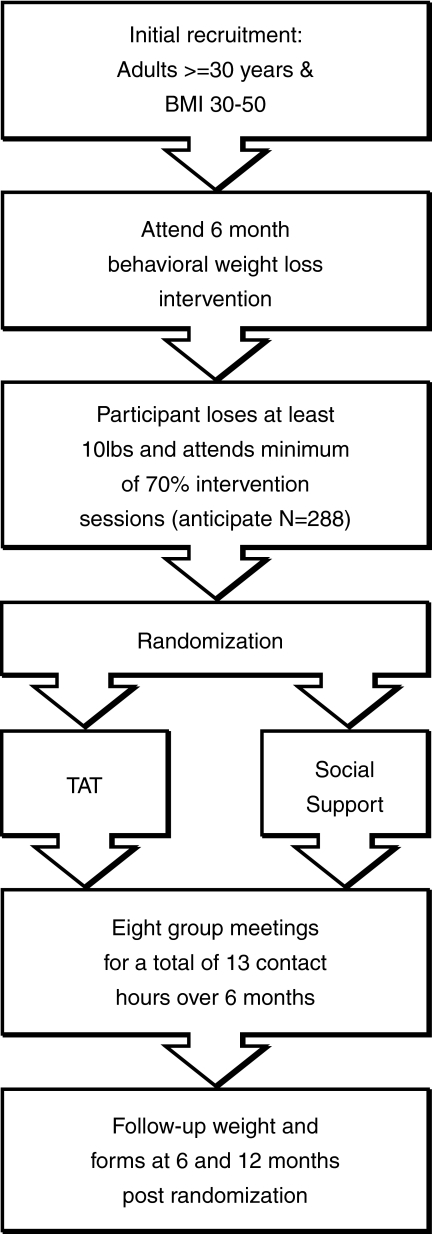
Objectives: The aim of this article is to present the rationale, study design, and methods of an ongoing randomized controlled trial assessing the efficacy of an energy psychology intervention, Tapas Acupressure Technique (TAT), to prevent weight regain following successful weight loss.
Design: This is a randomized controlled trial.
Settings/location: The study is being conducted at a large group-model health maintenance organization (HMO).
Subjects: The study subjects are adult members of an HMO.
Interventions: TAT is being compared to a self-directed social support comparison intervention.
Outcome measures: The primary outcome measure is weight-loss maintenance at 6 and 12 months post-randomization.
Conclusions: This randomized controlled trial will test the efficacy of an energy psychology intervention, TAT, by comparing it with a self-directed social support group intervention. This is, to our knowledge, the largest randomized controlled study to date of an energy psychology intervention. Positive findings would support the use of TAT as a tool to prevent weight regain following successful weight loss.
Figures

References
-
- Ogden CL. Carroll MD. Curtin LR, et al. Prevalence of overweight and obesity in the United States, 1999–2004. JAMA. 2006;295:1549–1555. - PubMed
-
- Franks P. Muennig P. Lubetkin E. Jia H. The burden of disease associated with being African-American in the United States and the contribution of socio-economic status. Soc Sci Med. 2006;62:2469–2478. - PubMed
-
- Flegal KM. Graubard BI. Williamson DF. Gail MH. Excess deaths associated with underweight, overweight, and obesity. JAMA. 2005;293:1861–1867. - PubMed
-
- Adams KF. Schatzkin A. Harris TB, et al. Overweight, obesity, and mortality in a large prospective cohort of persons 50 to 71 years old. NEJM. 2006;355:763–778. - PubMed
-
- Olshansky SJ. Passaro DJ. Hershow RC, et al. A potential decline in life expectancy in the United States in the 21st century. NEJM. 2005;352:1138–1145. - PubMed
Publication types
MeSH terms
Grants and funding
LinkOut - more resources
Full Text Sources
Medical