Review
. 2010 Jun 22:7:54.
doi: 10.1186/1742-4690-7-54.

Innate immune recognition and activation during HIV infection

Affiliations
Review

Innate immune recognition and activation during HIV infection

Trine H Mogensen et al. Retrovirology. .

Abstract

The pathogenesis of HIV infection, and in particular the development of immunodeficiency, remains incompletely understood. Whichever intricate molecular mechanisms are at play between HIV and the host, it is evident that the organism is incapable of restricting and eradicating the invading pathogen. Both innate and adaptive immune responses are raised, but they appear to be insufficient or too late to eliminate the virus. Moreover, the picture is complicated by the fact that the very same cells and responses aimed at eliminating the virus seem to play deleterious roles by driving ongoing immune activation and progressive immunodeficiency. Whereas much knowledge exists on the role of adaptive immunity during HIV infection, it has only recently been appreciated that the innate immune response also plays an important part in HIV pathogenesis. In this review, we present current knowledge on innate immune recognition and activation during HIV infection based on studies in cell culture, non-human primates, and HIV-infected individuals, and discuss the implications for the understanding of HIV immunopathogenesis.


Figures
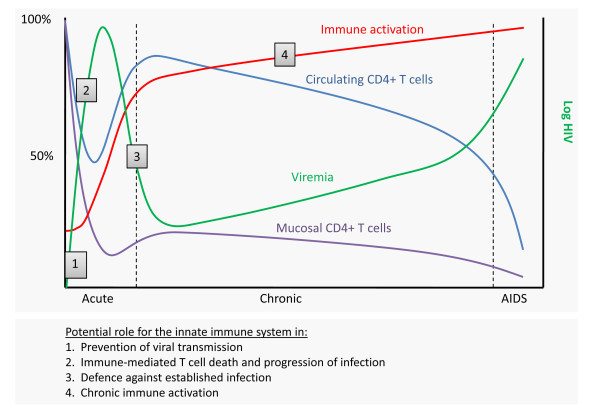
Figure 1
Figure 1
Potential roles of the innate immune system during HIV infection. (1) Following exposure at mucosal surfaces, HIV is transmitted with very low transmission efficiency, indicating that innate antiviral mechanisms are operative to prevent establishment of infection. (2) The early inflammatory response leads to recruitment and activation of various leukocytes, some of which serve as target cells for de novo HIV infection. (3) After acute infection, circulating viral load is generally decreased to a low level. This is mediated by the adaptive immune response, which is activated through processes driven by the innate immune response. Moreover, direct innate antiviral mechanisms contribute to control of virus replication during the chronic phase. (4) Persistent immune activation during chronic HIV infection involves activities stimulated by HIV-derived or opportunistic PAMPs through PRRs.
Figure 2
Figure 2
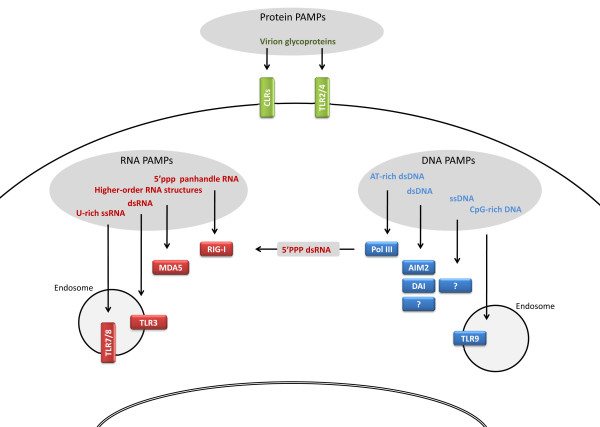
Viral PAMPs and related cellular PRRs. Viral glycoproteins may be recognized by TLR2/4 or CLRs on the cell surface. In the intracellular environment, various viral RNA and DNA structures are recognized by nucleotide sensors localized in endosomes or in the cytoplasm. It remains unknown whether nuclear PRRs exist able to recognize viral PAMPs in the nucleus.
Figure 3
Figure 3
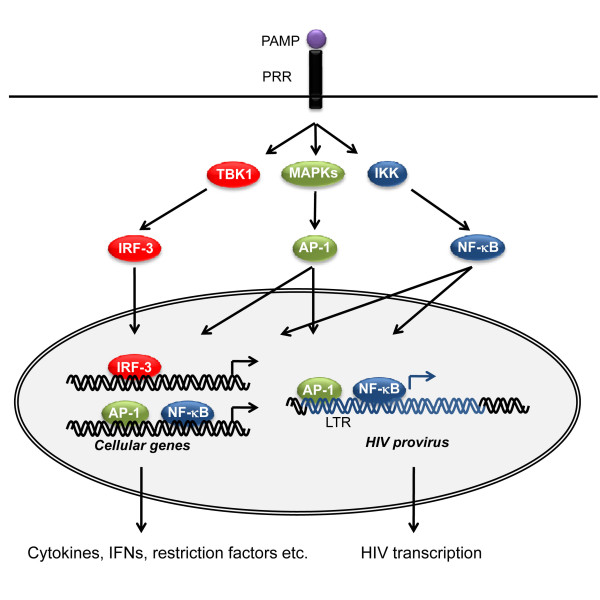
Principles in PRR signalling and transcription of cellular genes and HIV provirus. Sensing of microbial PAMPs by PRRs stimulates intracellular signalling pathways, leading to activation of transcription factors, notably NF-κB, IRF-1, and AP-1. These transcription factors bind to specific sequences present in gene promoter regions and activate transcription of antiviral and inflammatory genes. Importantly, NF-κB and AP-1 also activate transcription of the HIV provirus through binding to the corresponding elements in the HIV LTR to induce viral replication. TBK, TANK-binding kinase. IKK, IκB kinase.
Figure 4
Figure 4
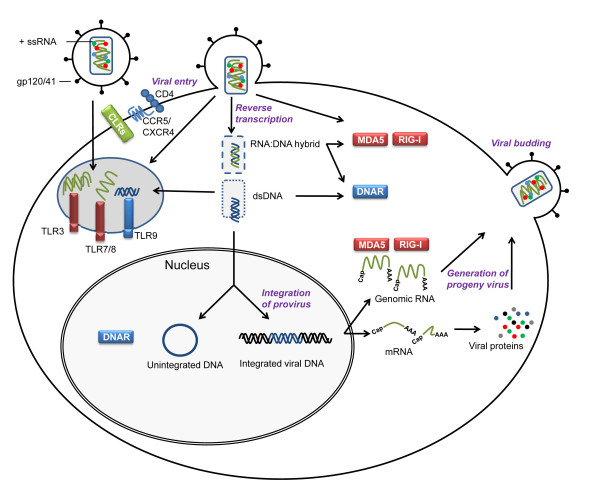
Theoretical possibilities for innate immune recognition during the life cycle of HIV. The HIV life cycle generates a number of potential PAMPs (e.g. dsRNA structures, DNA:RNA hybrids, and dsDNA) as well as aberrant localization of molecular structures shared between virus and host (RNA and DNA in endosomes). Some of these are recognized by PRRs and activate expression of antiviral and inflammatory gene products. Recognition of uridine-rich HIV LTR-derived ssRNA and gp120 by TLR7/8 and DC-SIGN, respectively, remain the only experimentally confirmed HIV PAMPs to date.
Figure 5
Figure 5
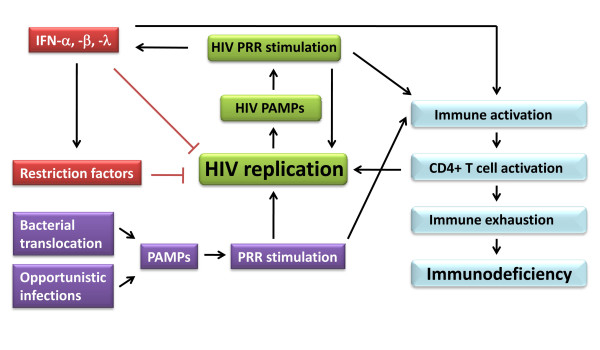
HIV and innate immune activation - impact on viral control and immunopathology. HIV infection results in constitutive activation of the innate immune system due to PAMPs derived from HIV, translocated bacteria, or opportunistic pathogens. This stimulates antiviral activities, but also potentially contributes to chronic immune activation. For a more detailed discussion, see text.

References

    1. McMichael AJ, Borrow P, Tomaras GD, Goonetilleke N, Haynes BF. The immune response during acute HIV-1 infection: clues for vaccine development. Nat Rev Immunol. 2010;10:11–23. doi: 10.1038/nri2674. - DOI - PMC - PubMed
    1. Cadogan M, Dalgleish AG. HIV immunopathogenesis and strategies for intervention. Lancet Infect Dis. 2008;8:675–684. doi: 10.1016/S1473-3099(08)70205-6. - DOI - PubMed
    1. Warrilow D, Stenzel D, Harrich D. Isolated HIV-1 core is active for reverse transcription. Retrovirology. 2007;4:77. doi: 10.1186/1742-4690-4-77. - DOI - PMC - PubMed
    1. Grossman Z, Meier-Schellersheim M, Paul WE, Picker LJ. Pathogenesis of HIV infection: what the virus spares is as important as what it destroys. Nat Med. 2006;12:289–295. doi: 10.1038/nm1380. - DOI - PubMed
    1. Finkel TH, Tudor-Williams G, Banda NK, Cotton MF, Curiel T, Monks C, Baba TW, Ruprecht RM, Kupfer A. Apoptosis occurs predominantly in bystander cells and not in productively infected cells of HIV- and SIV-infected lymph nodes. Nat Med. 1995;1:129–134. doi: 10.1038/nm0295-129. - DOI - PubMed

Publication types