


A cluster-randomized trial to provide clinicians inhaled corticosteroid adherence information for their patients with asthma
- PMID: 20569973
- PMCID: PMC2917519
- DOI: 10.1016/j.jaci.2010.03.034
A cluster-randomized trial to provide clinicians inhaled corticosteroid adherence information for their patients with asthma
Abstract
Background: Inhaled corticosteroid (ICS) nonadherence is common among patients with asthma; however, interventions to improve adherence have often been complex and not easily applied to large patient populations.
Objective: To assess the effect of supplying patient adherence information to primary care providers.
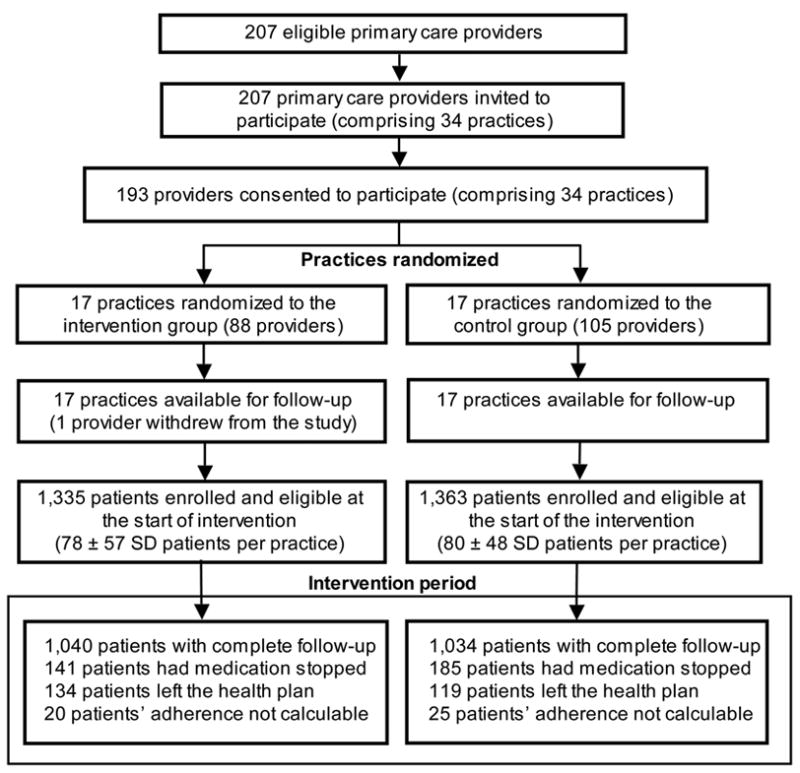
Methods: Patients and providers were members of a health system serving southeast Michigan. Providers (88 intervention; 105 control) and patients (1335 intervention; 1363 control) were randomized together by practice. Patients were age 5 to 56 years, had a diagnosis of asthma, and had existing prescriptions for ICS medication. Adherence was estimated by using prescription and fill data. Unlike clinicians in the control arm, intervention arm providers could view updated ICS adherence information on their patients via electronic prescription software, and further details on patient ICS use could be viewed by selecting that option. The primary outcome was ICS adherence in last 3 months of the study period.
Results: At the study end for the intention-to-treat analysis, ICS adherence was not different among patients in the intervention arm compared with those in the control arm (21.3% vs 23.3%, respectively; P = .553). However, adherence was significantly higher among patients whose clinician elected to view their detailed adherence information (35.7%) compared with both control arm patients (P = .026) and intervention arm patients whose provider did not view adherence data (P = .002).
Conclusions: Overall, providing adherence information to clinicians did not improve ICS use among patients with asthma. However, patient use may improve when clinicians are sufficiently interested in adherence to view the details of this medication use.
Trial registration: ClinicalTrials.gov NCT00459368.
Copyright 2010 American Academy of Allergy, Asthma & Immunology. Published by Mosby, Inc. All rights reserved.
Figures
References
-
- Osterberg L, Blaschke T. Adherence to medication. N Engl J Med. 2005;353(5):487–97. - PubMed
-
- Horne R, Weinman J, Hankins M. The beliefs about medicines questionnaire: The development and evaluation of a new method for assessing the cognitive representation of medication. Psychol Health. 1999;14(1):1–24.
-
- Expert Panel Report 3 (EPR-3): Guidelines for the Diagnosis and Management of Asthma-Summary Report 2007. J Allergy Clin Immunol. 2007;120(5 Suppl):S94–138. - PubMed
-
- Williams LK, Pladevall M, Xi H, Peterson EL, Joseph C, Lafata JE, et al. Relationship between adherence to inhaled corticosteroids and poor outcomes among adults with asthma. The Journal of Allergy and Clinical Immunology. 2004;114(6):1288–93. - PubMed
-
- Apter AJ, Boston RC, George M, Norfleet AL, Tenhave T, Coyne JC, et al. Modifiable barriers to adherence to inhaled steroids among adults with asthma: it’s not just black and white. J Allergy Clin Immunol. 2003;111(6):1219–26. - PubMed
