Mobile phone base stations and early childhood cancers: case-control study
- PMID: 20570865
- PMCID: PMC3191724
- DOI: 10.1136/bmj.c3077
Mobile phone base stations and early childhood cancers: case-control study
Abstract
Objective: To investigate the risk of early childhood cancers associated with the mother's exposure to radiofrequency from and proximity to macrocell mobile phone base stations (masts) during pregnancy.
Design: Case-control study.
Setting: Cancer registry and national birth register data in Great Britain.
Participants: 1397 cases of cancer in children aged 0-4 from national cancer registry 1999-2001 and 5588 birth controls from national birth register, individually matched by sex and date of birth (four controls per case).
Main outcome measures: Incidence of cancers of the brain and central nervous system, leukaemia, and non-Hodgkin's lymphomas, and all cancers combined, adjusted for small area measures of education level, socioeconomic deprivation, population density, and population mixing.
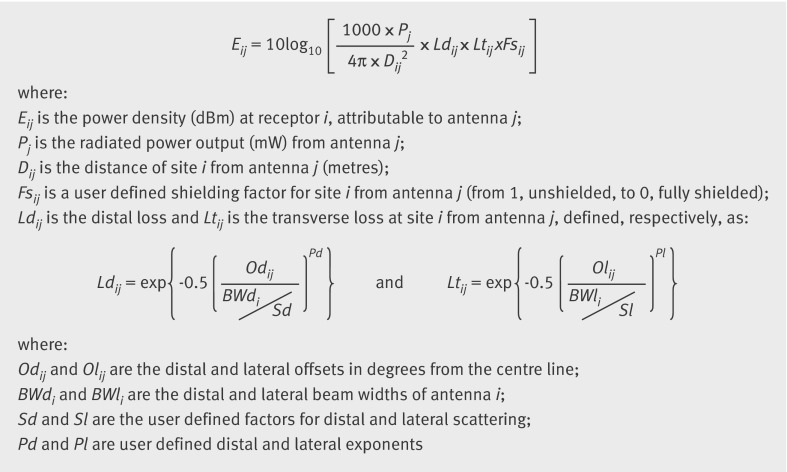
Results: Mean distance of registered address at birth from a macrocell base station, based on a national database of 76,890 base station antennas in 1996-2001, was similar for cases and controls (1107 (SD 1131) m v 1073 (SD 1130) m, P=0.31), as was total power output of base stations within 700 m of the address (2.89 (SD 5.9) kW v 3.00 (SD 6.0) kW, P=0.54) and modelled power density (-30.3 (SD 21.7) dBm v -29.7 (SD 21.5) dBm, P=0.41). For modelled power density at the address at birth, compared with the lowest exposure category the adjusted odds ratios were 1.01 (95% confidence interval 0.87 to 1.18) in the intermediate and 1.02 (0.88 to 1.20) in the highest exposure category for all cancers (P=0.79 for trend), 0.97 (0.69 to 1.37) and 0.76 (0.51 to 1.12), respectively, for brain and central nervous system cancers (P=0.33 for trend), and 1.16 (0.90 to 1.48) and 1.03 (0.79 to 1.34) for leukaemia and non-Hodgkin's lymphoma (P=0.51 for trend).
Conclusions: There is no association between risk of early childhood cancers and estimates of the mother's exposure to mobile phone base stations during pregnancy.
Conflict of interest statement
Competing interests: MBT, JB, LB, KdH, and NB declare that the answers to the questions on the Unified Competing interest form at
Comment in
-
Childhood cancer and proximity to mobile phone masts.BMJ. 2010 Jun 22;340:c3015. doi: 10.1136/bmj.c3015. BMJ. 2010. PMID: 20570864 No abstract available.
References
-
- Independent Expert Group on Mobile Phones. Mobile phones and health. 2000. www.iegmp.org.uk/report/text.htm.
-
- Khurance VG, Teo C, Kindi M, Hardell L, Carlberg M. Cell phones and brain tumors: a review including the long-term epidemiologic data. Surg Neurol 2009;72:205-14. - PubMed
-
- Otitoloju AA, Obe IA, Adewale OA, Otubanjo OA, Osunkalu VO. Preliminary study on the induction of sperm head abnormalities in mice, Mus musculus, exposed to radiofrequency radiations from global system for mobile communication base stations. Bull Environ Contam Toxicol 2010;84:51-4. - PubMed
Publication types
MeSH terms
Grants and funding
LinkOut - more resources
Full Text Sources
Medical