


Large inverted repeats within Xp11.2 are present at the breakpoints of isodicentric X chromosomes in Turner syndrome
- PMID: 20570968
- PMCID: PMC2916707
- DOI: 10.1093/hmg/ddq250
Large inverted repeats within Xp11.2 are present at the breakpoints of isodicentric X chromosomes in Turner syndrome
Abstract
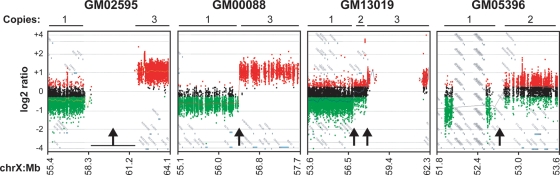
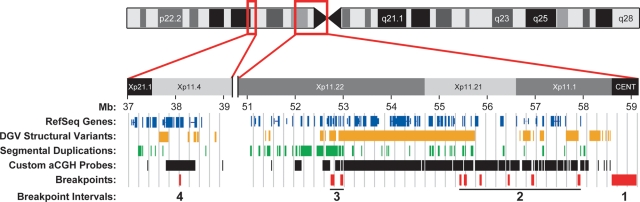
Turner syndrome (TS) results from whole or partial monosomy X and is mediated by haploinsufficiency of genes that normally escape X-inactivation. Although a 45,X karyotype is observed in half of all TS cases, the most frequent variant TS karyotype includes the isodicentric X chromosome alone [46,X,idic(X)(p11)] or as a mosaic [46,X,idic(X)(p11)/45,X]. Given the mechanism of idic(X)(p11) rearrangement is poorly understood and breakpoint sequence information is unknown, this study sought to investigate the molecular mechanism of idic(X)(p11) formation by determining their precise breakpoint intervals. Karyotype analysis and fluorescence in situ hybridization mapping of eight idic(X)(p11) cell lines and three unbalanced Xp11.2 translocation lines identified the majority of breakpoints within a 5 Mb region, from approximately 53 to 58 Mb, in Xp11.1-p11.22, clustering into four regions. To further refine the breakpoints, a high-resolution oligonucleotide microarray (average of approximately 350 bp) was designed and array-based comparative genomic hybridization (aCGH) was performed on all 11 idic(X)(p11) and Xp11.2 translocation lines. aCGH analyses identified all breakpoint regions, including an idic(X)(p11) line with two potential breakpoints, one breakpoint shared between two idic(X)(p11) lines and two Xp translocations that shared breakpoints with idic(X)(p11) lines. Four of the breakpoint regions included large inverted repeats composed of repetitive gene clusters and segmental duplications, which corresponded to regions of copy-number variation. These data indicate that the rearrangement sites on Xp11.2 that lead to isodicentric chromosome formation and translocations are probably not random and suggest that the complex repetitive architecture of this region predisposes it to rearrangements, some of which are recurrent.
Figures




References
-
- Lippe B. Turner syndrome. Endocrinol. Metab. Clin. North Am. 1991;20:121–152. - PubMed
-
- Zinn A.R., Page D.C., Fisher E.M. Turner syndrome: the case of the missing sex chromosome. Trends Genet. 1993;9:90–93. doi:10.1016/0168-9525(93)90230-F. - DOI - PubMed
-
- Howell R.T., Roberts S.H., Beard R.J. Dicentric X isochromosomes in man. J. Med. Genet. 1976;13:496–500. doi:10.1136/jmg.13.6.496. - DOI - PMC - PubMed
-
- Melaragno M.I., Fakih L.M., Cernach M.C., Maccagnan P. Isodicentric X chromosome and mosaicism: report on two cases of 45,X/46,X,idic(Xq)/47,X,idic(Xq),idic(Xq) and review of the literature. Am. J. Med. Genet. 1993;47:357–359. doi:10.1002/ajmg.1320470312. - DOI - PubMed
-
- Schmid W., Naef E., Murset G., Prader A. Cytogenetic findings in 89 cases of Turner's syndrome with abnormal karyotypes. Humangenetik. 1974;24:93–104. - PubMed
Publication types
MeSH terms
Grants and funding
LinkOut - more resources
Full Text Sources
Medical
Miscellaneous
