. 2010 Oct;38(19):6813-30.
doi: 10.1093/nar/gkq521. Epub 2010 Jun 22.

Rational design of an orthogonal tryptophanyl nonsense suppressor tRNA

Affiliations

Rational design of an orthogonal tryptophanyl nonsense suppressor tRNA

Randall A Hughes et al. Nucleic Acids Res. 2010 Oct.

Abstract

While a number of aminoacyl tRNA synthetase (aaRS):tRNA pairs have been engineered to alter or expand the genetic code, only the Methanococcus jannaschii tyrosyl tRNA synthetase and tRNA have been used extensively in bacteria, limiting the types and numbers of unnatural amino acids that can be utilized at any one time to expand the genetic code. In order to expand the number and type of aaRS/tRNA pairs available for engineering bacterial genetic codes, we have developed an orthogonal tryptophanyl tRNA synthetase and tRNA pair, derived from Saccharomyces cerevisiae. In the process of developing an amber suppressor tRNA, we discovered that the Escherichia coli lysyl tRNA synthetase was responsible for misacylating the initial amber suppressor version of the yeast tryptophanyl tRNA. It was discovered that modification of the G:C content of the anticodon stem and therefore reducing the structural flexibility of this stem eliminated misacylation by the E. coli lysyl tRNA synthetase, and led to the development of a functional, orthogonal suppressor pair that should prove useful for the incorporation of bulky, unnatural amino acids into the genetic code. Our results provide insight into the role of tRNA flexibility in molecular recognition and the engineering and evolution of tRNA specificity.


Figures
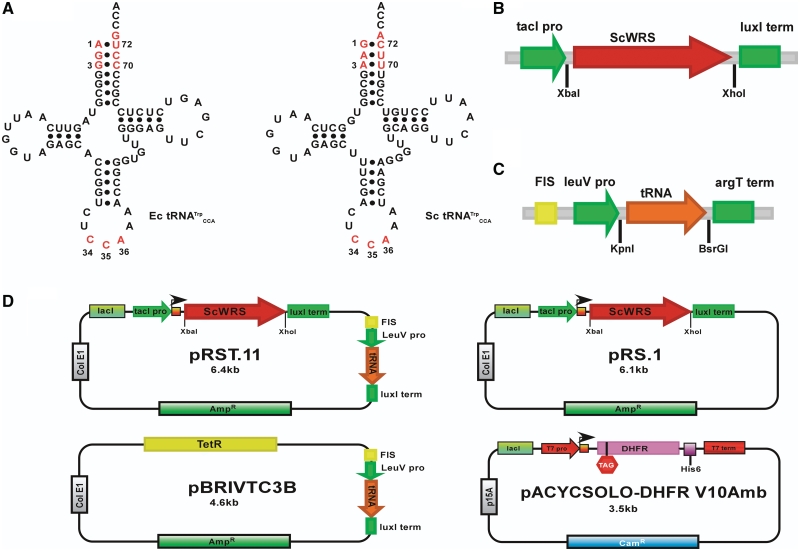
Figure 1.
Figure 1.
Tryptophan tRNAs and DNA expression constructs. (A) Cloverleaf representations of E. coli tRNATrp and S. cerevisiae tRNATrp. The known identity elements for each tRNA are shown in red. (B) Expression construct for ScWRS in plasmids pRS.1 and pRST.11B. (C) Expression construct for the Sc-tRNATrpAmb and its variants in plasmids pBRIVTC3B and pRST.11B. (D) Plasmid constructs. pRST.11B is the dual tRNA/aaRS expression vector containing both of the expression constructs shown in (B and C). Plasmid pRS.1 expresses only the ScWRS and is similar to pRST.11B except that it lacks the tRNA expression construct shown in (B). Plasmid pBRIVTC3B expresses only the tRNA. Plasmid pACYCSOLO-DHFR V10Amb is the target protein (DHFR) expression vector. The encoded DHFR gene contains an in-frame amber (TAG) mutation at the 10th amino acid position and a C-terminal HisTag.
Figure 2.
Figure 2.
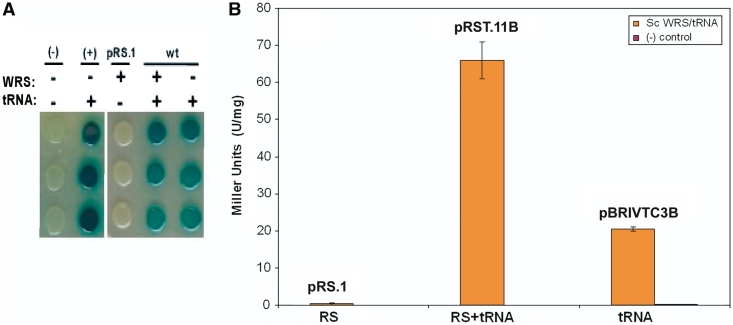
LacZ suppression assay with Sc-tRNATrpamb. (A) β-galactosidase suppression assay for ScWRS/tRNATrpAmb pair activity. Triplicate spots from the same initial culture are shown in column orientation. Cultures transformed with (+) or without (−) the Sc-tRNATrpAmb or ScWRS are shown in the right panel. The (−) negative control culture represents the background level of β-galactosidase activity in the absence of a suppressor tRNA. The (+) control represents β-galactosidase activity in the presence of a known amber suppressor tRNA [SupF, (Ec-tRNATyrAmb)] which is expressed from the pBRIVTC3B plasmid similar to the experimental suppressor tRNAs. (B) Quantitation of β-galactosidase activity produced by the suppression assay shown in A. pRS.1 expresses just the ScWRS, pRST.11B expresses the ScWRS/tRNATrpAmb pair and pBRIVTC3B expresses just the Sc-tRNATrpAmb suppressor. Error bars represent 1 SD (n = 3).
Figure 3.
Figure 3.
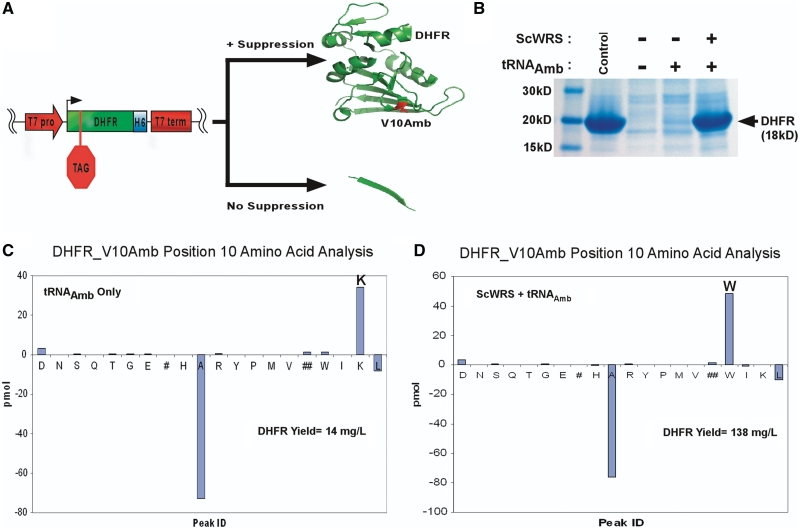
DHFR suppression assay. (A) The gene for DHFR containing a V10Amber mutation on plasmid pACYCSolo-DHFR_V10Amb produces full-length protein when a functional nonsense suppressor is co-expressed with it. (B) Coomassie stained SDS–PAGE gel showing purification fractions from an immobilized nickel chromatography column for DHFR_V10Amb expressed without Sc-tRNATrpAmb or ScWRS (−) with Sc-tRNATrpAmb only (tRNAamb) or with both ScWRS and Sc-tRNATrpAmb (RS +tRNAamb). M = marker, W = wash fractions and E = elution fractions. Full length DHFR appears as an 18 kDa protein band. (C) N-terminal sequencing results for DHFR position 10 from a culture containing pBRIVTC3B (Sc-tRNATrpAmb only). The bar graph represents the detected chromatographic amino acid abundances for position 10 of DHFR minus those from position 9. Positive abundance represents occupation at position 10 of the DHFR sample, whereas the negatively abundant peaks are carried over from the previous round of sequencing (position 9). (D) N-terminal sequencing results for DHFR position 10 from a culture containing pRST.11B (ScWRS and Sc-tRNATrpAmb). The yields of purified DHFR produced via suppression of the V10Amber codon are given for each sample.
Figure 4.
Figure 4.
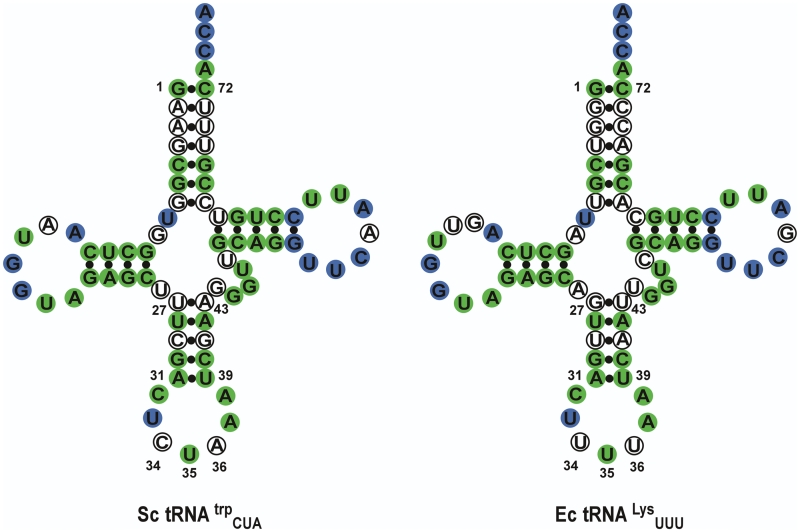
Comparing Sc-tRNATrpAmb and Ec-tRNALysUUU. Cloverleaf structures of both tRNAs showing the universally conserved residues in blue and residues conserved between the two tRNAs in green, for a total of 73% sequence identity overall.
Figure 5.
Figure 5.
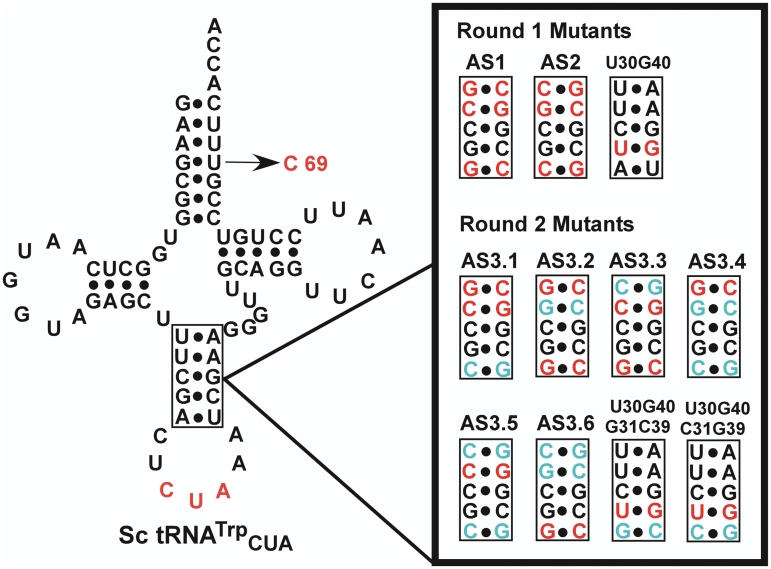
Rational Sc-tRNATrpCUA mutants. Designed anticodon stem sequences are shown. The first round of mutations from the original suppressor tRNA are shown in red. The anticodon stem mutants were also made in combination with the U69C mutation. The second round anticodon stem mutations that differ from the first set of suppressor designs are shown in cyan. Mutations preserved from the first round are shown in red. Unchanged nucleotides from the original suppressor tRNA are in black.
Figure 6.
Figure 6.
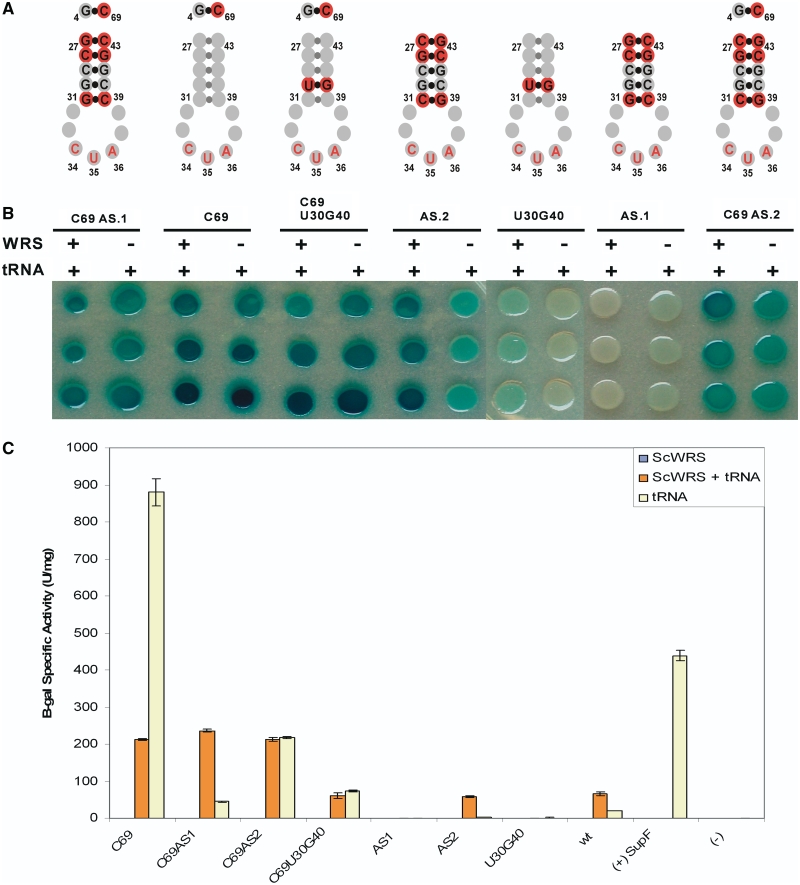
Suppression activity of rational suppressor tRNA mutants. (A) Structures of tRNA mutants anticodon stems. Sequence changes from Sc-tRNATrpAmb are denoted by red circles. (B) β-galactosidase colony spot activity assay. Each mutant tRNA was expressed with (+) or without (−) the ScWRS to test for orthogonality. Each sample was taken from the same culture and spotted in triplicate in column format. (C) Quantitation of suppression activity with β-galactosidase. Error bars represent 1 SD (n = 3).
Figure 7.
Figure 7.
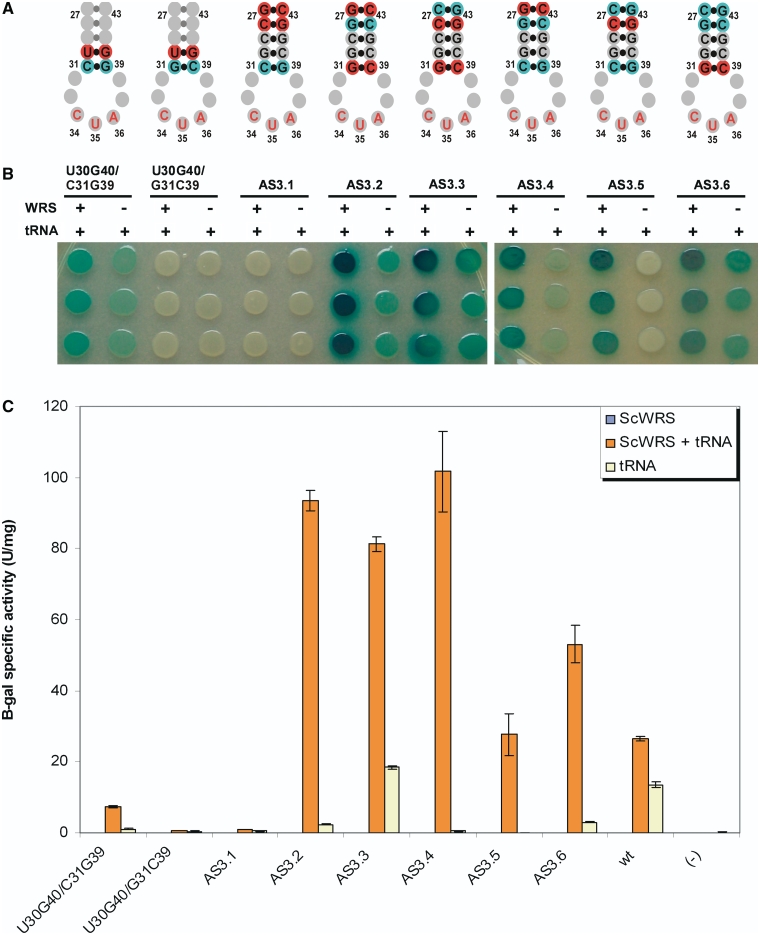
Suppression activity of optimized, rational suppressor tRNA mutants. (A) Mutant tRNA anticodon stem structures with mutations shown in red or cyan. (B) β-galactosidase colony spot activity assay. Each mutant tRNA was expressed with (+) or without (−) the ScWRS to test for orthogonality. Each sample was taken from the same culture and spotted in triplicate in column format. (C) Quantitation of suppression activity with β-galactosidase. Error bars represent 1 SD (n = 3).
Figure 8.
Figure 8.
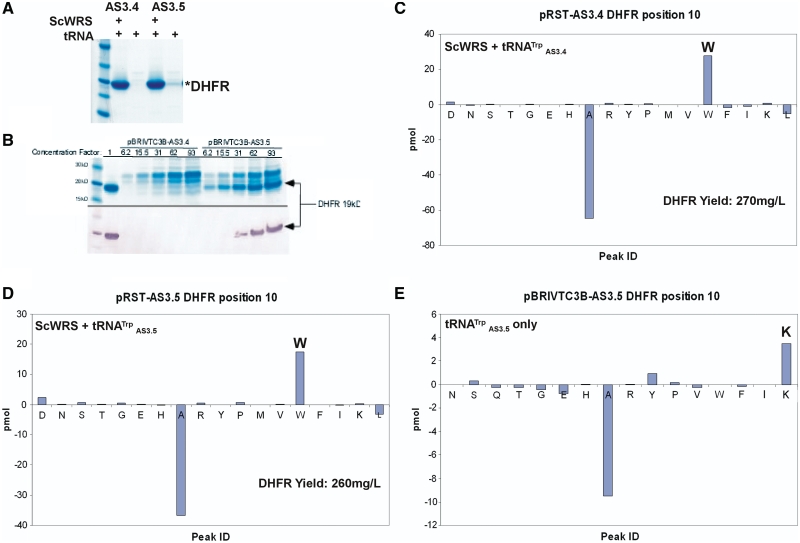
Verifying the orthogonality of AS3.4 and AS3.5. (A) Coomassie stained SDS–PAGE gel of IMAC purified DHFR expressed with and without ScWRS and with the AS3.4 or the AS3.5 suppressor reveals that low level background suppression (AS3.5 suppressor tRNA without ScWRS) still occurs with AS3.5. (B) Concentration of the suppressor tRNA-only (expressed from plasmid pBRIVTC3B) samples confirms the presence of the 18.7 kDa DHFR band in the AS3.5 fraction, but not the AS3.4 fraction. The lane next to the marker is wild-type DHFR run with no additional concentration. The elution fractions from IMAC columns for AS3.4 and AS3.5 expressed without ScWRS but with plasmid pACYCSOLO-DHFR_V10Amb were concentrated and run on the gel at fractions representing concentration factors of 6.2-, 15.5-, 31-, 62- and 93-fold over the initially isolated protein concentration (Top panel). Western blot probing of the C-terminal HisTag on DHFR by a primary AP-conjugated anti-polyhistidine antibody confirms that DHFR is expressed at low levels in the AS3.5 sample but not in the AS3.4 sample (Bottom panel). N-terminal sequencing of the purified DHFR samples reveals that both incorporate tryptophan when the ScWRS is co-expressed with the suppressor tRNA (C and D). However, the AS3.5 suppressor is also misacylated by the E. coli KRS when expressed by itself (E).
Figure 9.
Figure 9.
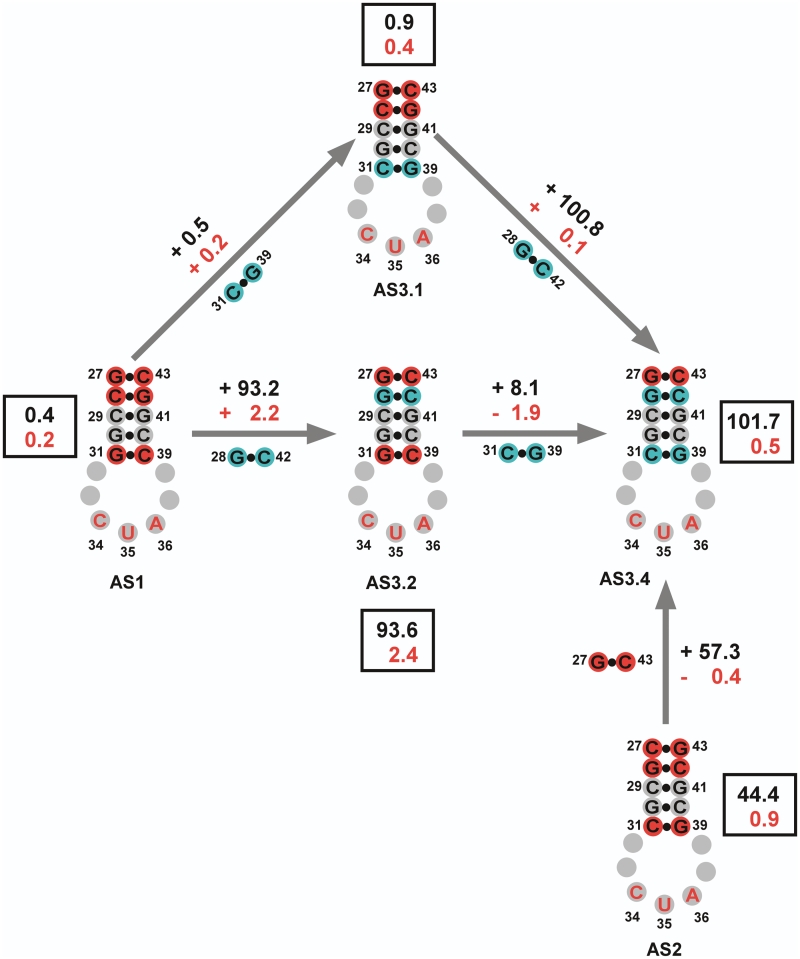
Dissecting the contribution of mutations to suppressor activity. Anticodon representations of the designed suppressors are shown with the mutations made in the first and second round of designs shown in red and cyan, respectively. Grey spheres represent positions unchanged from the original Sc-tRNATrpAmb suppressor. The suppressor activities were calculated from the average values obtained from the β-galactosidase assay. The top numbers (black) represent the change in activity between any two variants in the presence of the ScWRS. The bottom number (red) represents the change in the background suppressor activity (tRNA only) between any two variants. The boxed values are the raw averaged suppressor activities obtained for each variant, with the top number representing the activity with the ScWRS and the bottom number the activity without the ScWRS.

References

    1. Kiga D, Sakamoto K, Kodama K, Kigawa T, Matsuda T, Yabuki T, Shirouzu M, Harada Y, Nakayama H, Takio K, et al. An engineered Escherichia coli tyrosyl-tRNA synthetase for site-specific incorporation of an unnatural amino acid into proteins in eukaryotic translation and its application in a wheat germ cell-free system. Proc. Natl Acad. Sci. USA. 2002;99:9715–9720. - PMC - PubMed
    1. Xie J, Schultz PG. A chemical toolkit for proteins–an expanded genetic code. Nat. Rev. Mol. Cell Biol. 2006;7:775–782. - PubMed
    1. Wang L, Brock A, Herberich B, Schultz PG. Expanding the genetic code of Escherichia coli. Science. 2001;292:498–500. - PubMed
    1. Anderson JC, Wu N, Santoro SW, Lakshman V, King DS, Schultz PG. An expanded genetic code with a functional quadruplet. Proc. Natl Acad. Sci. USA. 2004;101:7566–7571. - PMC - PubMed
    1. Pastrnak M, Mageliery TM, Schultz PG. A new orthogonal suppressor tRNA/Aminoacyl-tRNA synthetase pair for evolving an organism with an expanded genetic code. Helv. Chim. Acta. 2000;83:2277–2286.

Publication types

MeSH terms