


doi: 10.1002/cbic.201000222.
Two-headed PROTAC: an effective new tool for targeted protein degradation
Affiliations
- PMID: 20572252
- PMCID: PMC3852688
- DOI: 10.1002/cbic.201000222
Item in Clipboard
Two-headed PROTAC: an effective new tool for targeted protein degradation
Chembiochem.
.
No abstract available
Figures
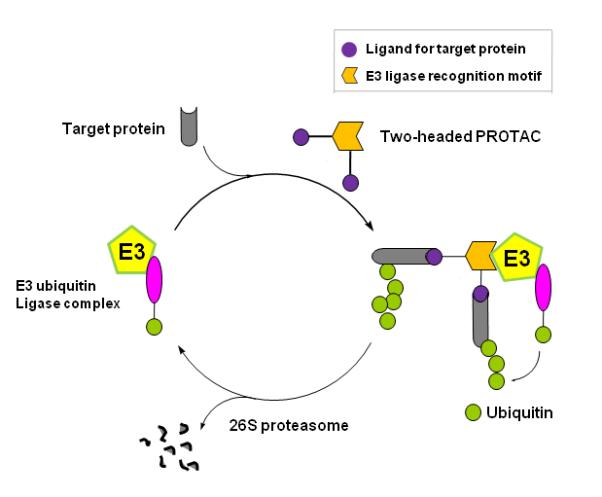
Overall strategy of chemical knock-out by a dimeric ligand based PROTAC. The new class of PROTAC is a chimeric molecule that consists of two ligands linked to a small peptide that corresponds to the recognition site of the pVHL E3 ligase. Upon entry into cells, the two ligands will be recognized by target protein, allowing for recruitment of the target protein to pVHL and its subsequent degradation by the proteasome. Use of two ligands is expected to enhance the efficiency of target protein recruitment to the E3 ligase complex.
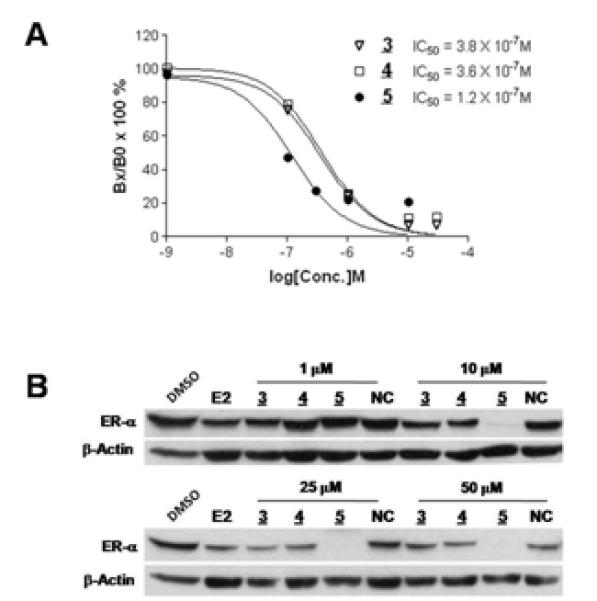
Dimeric ligand based PROTAC are more effective than their monomeric counterparts. A. While the monomeric PROTACs (3 & 4 ) have similar binding affinity to the ER, the dimeric PROTAC (5 ) has a three times greater affinity for the ER. The ordinate is Bx/Bo, specifically bound radioligand in the presence of a given amount of competitor (Bx) divided by specifically bound radioligand in the absence of competitor (Bo). B. The dimeric E2 based PROTAC (5 ) efficientially induces degradation of the ER in a concentration-dependent manner. Unlike its monomeric counterparts (3 & 4 ), the two-headed PROTAC (5) induced complete destruction of the ER. NC is a negative control in which the critical hydroxyproline is replaced with norleucine.
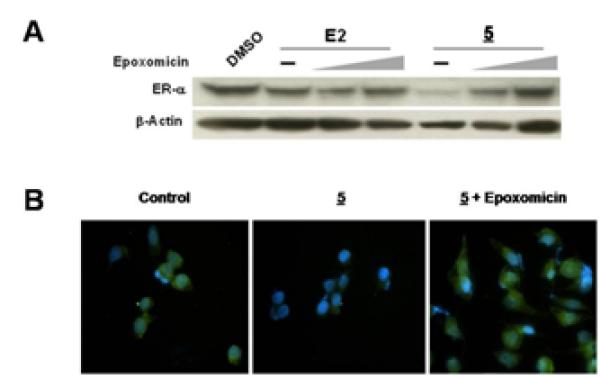
The two-headed PROTAC (5 ) induces degradation of the ER in a proteasome-dependent manner. A. Co-treatment of cells with the PROTAC (5 , 10 μM)and a proteasome inhibitor (0, 100 and 500 nM of epoxomicin) over 48 hours blocks the PROTAC-mediated degradation of the ER. E2 (10 nM) plus inhibitor is included as a positive control. B. Immunofluorescent images of MCF-7 cells treated as in 3A where the green color indicates the ER and the blue color (DAPI) indicates the nucleus. ER degradation is seen in (5 ) when compared to control, while co-treatment of (5 ) with epoxomicin (100 nM) caused accumulation of the ER.
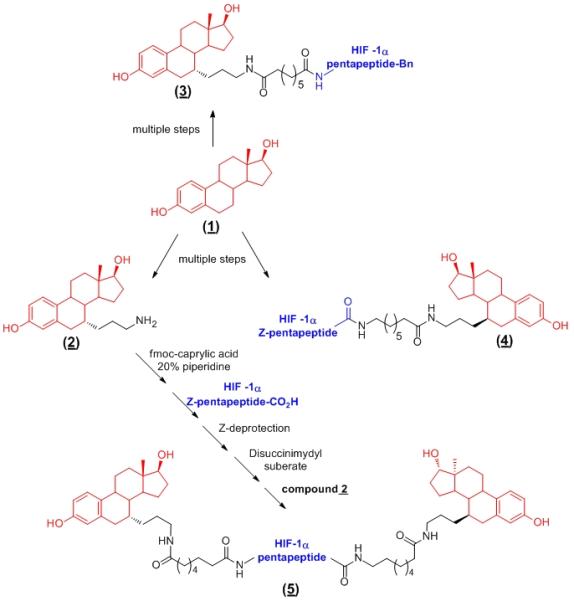
Synthetic scheme of the two-headed ER ligand based PROTAC (5 ) and structures of control monomeric PROTACs (3 & 4 ). A protein ligand (E2, 1 ) is attached to either the N-terminus (3 ) or C-terminus (4 ) of the E3 ligase recognition peptide. HIF-1α pentapeptide = H2N-Leu-Ala-ProOH-Tyr-Ile-Bn (for N-terminal attachment) or Z-Leu-Ala-ProOH-Tyr-Ile-CO2H (for C-terminal attachment).
References
-
- Crews CM, Splittgerber U. Trends Biochem Sci. 1999;24:317. - PubMed
-
- Schreiber SL. Bioorg Med Chem. 1998;6:1127. - PubMed
-
- Strausberg RL, Schreiber SL. Science. 2003;300:294. - PubMed
-
- Hershko A, Ciechanover A. Annu Rev Biochem. 1998;67:425. - PubMed
-
- Skowyra D, Craig KL, Tyers M, Elledge SJ, Harper JW. Cell. 1997;91:209. - PubMed
Publication types
MeSH terms
Substances
Grants and funding
LinkOut - more resources
Full Text Sources
Other Literature Sources
