


Recent trends in exposure to secondhand smoke in the United States population
- PMID: 20573192
- PMCID: PMC2912805
- DOI: 10.1186/1471-2458-10-359
Recent trends in exposure to secondhand smoke in the United States population
Abstract
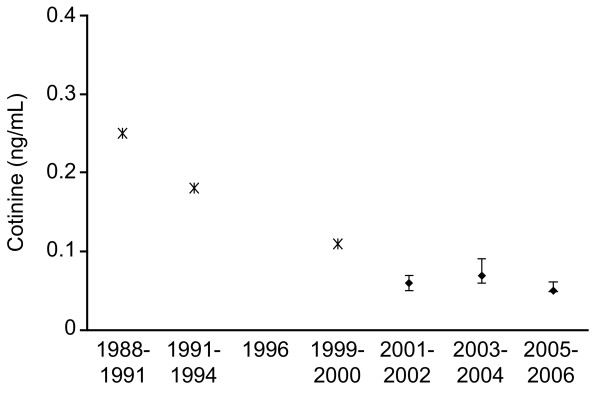
Background: Previous research using the National Health and Nutrition Examination Surveys (NHANES) data documented a significant downward trend in secondhand smoke (SHS) exposure between 1988 and 2002. The objective of this study was to assess whether the downward trend in exposure continued from 2001 through 2006.
Methods: We analyzed data from the 2001-2006 NHANES to estimate exposure of nonsmokers to SHS. Geometric means of serum cotinine levels for all nonsmokers were computed.
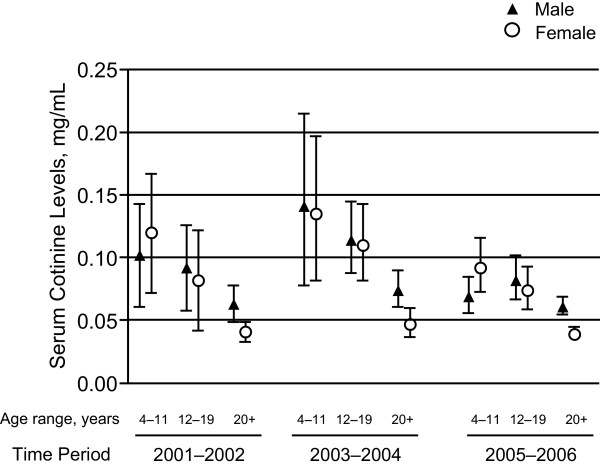
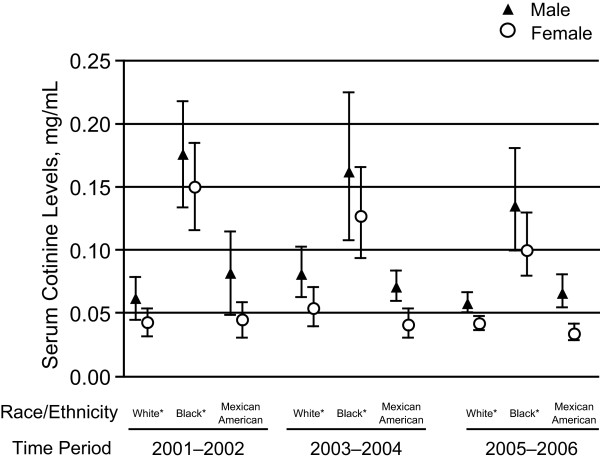
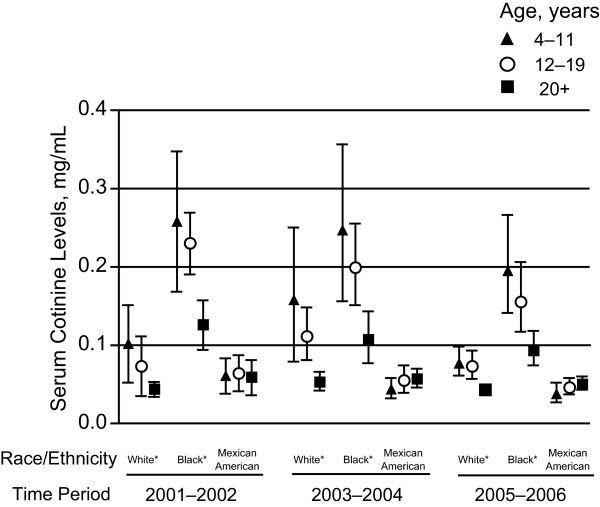
Results: Overall serum cotinine levels (95% Confidence Intervals) in 2001-2002, 2003-2004, and 2005-2006 were 0.06 ng/mL (0.05-0.07), 0.07 ng/mL (0.06-0.09), and 0.05 ng/mL (0.05-0.06), respectively. Subgroup analysis by age, gender, and race/ethnicity groups showed similar trends in cotinine levels. Children, males, and non-Hispanic Blacks had higher cotinine levels than adults, females, and non-Hispanic Whites and Mexican Americans, respectively. Insignificant P values from the Wald test indicate that serum cotinine levels did not differ over time.
Conclusions: The long-term trend of declining exposure to SHS among nonsmokers appears to have leveled off. However, disparities noted in previous research persist today, with the young, non-Hispanic Blacks, and males experiencing higher levels of exposure.
Figures
References
-
- U.S. Department of Health and Human Services. The Health Consequences of Involuntary Exposure to Tobacco Smoke: A Report of the Surgeon General. Atlanta, GA: U.S. Department of Health and Human Services, Centers for Disease Control and Prevention, Coordinating Center for Health Promotion, National Center for Chronic Disease Prevention and Health Promotion, Office on Smoking and Health; 2006.
-
- Centers for Disease Control and Prevention. Annual smoking-attributable mortality, years of potential life lost, and economic costs-United States, 1995-1999. MMWR Morb Mortal Wkly Rep. 2002;51(14):300–303. - PubMed
-
- Office of Environmental Health Hazard Assessment. Health effects assessment of exposure to environmental tobacco smoke. Sacramento, CA: California Environmental Protection Agency; 2005.
-
- DiFranza JR, Aligne CA, Weitzman M. Prenatal and postnatal environmental tobacco smoke exposure and children's health. Pediatrics. 2004;113(4 Suppl):1007–1015. - PubMed
Publication types
MeSH terms
Substances
LinkOut - more resources
Full Text Sources
Medical
