


Relationships between daily acute glucose fluctuations and cognitive performance among aged type 2 diabetic patients
- PMID: 20573753
- PMCID: PMC2945154
- DOI: 10.2337/dc10-0389
Relationships between daily acute glucose fluctuations and cognitive performance among aged type 2 diabetic patients
Abstract
Objective: The mean amplitude of glycemic excursions (MAGE) is a significant determinant of overall metabolic control as well as increased risk for diabetes complications. Older individuals with type 2 diabetes are more likely to have moderate cognitive deficits and structural changes in brain tissue. Considering that poor metabolic control is considered a deranging factor for cognitive performance in diabetic patients, we evaluated whether the contributions of MAGE to cognitive status in older patients with type 2 diabetes were independent from the main markers of glycemic control, such as sustained chronic hyperglycemia (A1C), postprandial glycemia (PPG), and fasting plasma glucose (FPG).
Research design and methods: In 121 older patients with type 2 diabetes, 48-h continuous subcutaneous glucose monitoring (CSGM) were assessed. MAGE and PPG were evaluated during CSGM. The relationship of MAGE to performance on cognitive tests was assessed, with adjustment for age, glycemic control markers, and other determinants of cognitive status. The cognitive tests were a composite score of executive and attention functioning and the Mini Mental Status Examination (MMSE).
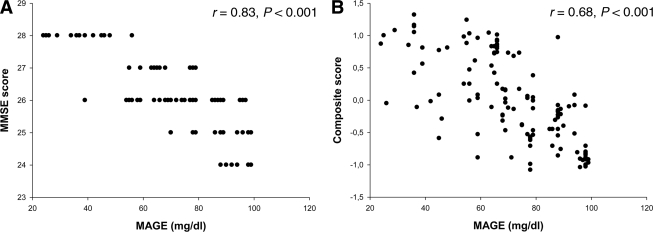
Results: MAGE was significantly correlated with MMSE (r = 0.83; P < 0.001) and with cognition composite score (r = 0.68; P < 0.001). Moreover, MAGE was associated with the MMSE (P < 0.001) and cognition composite score (P < 0.001) independently of age, sex, BMI, waist-to-hip (WHR) ratio, drug intake, physical activity, mean arterial blood pressure, FPG, PPG, and A1C.
Conclusions: MAGE during a daily period was associated with an impairment of cognitive functioning independent of A1C, FPG, and PPG. The present data suggest that interventional trials in older patients with type 2 diabetes should target not only A1C, PPG, and FPG but also daily acute glucose swings.
Figures
References
-
- Fontbonne A, Berr C, Ducimetière P, Alpérovitch A: Changes in cognitive abilities over a 4-year period are unfavourably affected in elderly diabetic subjects: results of the epidemiology of vascular aging study. Diabetes Care 2001; 24: 366– 370 - PubMed
-
- Cukierman-Yaffe T, Gerstein HC, Williamson JD, Lazar RM, Lovato L, Miller ME, Coker LH, Murray A, Sullivan MD, Marcovina SM, Launer LJ: Relationship between baseline glycemic control and cognitive function in individuals with type 2 diabetes and other cardiovascular risk factors: the action to control cardiovascular risk in diabetes-memory in diabetes (ACCORD-MIND) trial. Diabetes Care 2009; 32: 221– 226 - PMC - PubMed
-
- Shorr RI, de Rekeneire N, Resnick HE, Yaffe K, Somes GW, Kanaya AM, Simonsick EM, Newman AB, Harris TB: Glycemia and cognitive function in older adults using glucose-lowering drugs. J Nutr Health Aging 2006; 10: 297– 301 - PubMed
-
- Abbatecola AM, Rizzo MR, Barbieri M, Grella R, Arciello A, Laieta MT, Acampora R, Passariello N, Cacciapuoti F, Paolisso G: Postprandial plasma glucose excursions and cognitive functioning in aged type 2 diabetics. Neurology 2006; 67: 235– 240 - PubMed
-
- Cox DJ, Kovatchev BP, Gonder-Frederick LA, Summers KH, McCall A, Grimm KJ, Clarke WL: Relationships between hyperglycemia and cognitive performance among adults with type 1 and type 2 diabetes. Diabetes Care 2005; 28: 71– 77 - PubMed
MeSH terms
Substances
LinkOut - more resources
Full Text Sources
Medical
