


Unmetabolized serum folic acid and its relation to folic acid intake from diet and supplements in a nationally representative sample of adults aged > or =60 y in the United States
- PMID: 20573790
- PMCID: PMC2904036
- DOI: 10.3945/ajcn.2010.29499
Unmetabolized serum folic acid and its relation to folic acid intake from diet and supplements in a nationally representative sample of adults aged > or =60 y in the United States
Abstract
Background: Unmetabolized serum folic acid (UMFA) has been detected in adults. Previous research indicates that high folic acid intakes may be associated with risk of cancer.
Objective: The objective was to examine UMFA concentrations in relation to dietary and supplemental folate and status biomarkers in the US population aged > or =60 y.
Design: Surplus sera were analyzed with the use of data from the National Health and Nutrition Examination Survey (NHANES) 2001-2002, a cross-sectional, nationally representative survey (n = 1121).
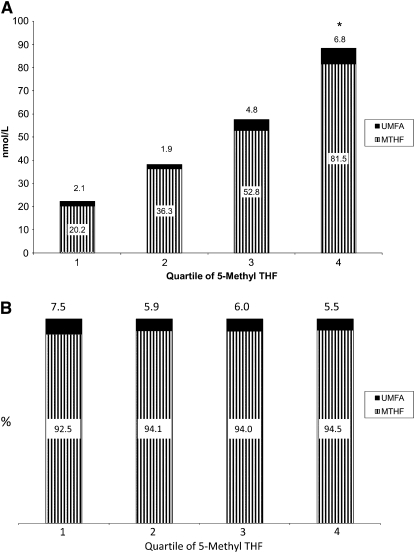
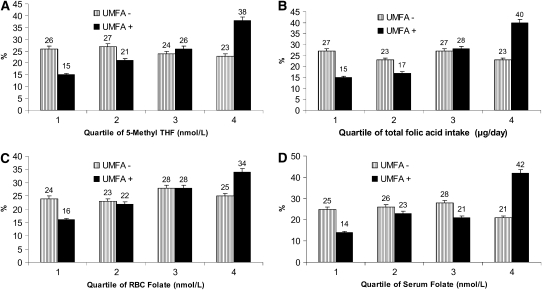
Results: UMFA was detected in 38% of the population, with a mean concentration of 4.4 +/- 0.6 nmol/L (median: 1.2+/- 0.2 nmol/L). The group with UMFA (UMFA+) had a significantly higher proportion of folic acid supplement users than did the group without UMFA (60% compared with 41%). UMFA+ men and women also had higher supplemental and total (food + supplements) folic acid intakes than did their counterparts without UMFA. Forty percent of the UMFA+ group was in the highest quartile of total folic acid intake, but total folic acid intake was only moderately related to UMFA concentrations (r(2) = 0.07). Serum folate concentrations were significantly higher in the UMFA+ group and were predictive of UMFA concentrations (r(2) = 0.15). Serum 5-methyltetrahydrofolate and vitamin B-12 concentrations were higher in the UMFA+ group, whereas there was no difference between the 2 UMFA groups in red blood cell folate, serum homocysteine, or methylmalonic acid concentrations.
Conclusions: Approximately 40% of older adults in the United States have UMFA that persists after a fast, and the presence of UMFA is not easily explained in NHANES by folic acid intakes alone. Given the possibility that excessive folic acid exposure may relate to cancer risk, monitoring of UMFA may be warranted.
Figures
Similar articles
-
Folate and vitamin B-12 biomarkers in NHANES: history of their measurement and use.Am J Clin Nutr. 2011 Jul;94(1):322S-331S. doi: 10.3945/ajcn.111.013300. Epub 2011 May 18. Am J Clin Nutr. 2011. PMID: 21593508 Free PMC article. Review.
-
Unmetabolized folic acid is detected in nearly all serum samples from US children, adolescents, and adults.J Nutr. 2015 Mar;145(3):520-31. doi: 10.3945/jn.114.201210. Epub 2014 Dec 10. J Nutr. 2015. PMID: 25733468 Free PMC article.
-
Association between Serum Unmetabolized Folic Acid Concentrations and Folic Acid from Fortified Foods.J Am Coll Nutr. 2017 Sep-Oct;36(7):572-578. doi: 10.1080/07315724.2017.1333929. Epub 2017 Sep 12. J Am Coll Nutr. 2017. PMID: 28895788 Free PMC article.
-
Biochemical indicators of B vitamin status in the US population after folic acid fortification: results from the National Health and Nutrition Examination Survey 1999-2000.Am J Clin Nutr. 2005 Aug;82(2):442-50. doi: 10.1093/ajcn.82.2.442. Am J Clin Nutr. 2005. PMID: 16087991
-
Biomarker responses to folic acid intervention in healthy adults: a meta-analysis of randomized controlled trials.Am J Clin Nutr. 2014 Jan;99(1):96-106. doi: 10.3945/ajcn.113.062752. Epub 2013 Nov 13. Am J Clin Nutr. 2014. PMID: 24225357 Review.
Cited by
-
Overview of a roundtable on NHANES monitoring of biomarkers of folate and vitamin B-12 status: measurement procedure issues.Am J Clin Nutr. 2011 Jul;94(1):297S-302S. doi: 10.3945/ajcn.111.017392. Epub 2011 May 18. Am J Clin Nutr. 2011. PMID: 21593504 Free PMC article. Review.
-
Folate and vitamin B-12 biomarkers in NHANES: history of their measurement and use.Am J Clin Nutr. 2011 Jul;94(1):322S-331S. doi: 10.3945/ajcn.111.013300. Epub 2011 May 18. Am J Clin Nutr. 2011. PMID: 21593508 Free PMC article. Review.
-
Transcobalamin 776C→G polymorphism is associated with peripheral neuropathy in elderly individuals with high folate intake.Am J Clin Nutr. 2016 Dec;104(6):1665-1670. doi: 10.3945/ajcn.116.139030. Epub 2016 Oct 12. Am J Clin Nutr. 2016. PMID: 27733392 Free PMC article.
-
Folic acid induces cell type-specific changes in the transcriptome of breast cancer cell lines: a proof-of-concept study.J Nutr Sci. 2016 Apr 26;5:e17. doi: 10.1017/jns.2016.8. eCollection 2016. J Nutr Sci. 2016. PMID: 27293554 Free PMC article.
-
A folic acid-enriched diet attenuates prostate involution in response to androgen deprivation.Prostate. 2019 Feb;79(2):183-194. doi: 10.1002/pros.23723. Epub 2018 Oct 8. Prostate. 2019. PMID: 30298636 Free PMC article.
References
-
- Lucock M, Wild J, Smithells R, Hartley R. Biotransformation of pteroylmonoglutamic acid during absorption: implications of Michaelis-Menten kinetics. Eur J Clin Nutr 1989;43:631–5 - PubMed
-
- Kelly P, McPartlin J, Goggins M, Weir DG, Scott JM. Unmetabolized folic acid in serum: acute studies in subjects consuming fortified food and supplements. Am J Clin Nutr 1997;65:1790–5 - PubMed
-
- Dietrich M, Brown CJ, Block G. The effect of folate fortification of cereal-grain products on blood folate status, dietary folate intake, and dietary folate sources among adult non-supplement users in the United States. J Am Coll Nutr 2005;24:266–74 - PubMed
-
- Pfeiffer CM, Johnson CL, Jain RB, et al. Trends in blood folate and vitamin B-12 concentrations in the United States, 1988 2004. Am J Clin Nutr 2007;86:718–27 - PubMed
Publication types
MeSH terms
Substances
LinkOut - more resources
Full Text Sources
Other Literature Sources
Medical
