


Metabolic profiling strategy for discovery of nutritional biomarkers: proline betaine as a marker of citrus consumption
- PMID: 20573794
- PMCID: PMC2904656
- DOI: 10.3945/ajcn.2010.29672
Metabolic profiling strategy for discovery of nutritional biomarkers: proline betaine as a marker of citrus consumption
Abstract
Background: New food biomarkers are needed to objectively evaluate the effect of diet on health and to check adherence to dietary recommendations and healthy eating patterns.
Objective: We developed a strategy for food biomarker discovery, which combined nutritional intervention with metabolic phenotyping and biomarker validation in a large-scale epidemiologic study.
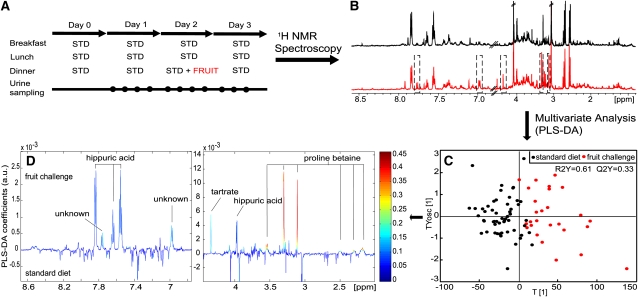
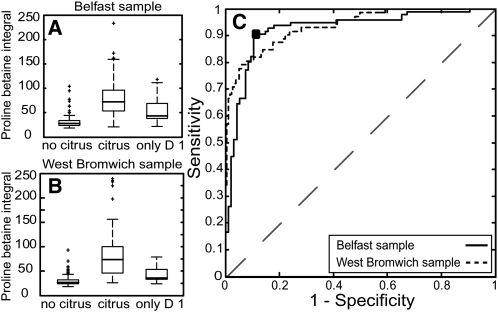
Design: We administered a standardized diet to 8 individuals and established a putative urinary biomarker of fruit consumption by using (1)H nuclear magnetic resonance (NMR) spectroscopic profiling. The origin of the biomarker was confirmed by using targeted NMR spectroscopy of various fruit. Excretion kinetics of the biomarker were measured. The biomarker was validated by using urinary NMR spectra from UK participants of the INTERMAP (International Collaborative Study of Macronutrients, Micronutrients, and Blood Pressure) (n = 499) in which citrus consumption was ascertained from four 24-h dietary recalls per person. Finally, dietary patterns of citrus consumers (n = 787) and nonconsumers (n = 1211) were compared.
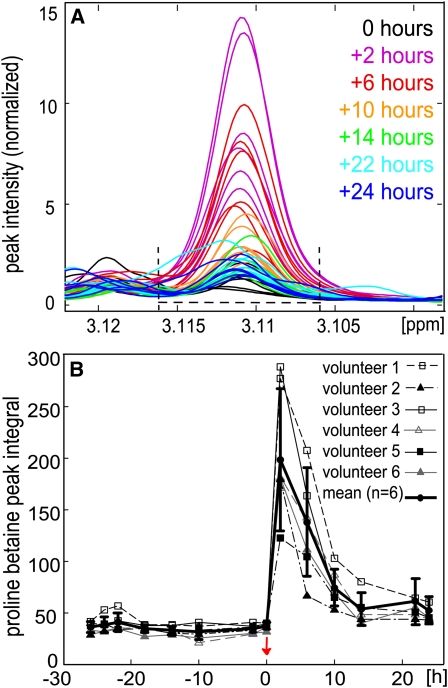
Results: We identified proline betaine as a putative biomarker of citrus consumption. High concentrations were observed only in citrus fruit. Most proline betaine was excreted < or =14 h after a first-order excretion profile. Biomarker validation in the epidemiologic data showed a sensitivity of 86.3% for elevated proline betaine excretion in participants who reported citrus consumption and a specificity of 90.6% (P < 0.0001). In comparison with noncitrus consumers, citrus consumers had lower intakes of fats, lower urinary sodium-potassium ratios, and higher intakes of vegetable protein, fiber, and most micronutrients.
Conclusion: The biomarker identification and validation strategy has the potential to identify biomarkers for healthier eating patterns associated with a reduced risk of major chronic diseases. The trials were registered at clinicaltrials.gov as NCT01102049 and NCT01102062.
Figures
References
-
- Mente A, de Koning L, Shannon HS, Anand SS. A systematic review of the evidence supporting a causal link between dietary factors and coronary heart disease. Arch Intern Med 2009;169:659–69 - PubMed
-
- Schulz M, Lahmann PH, Boeing H, et al. Fruit and vegetable consumption and risk of epithelial ovarian cancer: the European prospective investigation into cancer and nutrition. Cancer Epidemiol Biomarkers Prev 2005;14:2531–5 - PubMed
-
- van Duijnhoven FJB, Bueno-De-Mesquita HB, Ferrari P, et al. Fruit, vegetables, and colorectal cancer risk: the European Prospective Investigation into Cancer and Nutrition. Am J Clin Nutr 2009;89:1441–52 - PubMed
-
- Riboli E, Norat T. Epidemiologic evidence of the protective effect of fruit and vegetables on cancer risk. Am J Clin Nutr 2003;78:559S–69S - PubMed
-
- Appel LJ, Moore TJ, Obarzanek E, et al. A clinical trial of the effects of dietary patterns on blood pressure. N Engl J Med 1997;336:1117–24 - PubMed
Publication types
MeSH terms
Substances
Associated data
Grants and funding
LinkOut - more resources
Full Text Sources
Medical
