


Freeze-dried ham promotes azoxymethane-induced mucin-depleted foci and aberrant crypt foci in rat colon
- PMID: 20574917
- PMCID: PMC2936166
- DOI: 10.1080/01635580903532408
Freeze-dried ham promotes azoxymethane-induced mucin-depleted foci and aberrant crypt foci in rat colon
Abstract
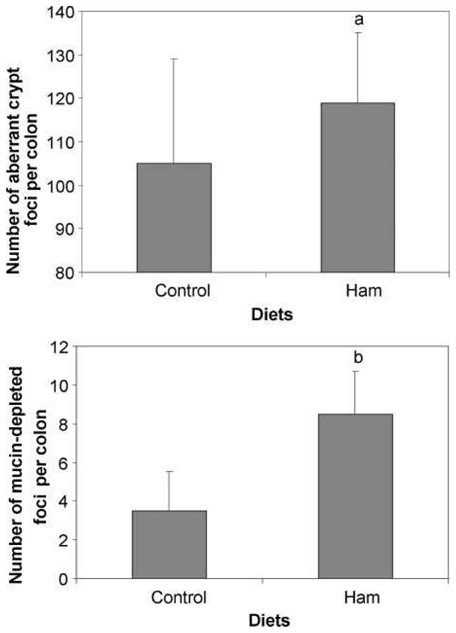
Processed and red meat consumption is associated with the risk of colorectal cancer. Meta-analyses have suggested that the risk associated with processed meat is higher. Most processed meats are cured and cooked, which leads to formation of free nitrosyl heme. We speculated that free nitrosyl heme is more toxic than native myoglobin. The promoting effect of a freeze-dried, cooked, cured ham diet was looked for in a 100-day study. Colon carcinogenesis endpoints were aberrant crypt foci and mucin depleted foci (MDF). A second study (14 days) was designed 1) to compare the effect of ham, hemoglobin, and hemin; and 2) to test the effect of sodium chloride, nitrite, and phosphate in diet on early biomarkers associated with heme-induced promotion. In the 100-day study, control and ham-fed rats had 3.5 and 8.5 MDF/colon, respectively (P < 0.0001). Promotion was associated with cytotoxicity and lipid peroxidation. In the short-term study, cytotoxicity and lipid peroxidation of fecal water, and the urinary marker of lipid peroxidation, increased dramatically in ham- and hemin-fed rat. In contrast, the hemoglobin diet, sodium chloride, nitrite, phosphate diet had no effect. Freeze-dried cooked ham can promote colon carcinogenesis in a rodent model. Hemin, but not hemoglobin, mimicked ham effect on early biochemical markers associated with carcinogenesis.
Figures
References
-
- Sandhu MS, White IR, Mcpherson K. Systematic review of the prospective cohort studies on meat consumption and colorectal cancer risk: a meta-analytical approach. Cancer Epidemiology Biomarkers & Prevention. 2001;10:439–446. - PubMed
-
- Norat T, Lukanova A, Ferrari P, Riboli E. Meat consumption and colorectal cancer risk: dose-response meta-analysis of epidemiological studies. International Journal of Cancer. 2002;98:241–256. - PubMed
-
- Larsson SC, Wolk A. Meat consumption and risk of colorectal cancer: a meta-analysis of prospective studies. Int J Cancer. 2006;119:2657–2664. - PubMed
