. 2010 Aug 15;518(16):3381-407.
doi: 10.1002/cne.22406.

Classic hippocampal sclerosis and hippocampal-onset epilepsy produced by a single "cryptic" episode of focal hippocampal excitation in awake rats

Affiliations

Classic hippocampal sclerosis and hippocampal-onset epilepsy produced by a single "cryptic" episode of focal hippocampal excitation in awake rats

Braxton A Norwood et al. J Comp Neurol. .

Abstract

In refractory temporal lobe epilepsy, seizures often arise from a shrunken hippocampus exhibiting a pattern of selective neuron loss called "classic hippocampal sclerosis." No single experimental injury has reproduced this specific pathology, suggesting that hippocampal atrophy might be a progressive "endstage" pathology resulting from years of spontaneous seizures. We posed the alternative hypothesis that classic hippocampal sclerosis results from a single excitatory event that has never been successfully modeled experimentally because convulsive status epilepticus, the insult most commonly used to produce epileptogenic brain injury, is too severe and necessarily terminated before the hippocampus receives the needed duration of excitation. We tested this hypothesis by producing prolonged hippocampal excitation in awake rats without causing convulsive status epilepticus. Two daily 30-minute episodes of perforant pathway stimulation in Sprague-Dawley rats increased granule cell paired-pulse inhibition, decreased epileptiform afterdischarge durations during 8 hours of subsequent stimulation, and prevented convulsive status epilepticus. Similarly, one 8-hour episode of reduced-intensity stimulation in Long-Evans rats, which are relatively resistant to developing status epilepticus, produced hippocampal discharges without causing status epilepticus. Both paradigms immediately produced the extensive neuronal injury that defines classic hippocampal sclerosis, without giving any clinical indication during the insult that an injury was being inflicted. Spontaneous hippocampal-onset seizures began 16-25 days postinjury, before hippocampal atrophy developed, as demonstrated by sequential magnetic resonance imaging. These results indicate that classic hippocampal sclerosis is uniquely produced by a single episode of clinically "cryptic" excitation. Epileptogenic insults may often involve prolonged excitation that goes undetected at the time of injury.


Figures

Figure 1
Figure 1
Hippocampal granule cell epileptiform activity during 3 hours of perforant pathway stimulation-induced status epilepticus (SE) in awake, freely moving Sprague-Dawley rats, and pathology following stimulation. A1: 125 sec of electrographic activity recorded directly from the granule cell layer during stimulation. Note that stimulation consisted of continuous 2 Hz paired-pulse stimuli (marked “2 Hz”) plus 10 sec-long 20 Hz trains delivered once per minute (marked “20 Hz”). A1a: 500 msec of evoked granule cell layer activity (responses to one pair of pulses at 2 Hz plus epileptiform granule cell discharges). The expanded trace in A1a is the area marked “a” in panel A1. Note that perforant pathway stimulation forced the granule cells to discharge and cause convulsive SE throughout the 3 hour stimulation period. B: Nissl-stained section of the normal dorsal hippocampus. C: NeuN-immunoreactivity in a section adjacent to that shown in panel B. D: FluoroJade-B (FJB) staining in the dorsal hippocampus 4 days after 3 hours of perforant pathway stimulation-induced convulsive SE in an awake rat. Note that FJB-positive neurons are evident in the dentate hilus (h) and sporadically in areas CA3 and CA1. Arrows denote degeneration in the inner molecular layer, indicating degeneration of hilar mossy cells and their axon terminals in the inner molecular layer. Note that despite confirmed granule cell epileptiform discharges for 3 hours, extensive pyramidal cell injury was not produced. Green FJB fluorescence was photographed, converted to grayscale, and then inverted to produce grayscale images of FJB-positive-, acutely degenerating neurons on a white background. E: NeuN immunoreactivity in the dorsal hippocampus 196 days after 3 hours of perforant pathway stimulation in an awake rat. Note that despite a long survival period during which many spontaneous epileptic seizures occurred, obvious cell loss was apparent only in the hilus (h), and extensive pyramidal cell loss did not occur. Scale bar in A1a: 5 sec in A1 and 50 msec in A1a; 10 mV in A1 and A1a; 200 μm in B–D.
Figure 2
Figure 2
Decreased granule cell excitability after two daily 30 min-long episodes of non-injurious perforant pathway stimulation in freely moving Sprague-Dawley rats. A: Granule cell layer responses to low frequency (0.1 Hz) perforant pathway stimulation before (Day 1) and after (Day 3) two daily 30 min-long stimulations. Arrows denote the second spike responses to identical afferent stimulation in the same rat. Note that the amplitudes of the second population spike were always smaller on Day 3, indicating increased paired-pulse inhibition as a result of prior stimulation. B1, B2: Representative granule cell layer activity (120 sec long) during stimulation on Day 1 (B1) and Day 3 (B2), consisting of continuous 2 Hz paired-pulse stimulation plus 10 sec-long 20 Hz trains of single stimuli delivered once per minute. Arrows show the decrease in large amplitude, negative-going spikes on Day 3 compared to Day 1, and (“a”) marks the locations expanded in B1a and B2a, which show the presence of shorter granule cell epileptiform discharges on Day 3 compared to Day 1. B1a, B2a: 500 msec-long extracts (one paired-pulse at 2 Hz and its associated evoked activity) occurring shortly after the 20 Hz train. Note that stimulation on Day 3 (B2a) evoked attenuated granule cell responses compared to the responses to identical stimuli in the same rat on Day 1. C: Quantitative analysis of the second spike amplitudes before and after two 30 minute stimulations in 10 rats. The decreased spike amplitude was found to be statistically significant (p<0.0001) by a paired t-test. D: Quantitative analysis of total afterdischarge duration during the 30 min of stimulation on Day 1 and the first 30 min of stimulation on Day 3 (n=9). Note that the afterdischarge durations on Day 3 were paired and compared with responses on Day 1 in each animal. The reduction was statistically significant (p<0.0001) by a paired t-test. Calibration bar: 5 ms and 10 mV in A, 10 mV; 5 sec and 10 mV in B1 and B2; 20 msec and 10 mV in B1a and B2a.
Figure 3
Figure 3
Hippocampal injury four days after perforant pathway stimulation in awake Sprague-Dawley rats. Rats were subjected to 30 min of stimulation on Days 1 and 2, and then 8 hours of identical stimulation on Day 3, followed by perfusion-fixation 4 days after the Day 3 stimulation. A: Unstained, freshly-cut, wet section of dorsal hippocampus under brightfield illumination. Note that injured neurons are visible in unstained sections, and are darker than undamaged regions (the dentate gyrus molecular layer; DG), apparently because degenerating neurons change shape, and their membranes reflect light out of the path of the objective lens (in the manner of a darkfield condenser), making dying cells appear darker than adjacent undamaged tissue that faithfully transmits light into the objective lens. B: FluoroJade-B (FJB)-stained coronal section of the dorsal hippocampus, showing FJB-positive cells in the hilus (h), and in areas CA3 and CA1. Note also the FJB-positive plexus in the inner molecular layer (arrows), which represents the degenerating axon terminals of the associational/commissural projection from damaged hilar mossy cells. C: FJB-stained horizontal section from the ventral hippocampus, demonstrating apparent neurodegeneration in the dentate hilus (h), in areas CA1 and CA3, and in layers 3 (III) and 5 (V) of the entorhinal cortex (EC). Note also the conspicuous sparing of the subiculum (S), presubiculum (Pr), and parasubiculum (Pa). Scale bar: 220 μm in (A) and (B); 450 μm in (C).
Figure 4
Figure 4
Limited ventral hippocampal- and extra-hippocampal injury after perforant pathway stimulation in awake Sprague-Dawley rats. Rats were subjected to 30 min of stimulation on Days 1 and 2, and then 8 hours of identical stimulation on Day 3, followed by perfusion-fixation 4 days after the Day 3 stimulation. A: FluoroJade-B (FJB) staining of a coronal brain section at low power, demonstrating acutely degenerating neurons in the hippocampus and in thalamic nuclei (box) and the cortex (arrow). A1: Magnification of the box in (A) showing FJB-positive cells in central lateral thalamic nucleus (CL), mediodorsal thalamic nucleus central (MDC) and lateral (MDL), and the paraventricular thalamic nucleus (PV). B: FJB staining of a horizontal section of a rat treated identically to the rat shown in Figure 3 above, but exhibiting little or no apparent injury to ventral dentate hilar neurons (h). Despite this variability in the extent of hilar cell loss throughout the longitudinal hippocampal axis, injury in the hippocampus “proper” (areas CA1-CA3) and in the entorhinal cortex (box expanded in B1) was highly consistent, as was the sparing of subiculum (S), presubiculum (Pr), and parasubiculum (Pa). B1: Magnification of the box in (B1). Note that FJB-positive cells are primarily in layers 3 (III) and 5 (V) of the entorhinal cortex (EC). Green FJB fluorescence was photographed, converted to grayscale, and then inverted to produce the images of black FJB-positive-, acutely degenerating neurons on a white background. Scale bar in B: 1 mm in (A) and (B); 200 μm in (A1) and (B1).
Figure 5
Figure 5
Acute and chronic pathology after perforant pathway stimulation in awake Sprague-Dawley rats. Rats were subjected to 30 min of stimulation on Days 1 and 2, and then 8 hours of identical stimulation on Day 3, followed by perfusion-fixation 4-117 days after the Day 3 stimulation. A: NeuN immunostaining in the dorsal hippocampus 77 days after being stimulated for 30 minutes on each of two consecutive days. Note no obvious damage after only the first two brief stimulations (30,30,0-group). B: FluoroJade-B (FJB) staining 4 days after the two 30 min-long stimulations plus 8 hours of identical stimulation on Day 3. Note extensive injury to CA1 and CA3 pyramidal cells, as well as hilar mossy cells, the origin of the degenerating axon plexus in the dentate inner molecular layer (arrows). Note also the lack of FJB staining of the dentate gryus (DG) and the unstained mossy fiber pathway in the stratum lucidum of area CA3 (asterisk). Green FJB fluorescence was photographed, converted to grayscale, and then inverted to produce the images of black FJB-positive-, acutely degenerating neurons on a white background. C: NeuN immunoreactivity in the dorsal hippocampus 117 days after 30,30,8-group stimulation, showing hippocampal atrophy and survival of dentate granule cells and “resistant zone” pyramidal cells (arrow). D: Nissl-stained section (1% cresyl violet) of dorsal hippocampus from a sham control rat, showing normal anatomy. E: Nissl-stained section from a 30,30,8-group rat 10 days after the third, 8 hr-long stimulation, showing the nearly complete loss of CA3 and CA1 neurons and proliferation of smaller cells throughout the area CA1 and area CA3 neuropil. D1 and E1: Magnification of the area CA1 boxes in panels D and E, showing CA1 pyramidal cell loss and apparent gliosis. F: NeuN immunostaining in a horizontal section from a control rat, showing normal anatomy. G: NeuN immunostaining in a horizontal section from the rat shown in panel C. Note the virtually total loss of CA3 and CA1 pyramidal cells and the survival of the dentate gyrus (DG) and subiculum (S). Note also the loss of neurons in the entorhinal cortex (EC). F1 and G1: Magnification of entorhinal cortex boxes in panels F and G, showing the prominent loss of NeuN-positive cells in layer III of the entorhinal cortex. Scale bar: 200 μm in A–E; D1,E1 = 65 μm in D1,E1; 300 μm in F,G; 98 μm in F1,G1.
Figure 6
Figure 6
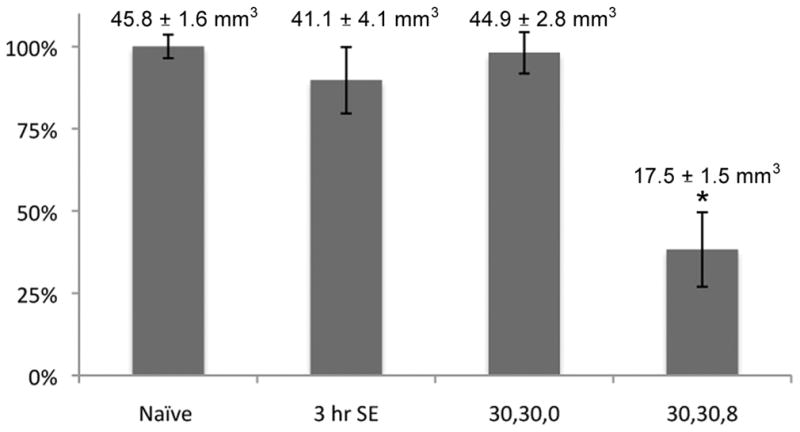
Total hippocampal volume two months after perforant pathway stimulation in freely moving Sprague-Dawley rats. The area of the hippocampus in every second section throughout the entire rostrocaudal extent of the hippocampus was measured using the Adobe Photoshop CS3 Extended Measurement program, which calculates the area bounded by an irregular border. The numerical data are presented above each graph bar. The asterisk denotes that the 30,30,8 group mean was significantly different from naïve control (p < 0.001 by Student’s t-test). Total hippocampal volumes >2 months after 3 hours of convulsive status epilepticus or 30,30,0 stimulation were not significantly different from naïve control (p > 0.05).
Figure 7
Figure 7
Coronal slices from T2-weighted magnetic resonance imaging 11 months after 8 hours of perforant pathway stimulation in Long-Evans rats that exhibited convulsive status epilepticus (CSE) (B), or non-convulsive satatus epilepticus (NCSE) (C). A1,A2: Naïve images acquired from the same animal seen in row B, prior to electrode implantation. B1,B2: Images acquired 11 months after 8 hours of perforant path stimulation (10 sec- long-20 Hz stimulus trains delivered once per minute for 8 hours) that caused mild (non-lethal) status epilepticus for the duration of the 8 hours of perforant pathway stimulation as a result of increased ambient temperature (see text). Arrows denote an elevated signal in extra-hippocampal areas. C1,C2: Images acquired 11 months after identical stimulation at normal ambient temperature, which did not cause convulsive status epilepticus. Note the lack of apparent injury in extra-hippocampal areas compared to the section in (B1). A3-C3: Nissl-stained coronal sections from rats subjected to convulsive vs. non-convulsive SE. A3: Nissl-stained section from a sham-stimulated rat. B3: Nissl-stained coronal section of the rat shown in B1 and B2. Note that the enhanced T2 signal reflected a pan-necrosis and loss of brain tissue presumably filled in vivo with cerebrospinal fluid. C3: Nissl-stained section from a stimulated rat that did not exhibit convulsive status epilepticus. Note the corresponding lack of extra-hippocampal damage in (A3) compared to panel (A2), but also greater pyramidal cell loss and hippocampal atrophy after non-convulsive status epilepticus (C3) than after convulsive status epilepticus (C3). Images were obtained in animals in which all metal electrodes had been removed within 24 hours of the end of stimulation or sham stimulation. Scale bar = 1 mm.
Figure 8
Figure 8
Hippocampal atrophy and synaptic reorganization (mossy fiber sprouting) in the dorsal hippocampus after perforant pathway stimulation in awake Sprague-Dawley rats. Rats were subjected to 30 min of stimulation on Days 1 and 2, and then 8 hours of identical stimulation on Day 3 (30,30,8-group). A: Nissl-stained section of the dorsal hippocampus from a naïve rat, illustrating normal anatomy. B: NeuN immunostaining in a dorsal hippocampal section from a naïve rat, showing the normal location of hippocampal neurons. C: NeuN immunostaining 56 days after 30,30,8-group stimulation, demonstrating classic hippocampal sclerosis from a single episode of stimulation on Day 3. Arrow points to surviving “resistant zone” neurons. D: Timm staining in a dorsal hippocampal section of a rat 181 days after two daily 30 minute episodes of perforant pathway stimulation (30,30,0 group). Note the normal pattern of Timm staining derived from the axons of dentate granule cells (mossy fibers; MF) and the axon terminals of CA3 pyramidal cells in areas CA3 and CA1 (asterisks). E: Timm-stained and Nissl- counterstained section of the dorsal hippocampus 193 days after 30,30,8-group stimulation, demonstrating classic hippocampal sclerosis, with survival of granule cells that form an aberrant axon plexus in the inner molecular layer (arrows). F: Magnification of box in panel E, showing the apparent innervation of surviving hippocampal neurons by the terminal portion of the mossy fiber pathway (arrows). Scale bar: 250 μm in A–E; 55 μm in F.
Figure 9
Figure 9
Hippocampal pathology after perforant pathway stimulation in awake, freely moving Long-Evans rats. A1 and A2: Nissl-stained coronal and horizontal sections of the dorsal (A1) and ventral (A2) hippocampus, respectively, of a naïve Long-Evans rat, showing normal hippocampal anatomy. B1 and B2: Nissl-stained sections of the dorsal (B1) and ventral (B2) hippocampus of a Long-Evans rat 261 days after a single 8 hour- long episode of perforant pathway stimulation that did not cause convulsive status epilepticus. Note classic hippocampal sclerosis throughout the hippocampal longitudinal axis. Scale bar: 450 μm.
Figure 10
Figure 10
Spontaneous granule cell layer activity recorded in an awake Sprague-Dawley rat 129 days after perforant pathway stimulation that evoked hippocampal excitation for 8 hrs, but not convulsive status epilepticus. Treatment was 30 min of stimulation on Days 1 and 2, and then 8 hours of identical stimulation on Day 3, followed by continuous electrographic and video monitoring. A: 60 seconds of activity recorded directly from the granule cell layer. Asterisk marks the occurrence of the first sign of a spontaneous behavioral seizure (forepaw clonus leading to rearing). Note that high amplitude activity (boxes 1, 2, and 3) preceded the behavioral seizure onset. Expanded trace 1: Expanded view of box 1 in (A) above. Note that large amplitude activity began as positive-going potentials with a small superimposed negative-going population spike, activity consistent with seizure onset in the entorhinal cortex and propagation to the granule cell layer via the perforant pathway. Expanded trace 2: Expanded view of box 2 in (A) above. Note that the spontaneous granule cell layer events increase in amplitude and frequency, and appear virtually identical to the granule cell evoked potentials recorded in response to perforant pathway stimulation (compare the spontaneous potentials in (B2) with the evoked potential in (B1). Expanded trace 3: Spontaneous granule cell layer events increase in amplitude and frequency just prior to behavioral seizure onset (asterisk). Expanded trace 4: Spontaneous granule cell layer events continue after seizure onset. Calibration bars: 5 sec in (A); 25 msec in panels 1–4; 5 msec in B1 and B2; 5 mV in all panels.
Figure 11
Figure 11
Coronal slices from T2-weighted magnetic resonance images at various time points after sham stimulation or perforant pathway stimulation in awake Sprague-Dawley rats. Sham stimulation involved no delivery of stimuli to chronically implanted rats, followed by removal of the implanted electrodes in preparation for imaging. Stimulated rats were subjected to 30 min of stimulation on Days 1 and 2, and then 8 hours of identical stimulation on Day 3, followed by removal of the electrodes and repeated magnetic resonance imaging 10, 56, and 196 days later. Note that all images in each column were acquired in the same rat. A1,B1: Images from each naïve rat prior to electrode implantation. A2,B2: 10 days after sham (A2) or 8 hour stimulation (B2). Note elevated signal in the hippocampi of the 8 hr-stimulated animal. A3,B3: 8 weeks after stimulation, images of the same rats show hippocampal atrophy (apparent expansion of ventricular volume), as well as cortical shrinkage (arrow). A4,B4: 28 weeks after stimulation, images show continuing hippocampal atrophy and cortical shrinkage (arrow). Scale bar: 1 mm.

References

    1. Abercrombie M. Estimation of nuclear population from microtome sections. Anat Rec. 1946;94:239–247. - PubMed
    1. Andersen P, Holmqvist B, Voorhoeve PE. Entorhinal activation of dentate granule cells. Acta Physiol Scand. 1966;66:448–460. - PubMed
    1. Bengzon J, Kokaia Z, Elmér E, Nanobashvili A, Kokaia M, Lindvall O. Apoptosis and proliferation of dentate gyrus neurons after single and intermittent limbic seizures. Proc Natl Acad Sci USA. 1997;94:10432–10437. - PMC - PubMed
    1. Biagini G, Baldelli E, Longo D, Contri MB, Guerrini U, Sironi L, Gelosa P, Zini I, Ragsdale DS, Avoli M. Proepileptic influence of a focal vascular lesion affecting entorhinal cortex-CA3 connections after status epilepticus. J Neuropathol Exp Neurol. 2008;67:687–701. - PMC - PubMed
    1. Blümcke I, Pauli E, Clusmann H, Schramm J, Becker A, Elger C, Merschhemke M, Meencke HJ, Lehmann T, von Deimling A, Scheiwe C, Zentner J, Volk B, Romstöck J, Stefan H, Hildebrandt M. A new clinico-pathological classification system for mesial temporal sclerosis. Acta Neuropathol. 2007;113:235–244. - PMC - PubMed

Publication types