


Telephone-based psychiatric referral-care management intervention health outcomes
- PMID: 20575721
- PMCID: PMC2993053
- DOI: 10.1089/tmj.2009.0139
Telephone-based psychiatric referral-care management intervention health outcomes
Abstract
Objective: This study examined the effectiveness of a telephone-based referral-care management (TBR-CM) intervention on psychiatric health outcomes.
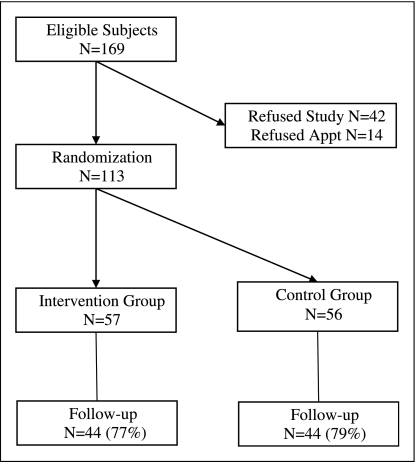
Materials and methods: Between September 2005 and May 2006, primary care patients (n = 169) at the Philadelphia Veterans Affairs Medical Center completed a psychiatric interview over the telephone, of which 113 gave consent and were randomized into the TBR-CM usual care or intervention groups (n = 40 [39%] depression, n = 40 [39%] substance abuse, and n = 33 [22%] comorbid condition: depression and substance abuse). Usual care consisted of participants receiving a psychiatric appointment, followed up with standard institutional reminders. The intervention care group received the same, with the addition of brief motivational telephone sessions. Baseline and 6-month interviews were used to obtain study data.
Results: Results indicated that there was improvement in mental health functioning (p < 0.0001), depression (p < 0.0001), and binge (p < 0.0332) outcomes over the 6-month interview (78% retention). However, there was no change observed for physical health functioning and drinks per week outcomes. For mental health functioning, depression, and binge rates there were no randomization group assignment effects, indicating that the intervention care group did not show better health outcomes despite showing higher levels of psychiatric appointment attendance.
Conclusions: Patients who are exposed to the intervention have similar health outcomes as patients in usual care. In conclusion, the TBR-CM intervention does not lead to relatively improved psychiatric health outcomes. Further research is necessary to examine the efforts needed to extend increased treatment engagement into improved health outcomes for intervention recipients.
Similar articles
-
Effectiveness of telephone-based referral care management, a brief intervention to improve psychiatric treatment engagement.Psychiatr Serv. 2008 Jul;59(7):776-81. doi: 10.1176/ps.2008.59.7.776. Psychiatr Serv. 2008. PMID: 18586995 Clinical Trial.
-
UPBEAT: the impact of a psychogeriatric intervention in VA medical centers. Unified Psychogeriatric Biopsychosocial Evaluation and Treatment.Med Care. 2001 May;39(5):500-12. doi: 10.1097/00005650-200105000-00010. Med Care. 2001. PMID: 11317098 Clinical Trial.
-
Randomized controlled trial of telephone monitoring with psychiatry inpatients with co-occurring substance use and mental health disorders.Drug Alcohol Depend. 2019 Jan 1;194:230-237. doi: 10.1016/j.drugalcdep.2018.09.010. Epub 2018 Oct 29. Drug Alcohol Depend. 2019. PMID: 30466040 Free PMC article. Clinical Trial.
-
Psychological interventions for co-occurring depression and substance use disorders.Cochrane Database Syst Rev. 2019 Nov 26;2019(11):CD009501. doi: 10.1002/14651858.CD009501.pub2. Cochrane Database Syst Rev. 2019. PMID: 31769015 Free PMC article.
-
Systematic reviews of the effectiveness of day care for people with severe mental disorders: (1) acute day hospital versus admission; (2) vocational rehabilitation; (3) day hospital versus outpatient care.Health Technol Assess. 2001;5(21):1-75. doi: 10.3310/hta5210. Health Technol Assess. 2001. PMID: 11532238 Review.
Cited by
-
Technology-Based Alcohol Interventions in Primary Care: Systematic Review.J Med Internet Res. 2019 Apr 8;21(4):e10859. doi: 10.2196/10859. J Med Internet Res. 2019. PMID: 30958270 Free PMC article.
-
Validity of Psychiatric Evaluation of Asylum Seekers through Telephone.Case Rep Psychiatry. 2021 Feb 10;2021:8856352. doi: 10.1155/2021/8856352. eCollection 2021. Case Rep Psychiatry. 2021. PMID: 33628562 Free PMC article.
-
Adapting psychotherapy in collaborative care for treating opioid use disorder and co-occurring psychiatric conditions in primary care.Fam Syst Health. 2023 Sep;41(3):377-388. doi: 10.1037/fsh0000791. Epub 2023 May 25. Fam Syst Health. 2023. PMID: 37227828 Free PMC article. Clinical Trial.
-
Non-adherence to telemedicine interventions for drug users: systematic review.Rev Saude Publica. 2014 Jun;48(3):521-31. doi: 10.1590/s0034-8910.2014048005130. Rev Saude Publica. 2014. PMID: 25119947 Free PMC article.
-
Aftercare services for patients with severe mental disorder: A randomized controlled trial.J Res Med Sci. 2014 Mar;19(3):240-5. J Res Med Sci. 2014. PMID: 24949032 Free PMC article.
References
-
- Lefforge NL. Donohue B. Strada MJ. Improving session attendance in mental health and substance abuse settings: A review of controlled studies. Behav Ther. 2007;38:1–22. - PubMed
-
- Zanjani F. Mavandadi S. TenHave T. Katz I. Durai NB. Krahn D. Llorente M. Kirchner J. Olsen E. Van Stone W. Cooley S. Oslin DW. Longitudinal course of substance treatment benefits in older male veteran at-risk drinkers. J Gerontol Med Sci. 2008;63:98–106. - PubMed
-
- Bernstein E. Bernstein J. Levenson S. Project ASSERT: An ED-based intervention to increase access to primary care, preventive services, and the substance abuse treatment system. Ann Emerg Med. 1997;30:181–189. - PubMed
-
- Donovan DM. Rosengren DB. Downey L. Cox GB. Sloan KL. Attrition prevention with individuals awaiting publicly funded drug treatment. Addiction. 2001;96:1149–1160. - PubMed
-
- Kitcheman J. Adams CE. Pervaiz A. Kader I. Mohandas D. Brookes G. Does an encouraging letter encourage attendance at psychiatric out-patient clinics? The Leeds PROMPTS randomized study. Psychol Med. 2008;38:717–723. - PubMed
Publication types
MeSH terms
Grants and funding
LinkOut - more resources
Full Text Sources
