. 2010 Jun 24:4:8.
doi: 10.1186/1754-1611-4-8.

Efficient cell-free expression with the endogenous E. Coli RNA polymerase and sigma factor 70

Affiliations

Efficient cell-free expression with the endogenous E. Coli RNA polymerase and sigma factor 70

Jonghyeon Shin et al. J Biol Eng. .

Abstract

Background: Escherichia coli cell-free expression systems use bacteriophage RNA polymerases, such as T7, to synthesize large amounts of recombinant proteins. These systems are used for many applications in biotechnology, such as proteomics. Recently, informational processes have been reconstituted in vitro with cell-free systems. These synthetic approaches, however, have been seriously limited by a lack of transcription modularity. The current available cell-free systems have been optimized to work with bacteriophage RNA polymerases, which put significant restrictions to engineer processes related to biological information. The development of efficient cell-free systems with broader transcription capabilities is required to study complex informational processes in vitro.

Results: In this work, an efficient cell-free expression system that uses the endogenous E. coli RNA polymerase only and sigma factor 70 for transcription was prepared. Approximately 0.75 mg/ml of Firefly luciferase and enhanced green fluorescent protein were produced in batch mode. A plasmid was optimized with different regulatory parts to increase the expression. In addition, a new eGFP was engineered that is more translatable in cell-free systems than the original eGFP. The protein production was characterized with three different adenosine triphosphate (ATP) regeneration systems: creatine phosphate (CP), phosphoenolpyruvate (PEP), and 3-phosphoglyceric acid (3-PGA). The maximum protein production was obtained with 3-PGA. Preparation of the crude extract was streamlined to a simple routine procedure that takes 12 hours including cell culture.

Conclusions: Although it uses the endogenous E. coli transcription machinery, this cell-free system can produce active proteins in quantities comparable to bacteriophage systems. The E. coli transcription provides much more possibilities to engineer informational processes in vitro. Many E. coli promoters/operators specific to sigma factor 70 are available that form a broad library of regulatory parts. In this work, cell-free expression is developed as a toolbox to design and to study synthetic gene circuits in vitro.


Figures
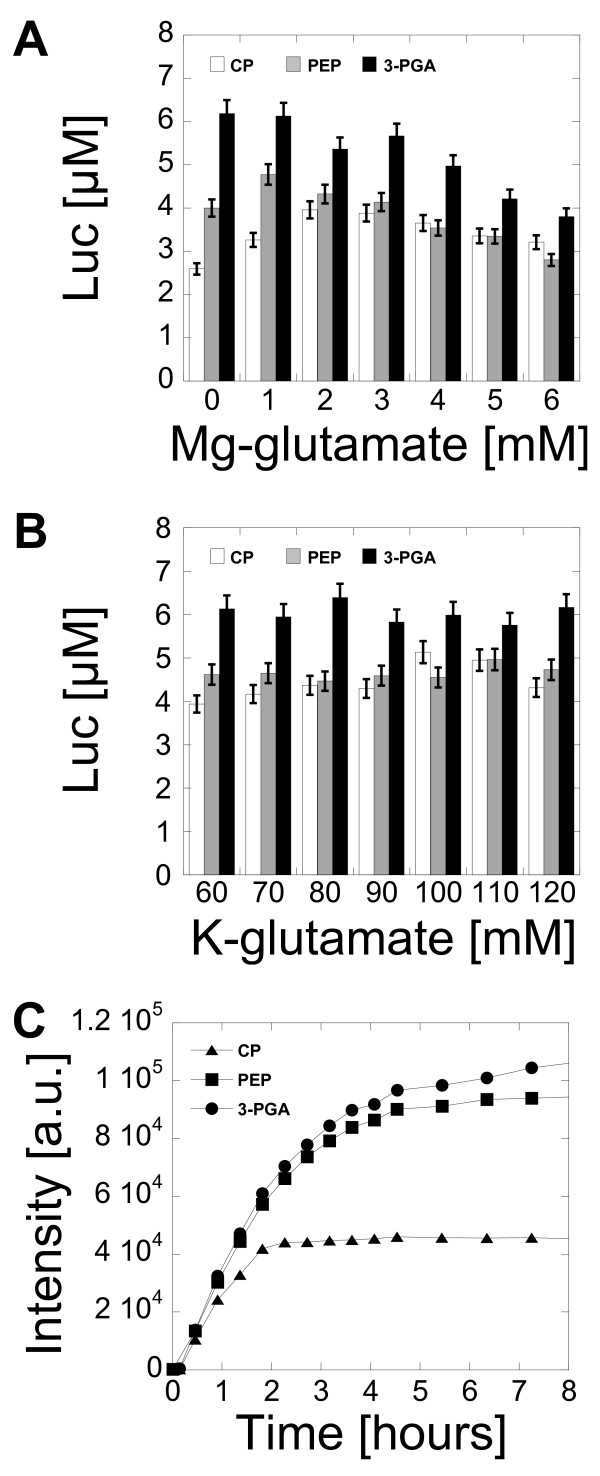
Figure 1
Figure 1
Protein synthesis as a function of magnesium glutamate and potassium glutamate in three different buffers CP, PEP and 3-PGA. (A) Luc synthesized as a function of magnesium glutamate with 5 nM plasmid pBEST-UTR1-Luc (CP, PEP and 3-PGA: 90 mM potassium glutamate, 1.5 mM of each amino acid, 2% PEG 8000). (B) Luc synthesized as a function of potassium glutamate with 5 nM plasmid pBEST-UTR1-Luc (CP: 2 mM magnesium glutamate, 1.5 mM of each amino acid, 2% PEG 8000; PEP: 1 mM magnesium glutamate, 1.5 mM of each amino acid, 2% PEG 8000; 3-PGA: 0 mM magnesium glutamate, 1.5 mM of each amino acid, 2% PEG 8000). (C) Kinetics of eGFP expression in the best conditions for the three different buffers with 5 nM plasmid pBEST-UTR1-eGFP (CP: 10 mM magnesium glutamate, 50 mM potassium glutamate, 1 mM of each amino acid, 2% PEG 8000; PEP: 9 mM magnesium glutamate, 30 mM potassium glutamate, 1 mM of each amino acid, 2% PEG 8000; 3-PGA: 6 mM magnesium glutamate, 40 mM potassium glutamate, 1 mM of each amino acid, 2% PEG 8000). Concentrations of magnesium glutamate and potassium glutamate reported here are the concentrations added to the cell-free reaction. The crude extract, dialyzed against the S30 buffer B, brings an additional 4.5 mM magnesium glutamate and 20 mM potassium glutamate to the cell-free reaction.
Figure 2
Figure 2
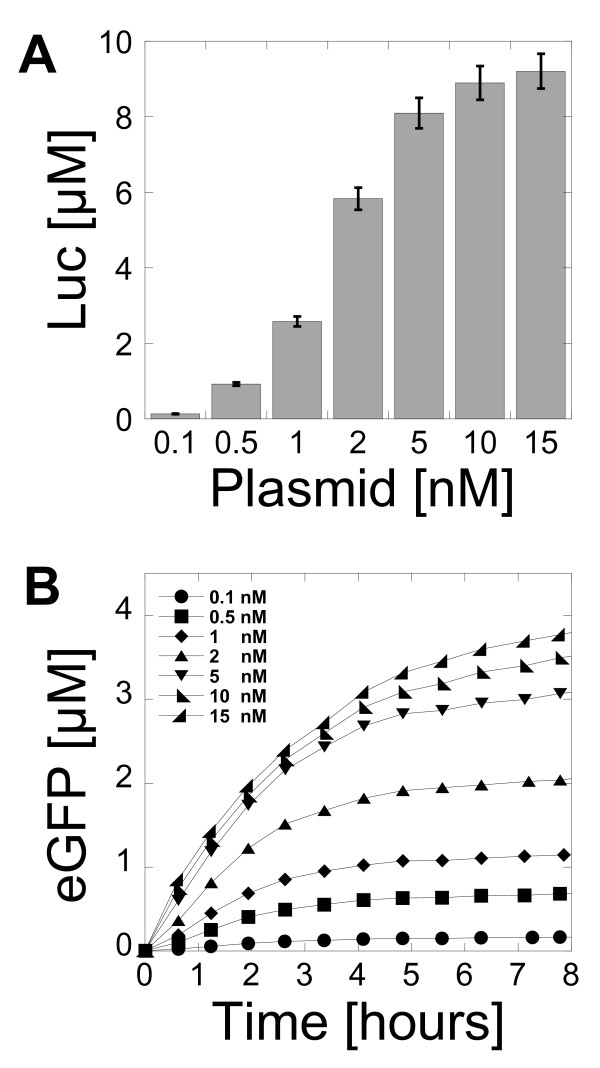
Protein synthesis as a function of plasmid concentration. (A) Luc synthesized as a function of plasmid pBEST-UTR1-Luc concentration in 3-PGA buffer (conditions: 0 mM magnesium glutamate, 80 mM potassium glutamate, 1.5 mM of each amino acids, 0.5% PEG 8000). (B) Kinetics of eGFP expression as a function of plasmid pBEST-UTR1-eGFP concentration in 3-PGA buffer (conditions: 4 mM magnesium glutamate, 60 mM potassium glutamate, 1 mM of each amino acids, 2.5% PEG 8000). Concentrations of magnesium glutamate and potassium glutamate reported here are the concentrations added to the cell-free reaction. The crude extract, dialyzed against the S30 buffer B, brings an additional 4.5 mM magnesium glutamate and 20 mM potassium glutamate to the cell-free reaction.
Figure 3
Figure 3
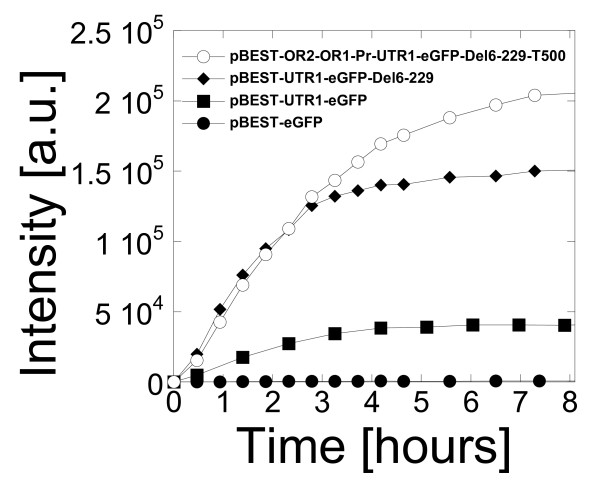
Cell-free protein synthesis of eGFP variants as a function of DNA regulatory parts. Expression kinetics of four eGFP variants, 1 nM plasmid final concentration (3-PGA buffer, conditions: 5 mM magnesium glutamate, 50 mM potassium glutamate, 1.5 mM of each amino acid, 2% PEG 8000). Concentrations of magnesium glutamate and potassium glutamate reported here are the concentrations added to the cell-free reaction. The crude extract, dialyzed against the S30 buffer B, brings an additional 4.5 mM magnesium glutamate and 20 mM potassium glutamate to the cell-free reaction.
Figure 4
Figure 4
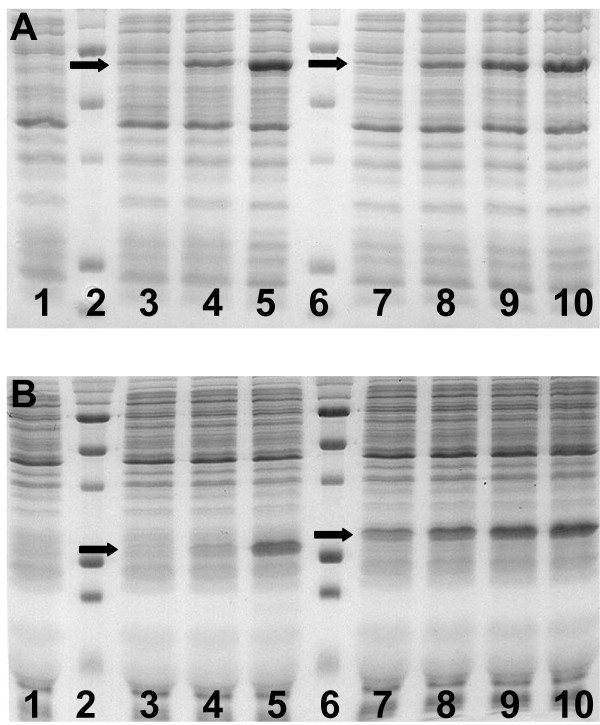
Analysis of protein production by polyacrylamide gel electrophoresis. For both gel, lane 1 is a negative control (no plasmid added in the reaction), lane 2 and 6 is a protein ladder (5 main bands from top to bottom 75, 50, 37, 25 and 20 kDa). Synthesized proteins are indicated by arrows. (A) Luc synthesized with 10 nM pBEST-Luc plasmid (lane 3), 1.5 nM pBEST-UTR1-Luc plasmid (lane 4), and 15 nM pBEST-UTR1-Luc plasmid (lane 4) (3-PGA buffer, conditions: 1 mM magnesium glutamate, 60 mM potassium glutamate, 1.5 mM of each amino acid, 0.5% PEG 8000). Pure Luc added to the cell-free reaction with no plasmid, 2 μM (lane 7), 6 μM (lane 8), 10 μM (lane 9) and 14 μM (lane 10). (B) eGFP synthesized with 15 nM pBEST-eGFP plasmid (lane 3), 1 nM pBEST-OR2-OR1-Pr-UTR1-eGFP-Del6-229-T500 plasmid (lane 4) and 10 nM pBEST-OR2-OR1-Pr-UTR1-eGFP-Del6-229-T500 plasmid (lane 5), (3-PGA buffer, conditions: 3 mM magnesium glutamate, 30 mM potassium glutamate, 1.5 mM of each amino acid, 2% PEG 8000). Pure eGFP added to the cell-free reaction with no plasmid, 10 μM (lane 7), 15 μM (lane 8), 20 μM (lane 9) and 25 μM (lane 10). Concentrations of magnesium glutamate and potassium glutamate reported here are the concentrations added to the cell-free reaction. The crude extract, dialyzed against the S30 buffer B, brings an additional 4.5 mM magnesium glutamate and 20 mM potassium glutamate to the cell-free reaction.
Figure 5
Figure 5
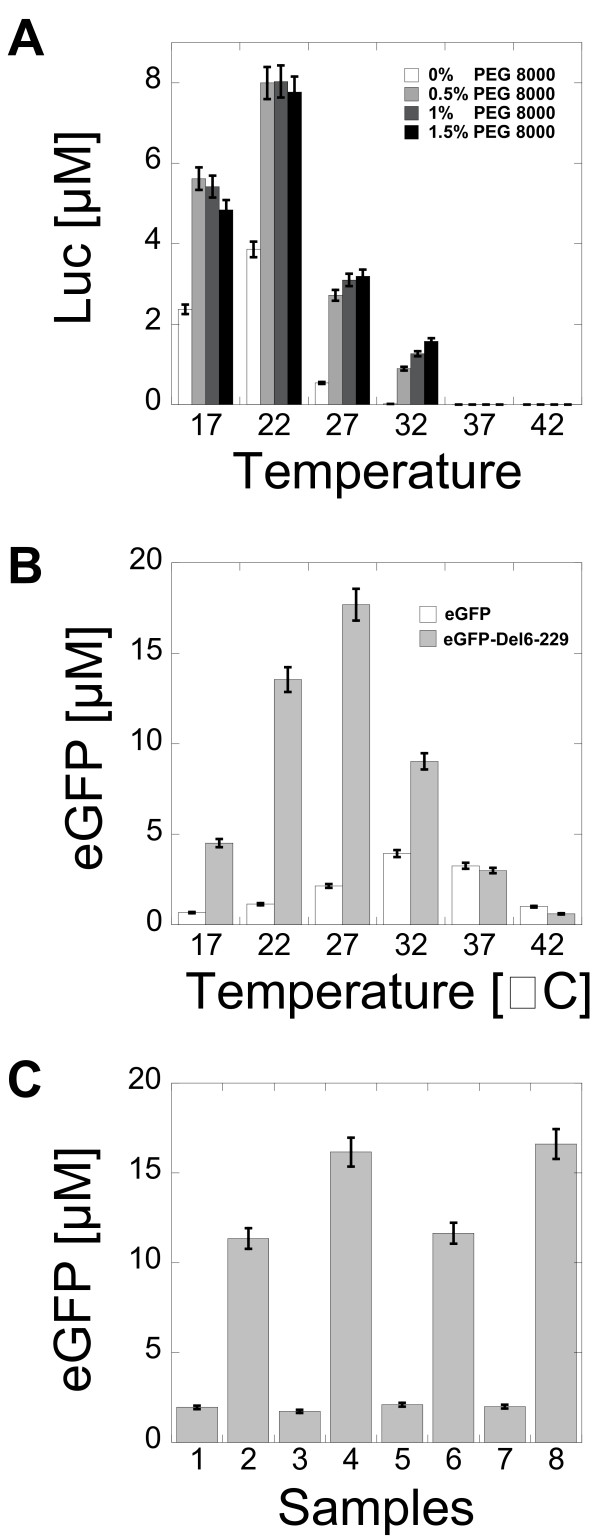
Luc, eGFP and eGFP-Del6-229 production as a function of temperature. (A) End-point measurement of Luc production as a function of PEG 8000 concentration and as a function of the reaction incubation temperature (3-PGA buffer, conditions: 0 mM magnesium glutamate, 80 mM potassium glutamate, 1.5 mM of each amino acid). (B) End-point measurement of eGFP and eGFP-Del6-229 production as a function of the reaction incubation temperature (3-PGA buffer, conditions: 4 mM magnesium glutamate, 60 mM potassium glutamate, 1.5 mM of each amino acid, 2.5% PEG 8000). (C) Temperature stability of eGFP and eGFP-Del6-229 protein expressed with 2 nM plasmids (pBEST-UTR1-eGFP-T500 and pBEST-UTR1-eGFP-Del6-229-T500). 1) 8 hours expression of eGFP at 32°C, 2) 8 hours expression of eGFP-Del6-229 at 32°C, 3) 8 hours expression of eGFP at 29°C, 4) 8 hours expression of eGFP-Del6-229 at 29°C, 5) 8 hours expression of eGFP at 32°C followed by 1 hour of incubation at 37°C, 6) 8 hours expression of eGFP-Del6-229 at 32°C followed by 1 hour of incubation at 37°C, 7) 8 hours expression of eGFP at 29°C followed by 1 hour of incubation at 37°C, 8) 8 hours expression of eGFP-Del6-229 at 29°C followed by 1 hour of incubation at 37°C. Concentrations of magnesium glutamate and potassium glutamate reported here are the concentrations added to the cell-free reaction. The crude extract, dialyzed against the S30 buffer B, brings an additional 4.5 mM magnesium glutamate and 20 mM potassium glutamate to the cell-free reaction.

References

    1. He M. Cell-free protein synthesis: applications in proteomics and biotechnology. N Biotechnol. 2008;25:126–32. doi: 10.1016/j.nbt.2008.08.004. - DOI - PubMed
    1. Kim DM, Kigawa T, Choi CY, Yokoyama S. A highly efficient cell-free protein synthesis system from Escherichia coli. Eur J Biochem. 1996;239:881–6. doi: 10.1111/j.1432-1033.1996.0881u.x. - DOI - PubMed
    1. Kim DM, Swartz JR. Regeneration of adenosine triphosphate from glycolytic intermediates for cell-free protein synthesis. Biotechnol Bioeng. 2001;74:309–16. doi: 10.1002/bit.1121. - DOI - PubMed
    1. Sitaraman K, Esposito D, Klarmann G, Le Grice SF, Hartley JL, Chatterjee DK. A novel cell-free protein synthesis system. J Biotechnol. 2004;110:257–63. doi: 10.1016/j.jbiotec.2004.02.014. - DOI - PubMed
    1. Kim TW, Oh IS, Keum JW, Kwon YC, Byun JY, Lee KH, Choi CY, Kim DM. Prolonged cell-free protein synthesis using dual energy sources: combined use of creatine phosphate and glucose for the efficient supply of ATP and retarded accumulation of phosphate. Biotechnol Bioeng. 2007;97:1510–5. doi: 10.1002/bit.21337. - DOI - PubMed