


Drug resistance is widespread among children who receive long-term antiretroviral treatment at a rural Tanzanian hospital
- PMID: 20576637
- PMCID: PMC2920178
- DOI: 10.1093/jac/dkq234
Drug resistance is widespread among children who receive long-term antiretroviral treatment at a rural Tanzanian hospital
Abstract
Objectives: To assess long-term virological efficacy and the emergence of drug resistance in children who receive antiretroviral treatment (ART) in rural Tanzania.
Patients and methods: Haydom Lutheran Hospital has provided ART to HIV-infected individuals since 2003. From February through May 2009, a cross-sectional virological efficacy survey was conducted among children (<15 years) who had completed >or=6 months of first-line non-nucleoside reverse transcriptase inhibitor (NNRTI)-based ART. Genotypic resistance was determined in those with a viral load of >200 copies/mL.
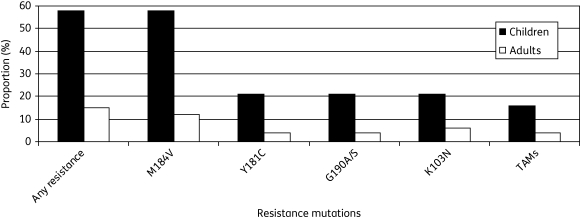
Results: Virological response was measured in 19 of 23 eligible children; 8 of 19 were girls and median age at ART initiation was 5 years (range 2-14 years). Median duration of ART at the time of the survey was 40 months (range 11-61 months). Only 8 children were virologically suppressed (<or=40 copies/mL), whereas 11 children had clinically relevant resistance mutations in the reverse transcriptase gene. The most frequent mutations were M184V (n = 11), conferring resistance to lamivudine and emtricitabine, and Y181C (n = 4), G190A/S (n = 4) and K103N (n = 4), conferring resistance to NNRTIs. Of concern, three children had thymidine analogue mutations, associated with cross-resistance to all nucleoside reverse transcriptase inhibitors. Despite widespread resistance, however, only one child experienced a new WHO stage 4 event and none had a CD4 cell count of <200 cells/mm(3).
Conclusions: Among children on long-term ART in rural Tanzania, >50% harboured drug resistance. Results for children were markedly poorer than for adults attending the same programme, underscoring the need for improved treatment strategies for children in resource-limited settings.
Figures
Comment in
-
Comment on: Drug resistance is widespread among children who receive long-term antiretroviral treatment at a rural Tanzanian hospital.J Antimicrob Chemother. 2011 Apr;66(4):956-7; author reply 957-8. doi: 10.1093/jac/dkr018. Epub 2011 Feb 7. J Antimicrob Chemother. 2011. PMID: 21393221 No abstract available.
References
-
- WHO. Towards Universal Access: Scaling Up Priority HIV/AIDS Interventions in the Health Sector. Progress Report 2009. Geneva: WHO; 2009.
-
- Chaix ML, Rouet F, Kouakoussui KA, et al. Genotypic human immunodeficiency virus type 1 drug resistance in highly active antiretroviral therapy-treated children in Abidjan, Cote d'Ivoire. Pediatr Infect Dis J. 2005;24:1072–6. - PubMed
-
- Song R, Jelagat J, Dzombo D, et al. Efficacy of highly active antiretroviral therapy in HIV-1 infected children in Kenya. Pediatrics. 2007;120:e856–61. doi:10.1542/peds.2006-1122. - DOI - PubMed
-
- Germanaud D, Derache A, Traore M, et al. Level of viral load and antiretroviral resistance after 6 months of non-nucleoside reverse transcriptase inhibitor first-line treatment in HIV-1-infected children in Mali. J Antimicrob Chemother. 2010;65:118–24. doi:10.1093/jac/dkp412. - DOI - PubMed
-
- Jittamala P, Puthanakit T, Chaiinseeard S, et al. Predictors of virologic failure and genotypic resistance mutation patterns in Thai children receiving non-nucleoside reverse transcriptase inhibitor-based antiretroviral therapy. Pediatr Infect Dis J. 2009;28:826–30. - PubMed
Publication types
MeSH terms
Substances
LinkOut - more resources
Full Text Sources
Medical
Research Materials
