


Typical and atypical development of functional human brain networks: insights from resting-state FMRI
- PMID: 20577585
- PMCID: PMC2889680
- DOI: 10.3389/fnsys.2010.00021
Typical and atypical development of functional human brain networks: insights from resting-state FMRI
Abstract
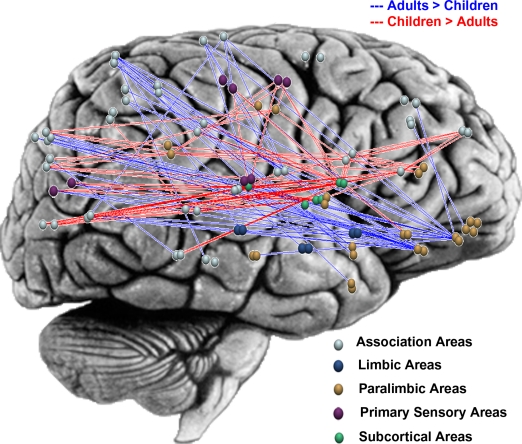
Over the past several decades, structural MRI studies have provided remarkable insights into human brain development by revealing the trajectory of gray and white matter maturation from childhood to adolescence and adulthood. In parallel, functional MRI studies have demonstrated changes in brain activation patterns accompanying cognitive development. Despite these advances, studying the maturation of functional brain networks underlying brain development continues to present unique scientific and methodological challenges. Resting-state fMRI (rsfMRI) has emerged as a novel method for investigating the development of large-scale functional brain networks in infants and young children. We review existing rsfMRI developmental studies and discuss how this method has begun to make significant contributions to our understanding of maturing brain organization. In particular, rsfMRI has been used to complement studies in other modalities investigating the emergence of functional segregation and integration across short and long-range connections spanning the entire brain. We show that rsfMRI studies help to clarify and reveal important principles of functional brain development, including a shift from diffuse to focal activation patterns, and simultaneous pruning of local connectivity and strengthening of long-range connectivity with age. The insights gained from these studies also shed light on potentially disrupted functional networks underlying atypical cognitive development associated with neurodevelopmental disorders. We conclude by identifying critical gaps in the current literature, discussing methodological issues, and suggesting avenues for future research.
Keywords: attention-deficit/hyperactivity disorder; autism spectrum disorders; brain maturation; cognitive development; functional connectivity; resting-state fMRI.
Figures
References
-
- Biswal B. B., Mennes M., Zuo X. N., Gohel S., Kelly C., Smith S. M., Beckmann C. F., Adelstein J. S., Buckner R. L., Colcombe S., Dogonowski A. M., Ernst M., Fair D., Hampson M., Hoptman M. J., Hyde J. S., Kiviniemi V. J., Kötter R., Li S. J., Lin C. P., Lowe M. J., Mackay C., Madden D. J., Madsen K. H., Margulies D. S., Mayberg H. S., McMahon K., Monk C. S., Mostofsky S. H., Nagel B. J., Pekar J. J., Peltier S. J., Petersen S. E., Riedl V., Rombouts S. A., Rypmam B., Schlaggar B. L., Schmidt S., Seidler R. D., Siegle G. J., Sorg C., Teng G. J., Veijola J., Villringer A., Walter M., Wang L., Weng X. C., Whitfield-Gabrieli S., Williamson P., Windischberger C., Zang Y. F., Zhang H. Y., Castellanos F. X., Milham M. P. (2010). Toward discovery science of human brain function. Proc. Natl. Acad. Sci. U.S.A. 107, 4734–473910.1073/pnas.0911855107 - DOI - PMC - PubMed
-
- Bondy J. A., Murty U. S. R. (1976). Graph Theory with Applications New York: American Elsevier Pub. Co.
Grants and funding
LinkOut - more resources
Full Text Sources
Miscellaneous
