


Sodium 4-phenylbutyrate ameliorates the effects of cataract-causing mutant gammaD-crystallin in cultured cells
- PMID: 20577655
- PMCID: PMC2890554
Sodium 4-phenylbutyrate ameliorates the effects of cataract-causing mutant gammaD-crystallin in cultured cells
Abstract
Purpose: gammaD-Crystallin (CRYGD) is a major structural lens crystallin and its mutations result in congenital cataract formation. In this study, we attempted to correct the altered protein features of G165fsX8 CRYGD protein with small chemical molecules.
Methods: Recombinant FLAG-tagged mutants (R15C, R15S, P24T, R61C, and G165fsX8) of CRYGD were expressed in COS-7 cells and treated with small chemical molecules with reported protein chaperoning properties (sodium 4-phenylbutyrate [4-PBA], trimethylamine N-oxide [TMAO], and glycerol and DMSO [DMSO]). Protein solubility in 0.5% Triton X-100 and subcellular distribution was examined by western blotting and immunofluorescence, respectively. Apoptosis was assayed as the percentage of fragmented nuclei in transfected cells. Expression of heat-shock proteins (Hsp70 and Hsp90) was examined by reverse transcription-polymerase chain reaction analysis.
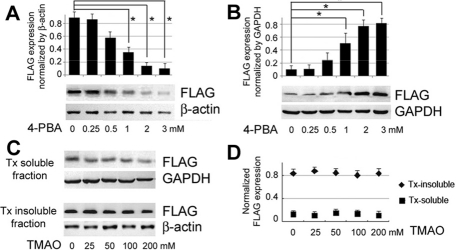
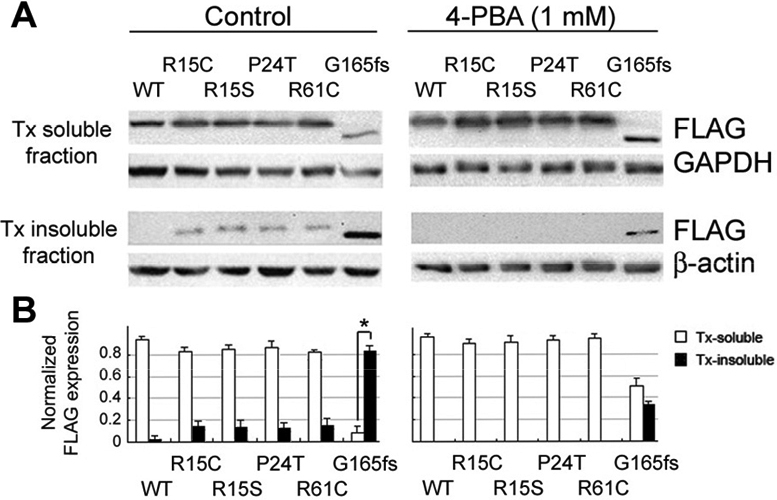
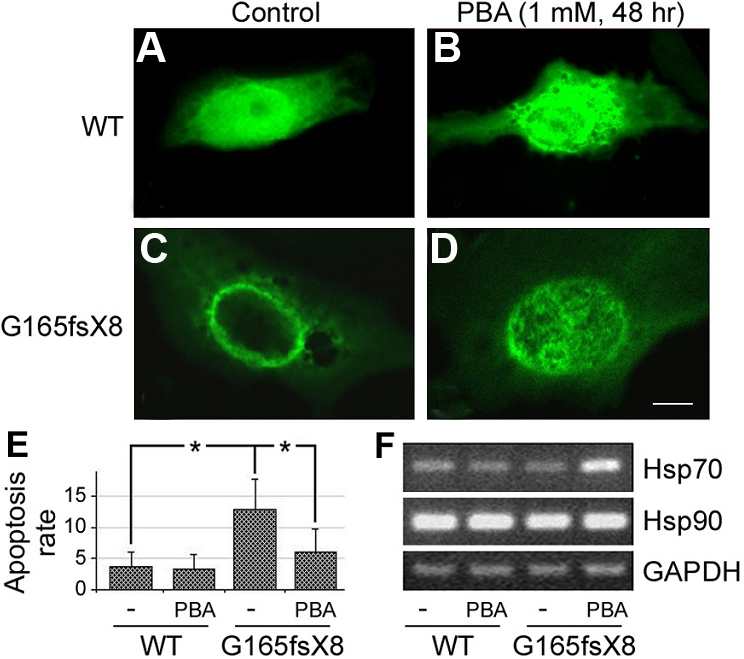
Results: Unlike WT and most mutants (R15C, R15S, P24T, and R61C) of CRYGD, G165fsX8 CRYGD was significantly insoluble in 0.5% Triton X-100. This insolubility was alleviated by dose-dependent 4-PBA treatment. The treatment relieved the mislocalization of G165fsX8 CRYGD from the nuclear envelope. Also, 4-PBA treatment reduced cell apoptosis and caused an upregulation of Hsp70.
Conclusions: 4-PBA treatment reduced the defective phenotype of mutant G165fsX8 CRYGD and rescued the affected cells from apoptosis. This could be a potential treatment for lens structural protein and prevent lens opacity in cataract formation.
Figures
References
-
- Aridor M, Hannan LA. Traffic jams II: an update of diseases of intracellular transport. Traffic. 2002;3:781–90. - PubMed
-
- Broadley SA, Hartl FU. The role of molecular chaperones in human misfolding diseases. FEBS Lett. 2009;583:2647–53. - PubMed
-
- Trombetta ES, Parodi AJ. Quality control and protein folding in the secretory pathway. Annu Rev Cell Dev Biol. 2003;19:649–76. - PubMed
-
- Ellgaard L, Molinari M, Helenius A. Setting the standards: quality control in the secretory pathway. Science. 1999;286:1882–8. - PubMed
Publication types
MeSH terms
Substances
LinkOut - more resources
Full Text Sources
Medical