Review
. 2011 Mar;16(2):109-27.
doi: 10.1007/s10741-010-9174-6.

Methods of assessing vagus nerve activity and reflexes

Affiliations
Review

Methods of assessing vagus nerve activity and reflexes

Mark W Chapleau et al. Heart Fail Rev. 2011 Mar.

Abstract

The methods used to assess cardiac parasympathetic (cardiovagal) activity and its effects on the heart in both humans and animal models are reviewed. Heart rate (HR)-based methods include measurements of the HR response to blockade of muscarinic cholinergic receptors (parasympathetic tone), beat-to-beat HR variability (HRV) (parasympathetic modulation), rate of post-exercise HR recovery (parasympathetic reactivation), and reflex-mediated changes in HR evoked by activation or inhibition of sensory (afferent) nerves. Sources of excitatory afferent input that increase cardiovagal activity and decrease HR include baroreceptors, chemoreceptors, trigeminal receptors, and subsets of cardiopulmonary receptors with vagal afferents. Sources of inhibitory afferent input include pulmonary stretch receptors with vagal afferents and subsets of visceral and somatic receptors with spinal afferents. The different methods used to assess cardiovagal control of the heart engage different mechanisms, and therefore provide unique and complementary insights into underlying physiology and pathophysiology. In addition, techniques for direct recording of cardiovagal nerve activity in animals; the use of decerebrate and in vitro preparations that avoid confounding effects of anesthesia; cardiovagal control of cardiac conduction, contractility, and refractoriness; and noncholinergic mechanisms are described. Advantages and limitations of the various methods are addressed, and future directions are proposed.


Figures

Fig. 1
Fig. 1
Determination of resting cardiac parasympathetic and sympathetic tone. The increase in mean HR after administering a muscarinic cholinergic receptor (M-ChR) blocker (e.g., atropine, tachycardia) reflects the cardiovagal tone present under baseline resting conditions. Conversely, the decrease in mean HR after β-adrenergic receptor (β-AdR) blockade (e.g., propranolol, bradycardia) reflects cardiac sympathetic tone. Subsequent administration of the second autonomic blocking agent during the peak HR response to the first agent identifies the intrinsic HR (double blockade) and enables calculation of residual sympathetic tone in absence of vagal tone (HR after M-ChR blockade—intrinsic HR) and residual vagal tone in absence of sympathetic tone (intrinsic HR–HR after β-AdR blockade)
Fig. 2
Fig. 2
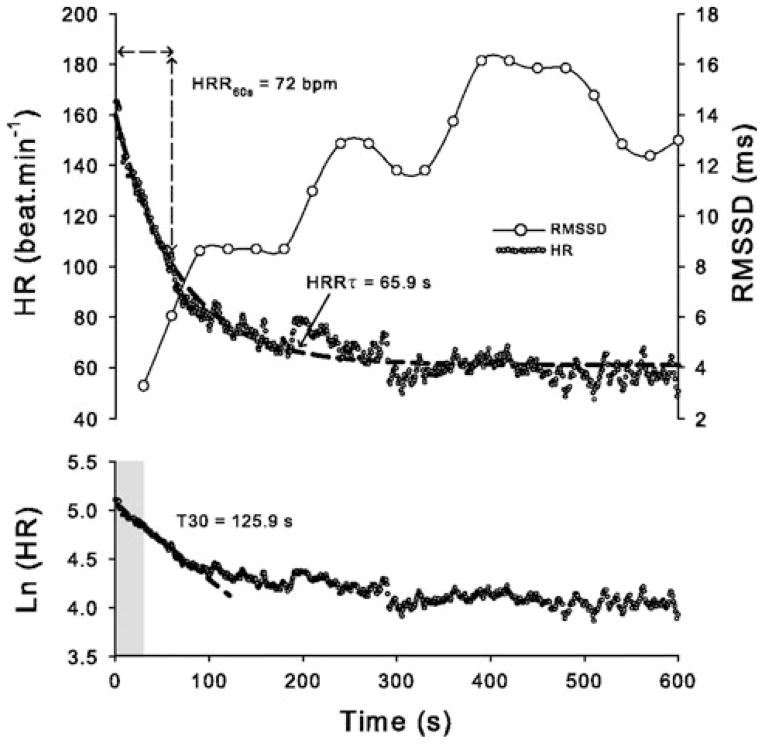
Indices that reflect HR recovery (HRR) after submaximal exercise. Shown are HR, Ln (HR), and rMSSD measured over time after termination of submaximal exercise in an individual subject. HRR indexes include the: (i) decrease in HR over the first 30 s of HRR obtained by semi-logarithmic regression analysis (T30), (ii) absolute difference between HR at completion of exercise and after 60 s of recovery (HRR60s), and (iii) time constant of HR decay obtained by fitting HRR data to a first-order exponential decay curve (HRRτ). Short-term HRR indexes (T30 and HRR60s) are considered as relatively specific markers of parasympathetic reactivation, while the slower HRRτ may involve a combination of parasympathetic reactivation and withdrawal of sympathetic activity. The root mean square of successive R-R interval differences (rMSDD) calculated over consecutive 30 s periods confirms parasympathetic reactivation. Reproduced with permission from Buchheit et al. [34]
Fig. 3
Fig. 3
Relationships between mean R-R interval and 3 indices of HRV in 3 subjects. Nitroprusside and phenylephrine were infused to change blood pressure and evoke baroreflex-mediated changes in parasympathetic activity. Initially, HRV and R-R interval both increased markedly with increases in parasympathetic activity in the young subject (24-year-old woman, squares), but HRV declined as mean R-R interval continued to increase at higher levels of parasympathetic activity. The nonlinear relationship between HRV and mean R-R interval was also apparent although less pronounced in the middle-aged (47-year-old woman, circles) and older (60-year-old man, triangles) subjects who exhibited low HRV. Indices of HRV included the standard deviation of R-R intervals (SD), the root mean square of successive R-R interval differences (MSSD), and high frequency (HF) HRV. Reproduced with permission from Goldberger et al. [30]
Fig. 4
Fig. 4
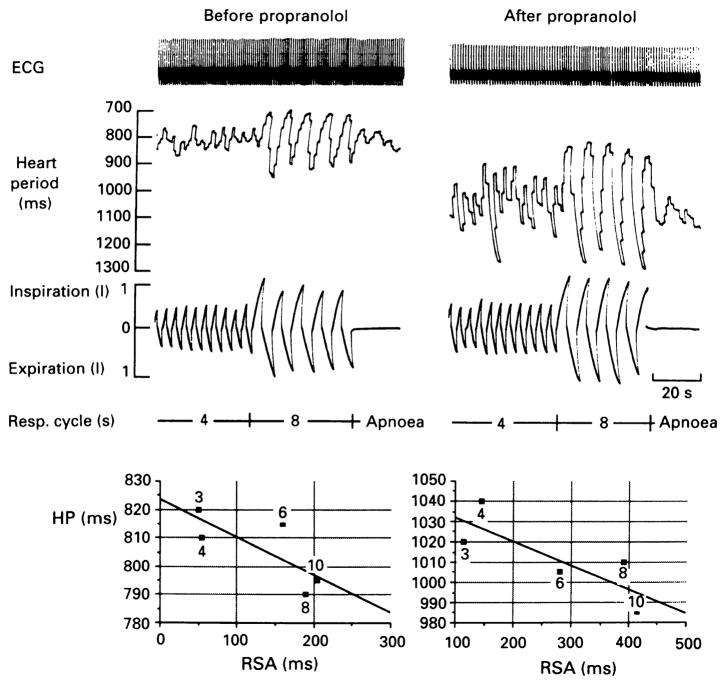
Example of increases in respiratory sinus arrhythmia during paced breathing at lower frequencies with decrease or no change in mean R-R interval. Upper panel: shown are ECG, heart period (R-R interval), and respiration during normal (4 s respiratory cycle length, 15 breaths/min) and slow (8 s respiratory cycle length, 7.5 breaths/min) breathing in a subject before (left panel) and after (right panel) administration of the β-adrenergic receptor blocker propranolol (0.2 mg/kg, IV). Respiratory sinus arrhythmia is markedly increased at lower breathing frequency while mean heart period remains relatively unchanged. Lower panel: Shown are values of mean heart period (HP) plotted against respiratory sinus arrhythmia (RSA, max–min HP) with respiratory cycle lengths of 3, 4, 6, 8, and 10 s as indicated on figure. Linear regression analysis shows inverse relationship between HP and RSA before and after propranolol. Reproduced with permission from Kollai and Mizsei [26]
Fig. 5
Fig. 5
Overview of reflex control of cardiovagal (parasympathetic) nerve activity and HR. Excitatory (+) and inhibitory (−) afferent inputs to the central nervous system trigger reflex decreases and increases in HR, respectively
Fig. 6
Fig. 6
Spontaneous baroreflex sensitivity (BRS) and number of baroreflex sequences measured over 24-h day/night cycle in young and old mild hypertensive subjects. Shown are the average hourly values of the number of baroreflex sequences (left) and BRS (average slope of systolic pressure-PI relations) (right) measured over a 24-h period using the sequence method in young (24 ±6 years, n =8, solid circles) and old (64 ±3 years, n =8, open circles) subjects. Data for “up” and “down” baroreflex sequences are shown in the upper and lower panels, respectively. Young subjects showed a striking diurnal variation in both the number of sequences and BRS with a decrease in number of sequences and increase in BRS at night. The elderly subjects exhibited low numbers of sequences, decreased BRS, and loss of diurnal variability. Reproduced with permission from Parati et al. [52]
Fig. 7
Fig. 7
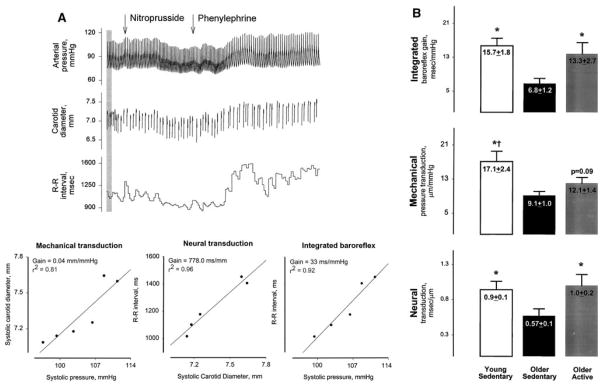
Analysis of vascular and neural components of cardiovagal baroreflex sensitivity in humans. Panel A shown are measurements of arterial pressure, carotid artery diameter, and R-R interval from one subject during nitroprusside- and phenylephrine-induced decreases and increases in arterial pressure, respectively. The calculated slopes of relationships between systolic carotid diameter and systolic pressure (left), R-R interval and systolic diameter (middle), and R-R interval and systolic pressure (right) denote the sensitivity of the mechanical component, neural component, and integrated baroreflex, respectively. Panel B shown are data from young sedentary, older sedentary, and older active subjects. Both mechanical and neural components of the reflex were significantly decreased in the older sedentary group. Baroreflex sensitivity was preserved in active older individuals, an effect attributed primarily to a positive effect of activity on the neural component of the reflex. Reproduced with permission from Hunt et al. 2001 [112, 113]
Fig. 8
Fig. 8
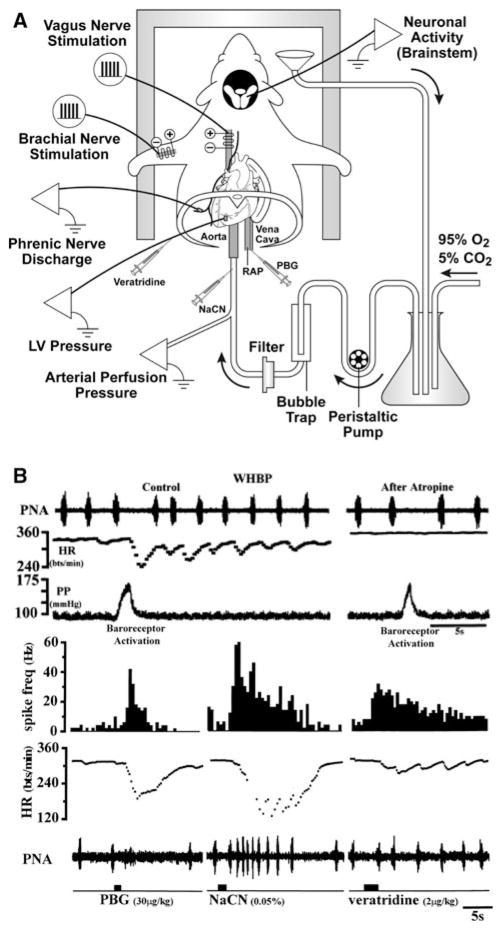
Working heart-brain stem preparation (WHBP). Rats or mice are subjected to subdiaphragmatic transection and decerebration under inhalation anesthesia. The WHBP is placed in a recording chamber, perfused with buffer, and instrumented. Panel A depicted are measurements of arterial perfusion pressure, left ventricular (LV) pressure, right atrial pressure (RAP), phrenic nerve activity, and neuronal activity in brain stem (e.g., nucleus tractus solitarius). The arterial baroreflex is activated by ramp increases in perfusion pressure. Chemical activation left ventricle, pulmonary, and arterial chemoreceptor afferents is achieved by injections of veratridine into the left ventricle, phenylbiguanide into the right atrium, and sodium cyanide into the aorta. The somatic afferent reflex is activated by electrical stimulation of the brachial nerve in the forelimb. HR responses to electrical stimulation of the vagus nerve can also be measured. Panel B shown are HR and phrenic nerve activity (PNA) responses to baroreceptor activation (before and after atropine); and chemical activation of pulmonary C-fibers (phenylbiguanide, PBG), arterial chemoreceptors (sodium cyanide, NaCN), and ventricular receptors (veratridine). Modified from Nalivaiko et al. [124] and Paton [122] and reproduced with permission

References

    1. La Rovere MT, Bigger JT, Jr, Marcus FI, Mortara A, Schwartz PJ for the ATRAMI investigators. Baroreflex sensitivity and heart-rate variability in prediction of total cardiac mortality after myocardial infarction. Lancet. 1998;351:478–484. - PubMed
    1. Rosas-Ballina M, Tracey KJ. Cholinergic control of inflammation. J Intern Med. 2009;265:663–679. - PMC - PubMed
    1. Thayer JF, Lane RD. The role of vagal function in the risk for cardiovascular disease and mortality. Biol Psychol. 2007;74:224–242. - PubMed
    1. Katona PG, Lipson D, Dauchot PJ. Opposing central and peripheral effects of atropine on parasympathetic cardiac control. Am J Physiol Heart. 1977;232:H146–H151. - PubMed
    1. Brodde OE, Bruck H, Leineweber K, Seyfarth T. Presence, distribution and physiological function of adrenergic and muscarinic receptor subtypes in the human heart. Basic Res Cardiol. 2001;96:528–538. - PubMed

Publication types

Substances