


Isolation of mitochondria from the CNS
- PMID: 20578034
- PMCID: PMC2908900
- DOI: 10.1002/0471142301.ns0722s52
Isolation of mitochondria from the CNS
Abstract
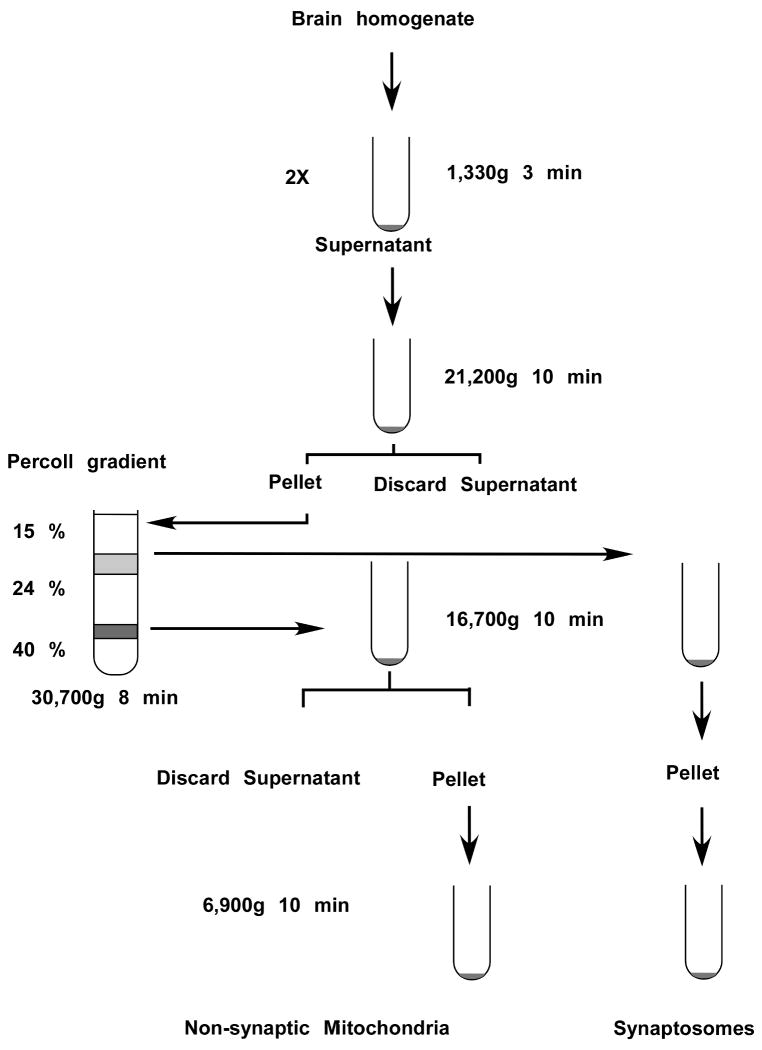
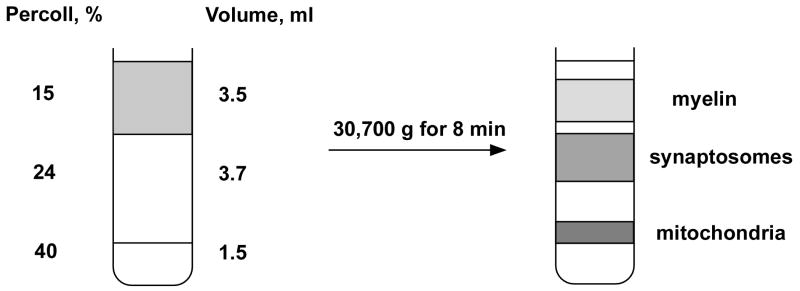
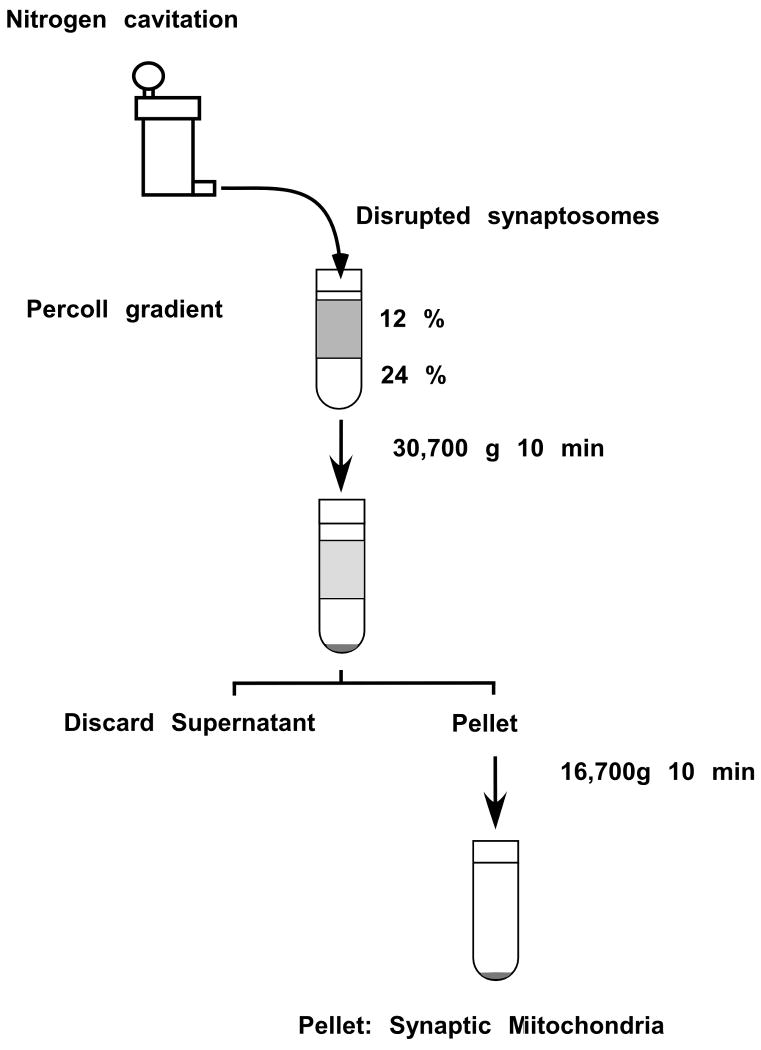
This unit contains a protocol describing the isolation of brain mitochondria by using discontinuous Percoll gradient centrifugation. The Percoll density gradient centrifugation separates synaptosomes, myelin, and free nonsynaptic mitochondria released from cells during tissue homogenization into individual fractions. Mitochondria entrapped in synaptosomes (synaptic mitochondria) can be liberated using nitrogen cavitation and then further purified by Percoll gradient centrifugation. These methods yield mitochondria that exhibit good respiratory coupling and high respiratory rates.
Figures
References
-
- Beal MF. Mitochondria take center stage in aging and neurodegeneration. Ann Neurol. 2005;58:495–505. - PubMed
-
- Booth RF, Clark JB. A method for the rapid separation of soluble and particulate components of rat brain synaptosomes. FEBS Lett. 1979;107:387–392. - PubMed
-
- Brown MR, Sullivan PG, Dorenbos KA, Modafferi EA, Geddes JW, Steward O. Nitrogen disruption of synaptoneurosomes: an alternative method to isolate brain mitochondria. J Neurosci Methods. 2004;137:299–303. - PubMed
-
This paper describes the protocol that uses the nitrogen cavitation to isolate the whole mitochondrial population (non-synaptic and synaptic mitochondria) from brain homogenate.
-
- Brown MR, Sullivan PG, Geddes JW. Synaptic mitochondria are more susceptible to Ca2+overload than nonsynaptic mitochondria. J Biol Chem. 2006;281:11658–11668. - PubMed
MeSH terms
Substances
Grants and funding
LinkOut - more resources
Full Text Sources
Other Literature Sources
