. 2010 Oct 15;116(20):4777-87.
doi: 10.1002/cncr.25292.

Age at diagnosis and the utility of prognostic testing in patients with chronic lymphocytic leukemia

Affiliations

Age at diagnosis and the utility of prognostic testing in patients with chronic lymphocytic leukemia

Tait D Shanafelt et al. Cancer. .

Abstract

Background: A study was undertaken to analyze the survival of chronic lymphocytic leukemia (CLL) patients relative to age-matched individuals in the general population and determine the age-stratified utility of prognostic testing.

Methods: All 2487 patients diagnosed with CLL between January 1995 and June 2008 and cared for in the Mayo Clinic Division of Hematology were categorized by age at diagnosis and evaluated for differences in clinical characteristics, time to first treatment, and overall survival (OS).

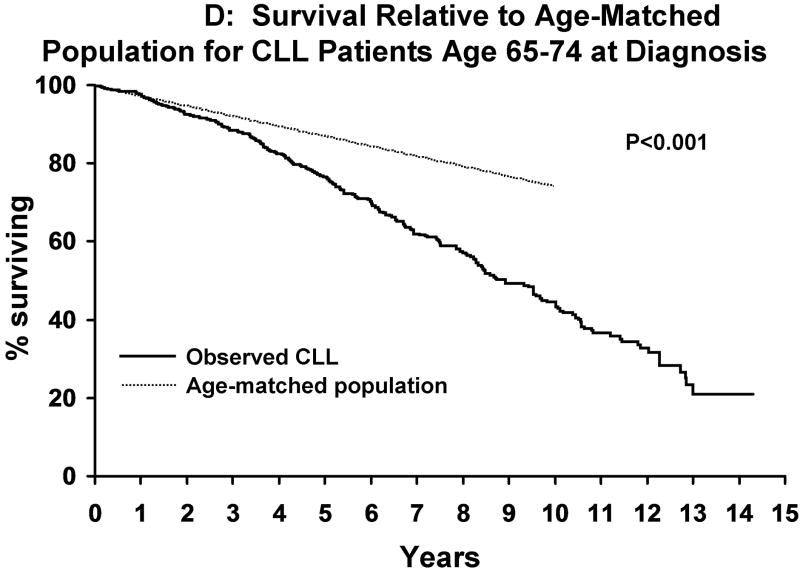
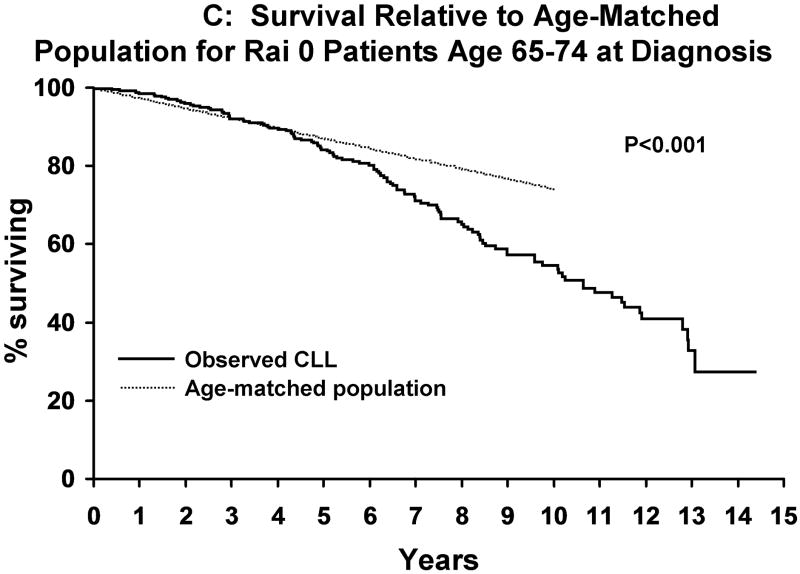
Results: Among Rai stage 0 patients, survival was shorter than the age-matched general population for patients aged <55 years (P < .001), 55 to 64 years (P < .001), and 65 to 74 years (P < .001), but not those aged ≥75 years at diagnosis (P = not significant). CD38, IGHV mutation, and ZAP-70 each predicted time to first treatment independent of stage for all age groups (all P < .04), but had less value for predicting OS, particularly as age increased. IGHV and fluorescent in situ hybridization (FISH) predicted OS independent of stage for patients aged <55 years (P ≤ .001), 55 to 64 years (P ≤ .004), and 65 to 74 years (P ≤ .001), but not those aged ≥75 years. CD38 and ZAP-70 each predicted OS independent of stage for only 2 of 4 age categories. Among Rai 0 patients aged <75 years, survival was shorter than the age-matched population only for IGHV unmutated (P < .001) patients or those with unfavorable FISH (P < .001).

Conclusions: Survival of CLL patients aged <75 years is shorter than the age-matched general population regardless of disease stage. Among patients aged <75 years, the simple combinations of stage and IGHV or stage and FISH identifies those with excess risk of death relative to the age-matched population. Although useful for predicting time to first treatment independent of stage for patients of all ages, prognostic testing had little utility for predicting OS independent of stage among patients aged ≥75 years.


Conflict of interest statement

The authors have no conflicts of interest to declare.

Figures
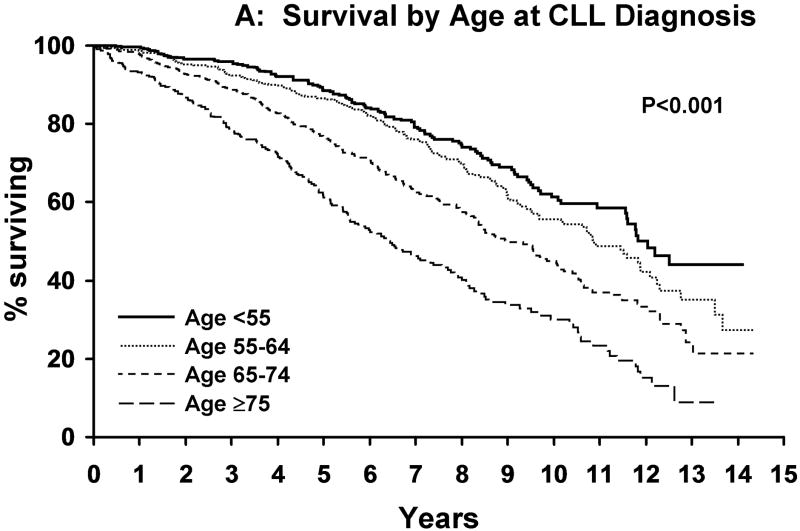
Figure 1
Figure 1. Survival CLL Patients Relative To Age-Matched Individuals
A indicates survival of CLL patients based on age at diagnosis [age <55 (n=593), age 55-64 (n=713), age 65-74 (n=748), age ≥75 (n=433)]. Figure 1B indicates the survival of CLL patients 75 at diagnosis(n=433) relative to the age matched population age >75.
Figure 1
Figure 1. Survival CLL Patients Relative To Age-Matched Individuals
A indicates survival of CLL patients based on age at diagnosis [age <55 (n=593), age 55-64 (n=713), age 65-74 (n=748), age ≥75 (n=433)]. Figure 1B indicates the survival of CLL patients 75 at diagnosis(n=433) relative to the age matched population age >75.
Figure 1
Figure 1. Survival CLL Patients Relative To Age-Matched Individuals
A indicates survival of CLL patients based on age at diagnosis [age <55 (n=593), age 55-64 (n=713), age 65-74 (n=748), age ≥75 (n=433)]. Figure 1B indicates the survival of CLL patients 75 at diagnosis(n=433) relative to the age matched population age >75.
Figure 1
Figure 1. Survival CLL Patients Relative To Age-Matched Individuals
A indicates survival of CLL patients based on age at diagnosis [age <55 (n=593), age 55-64 (n=713), age 65-74 (n=748), age ≥75 (n=433)]. Figure 1B indicates the survival of CLL patients 75 at diagnosis(n=433) relative to the age matched population age >75.
Figure 1
Figure 1. Survival CLL Patients Relative To Age-Matched Individuals
A indicates survival of CLL patients based on age at diagnosis [age <55 (n=593), age 55-64 (n=713), age 65-74 (n=748), age ≥75 (n=433)]. Figure 1B indicates the survival of CLL patients 75 at diagnosis(n=433) relative to the age matched population age >75.
Figure 2
Figure 2. Survival Rai Stage 0 CLL Patients Relative To Age-Matched Individuals
A indicates the survival of Rai 0 CLL patients 75 at diagnosis(n=244) relative to the age matched population age >75.
Figure 2
Figure 2. Survival Rai Stage 0 CLL Patients Relative To Age-Matched Individuals
A indicates the survival of Rai 0 CLL patients 75 at diagnosis(n=244) relative to the age matched population age >75.
Figure 2
Figure 2. Survival Rai Stage 0 CLL Patients Relative To Age-Matched Individuals
A indicates the survival of Rai 0 CLL patients 75 at diagnosis(n=244) relative to the age matched population age >75.
Figure 2
Figure 2. Survival Rai Stage 0 CLL Patients Relative To Age-Matched Individuals
A indicates the survival of Rai 0 CLL patients 75 at diagnosis(n=244) relative to the age matched population age >75.
Figure 3
Figure 3. Survival of Rai 0 Patients Age <75 Relative To Age-Matched Individuals Based on IGHV Mutation Status and Cytogenetic Analysis By FISH
A: Survival of Rai 0, IGHV mutated CLL patients Age <75 (n=344) relative to the age-matched population. Figure 3B: Survival of Rai 0, IGHV unmutated CLL patients Age <75 (n=160) relative to the age-matched population. Figure 3C: Survival of Rai 0, CLL patients Age <75 (n=317) with favorable FISH (no 17p- or 11q-) relative to the age-matched population. Figure 3D: Survival of Rai 0, CLL patients Age <75 (n=27) with unfavorable FISH (e.g. 17p- or 11q-) relative to the age-matched population.
Figure 3
Figure 3. Survival of Rai 0 Patients Age <75 Relative To Age-Matched Individuals Based on IGHV Mutation Status and Cytogenetic Analysis By FISH
A: Survival of Rai 0, IGHV mutated CLL patients Age <75 (n=344) relative to the age-matched population. Figure 3B: Survival of Rai 0, IGHV unmutated CLL patients Age <75 (n=160) relative to the age-matched population. Figure 3C: Survival of Rai 0, CLL patients Age <75 (n=317) with favorable FISH (no 17p- or 11q-) relative to the age-matched population. Figure 3D: Survival of Rai 0, CLL patients Age <75 (n=27) with unfavorable FISH (e.g. 17p- or 11q-) relative to the age-matched population.
Figure 3
Figure 3. Survival of Rai 0 Patients Age <75 Relative To Age-Matched Individuals Based on IGHV Mutation Status and Cytogenetic Analysis By FISH
A: Survival of Rai 0, IGHV mutated CLL patients Age <75 (n=344) relative to the age-matched population. Figure 3B: Survival of Rai 0, IGHV unmutated CLL patients Age <75 (n=160) relative to the age-matched population. Figure 3C: Survival of Rai 0, CLL patients Age <75 (n=317) with favorable FISH (no 17p- or 11q-) relative to the age-matched population. Figure 3D: Survival of Rai 0, CLL patients Age <75 (n=27) with unfavorable FISH (e.g. 17p- or 11q-) relative to the age-matched population.
Figure 3
Figure 3. Survival of Rai 0 Patients Age <75 Relative To Age-Matched Individuals Based on IGHV Mutation Status and Cytogenetic Analysis By FISH
A: Survival of Rai 0, IGHV mutated CLL patients Age <75 (n=344) relative to the age-matched population. Figure 3B: Survival of Rai 0, IGHV unmutated CLL patients Age <75 (n=160) relative to the age-matched population. Figure 3C: Survival of Rai 0, CLL patients Age <75 (n=317) with favorable FISH (no 17p- or 11q-) relative to the age-matched population. Figure 3D: Survival of Rai 0, CLL patients Age <75 (n=27) with unfavorable FISH (e.g. 17p- or 11q-) relative to the age-matched population.

References

    1. Jemal A, Siegel R, Ward E, et al. Cancer statistics, 2009. CA Cancer J Clin. 2009;59:225–49. - PubMed
    1. Diehl LF, Karnell LH, Menck HR The American College of Surgeons Commission on Cancer and the American Cancer Society. The National Cancer Data Base report on age, gender, treatment, and outcomes of patients with chronic lymphocytic leukemia. Cancer. 1999;86:2684–92. - PubMed
    1. Call T, Phyilky R, Noel P, et al. Incidence of chronic lymphocytic leukemia in Olmsted County, Minnesota, 1935 through 1989, with emphasis on changes in initial stage at diagnosis. Mayo Clinic Proceedings. 1994;69:323–328. - PubMed
    1. Rozman C, Bosch F, Montserrat E. Chronic lymphocytic leukemia: a changing natural history? Leukemia. 1997;11:775–778. - PubMed
    1. Molica S, Levato D. What is changing in the natural history of chronic lymphocytic leukemia. Haematologica. 2001;86:8–12. - PubMed

Publication types