


Do proton pump inhibitors decrease calcium absorption?
- PMID: 20578215
- PMCID: PMC3179281
- DOI: 10.1002/jbmr.166
Do proton pump inhibitors decrease calcium absorption?
Erratum in
- J Bone Miner Res. 2011 Feb;26(2):439
Abstract
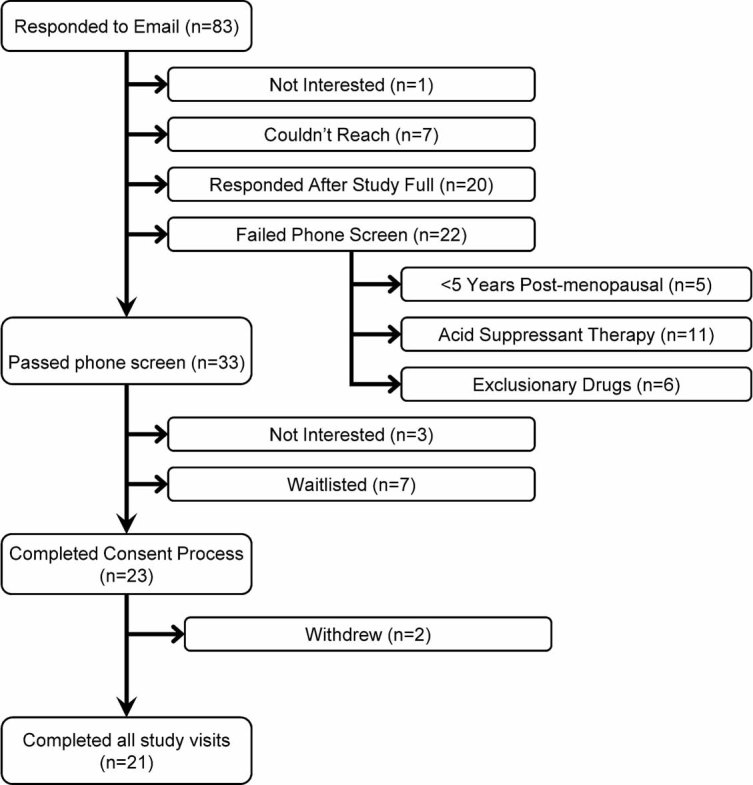
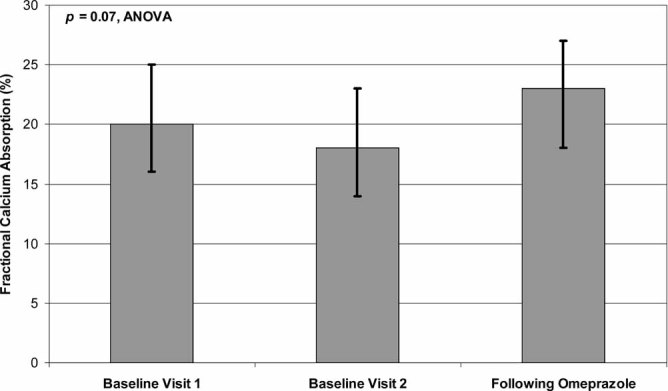
Proton pump inhibitors (PPIs) increase osteoporotic fracture risk presumably via hypochlorhydria and consequent reduced fractional calcium absorption (FCA). Existing studies provide conflicting information regarding the direct effects of PPIs on FCA. We evaluated the effect of PPI therapy on FCA. We recruited women at least 5 years past menopause who were not taking acid suppressants. Participants underwent three 24-hour inpatient FCA studies using the dual stable isotope method. Two FCA studies were performed 1 month apart to establish baseline calcium absorption. The third study occurred after taking omeprazole (40 mg/day) for 30 days. Each participant consumed the same foods during all FCA studies; study meals replicated subjects' dietary habits based on 7-day diet diaries. Twenty-one postmenopausal women ages 58 ± 7 years (mean ± SD) completed all study visits. Seventeen women were white, and 2 each were black and Hispanic. FCA (mean ± SD) was 20% ± 10% at visit 1, 18% ± 10% at visit 2, and 23% ± 10% following 30 ± 3 days of daily omeprazole (p = .07, ANOVA). Multiple linear regression revealed that age, gastric pH, serum omeprazole levels, adherence to omeprazole, and 25-hydroxyvitamin D levels were unrelated to changes in FCA between study visits 2 and 3. The 1,25-dihydroxyvitamin D(3) level at visit 2 was the only variable (p = .049) associated with the change in FCA between visits 2 and 3. PPI-associated hypochlorhydria does not decrease FCA following 30 days of continuous use. Future studies should focus on identifying mechanisms by which PPIs increase the risk of osteoporotic fracture.
Copyright © 2010 American Society for Bone and Mineral Research.
Figures
References
-
- Vestergaard P, Rejnmark L, Mosekilde L. Proton pump inhibitors, histamine H2 receptor antagonists, and other antacid medications and the risk of fracture. Calcif Tissue Int. 2006;79:76–83. - PubMed
-
- Yang YX, Lewis JD, Epstein S, et al. Long-term proton pump inhibitor therapy and risk of hip fracture. JAMA. 2006;296:2947–2953. - PubMed
-
- de Vries F, Cooper AL, Cockle SM, van Staa TP, Cooper C. Fracture risk in patients receiving acid-suppressant medication alone and in combination with bisphosphonates. Osteoporos Int. 2009;20:1989–1998. - PubMed
Publication types
MeSH terms
Substances
Grants and funding
LinkOut - more resources
Full Text Sources
Medical
Miscellaneous
