Review
. 2010 Sep;224(3):626-35.
doi: 10.1002/jcp.22196.

Divergent molecular mechanisms underlying the pleiotropic functions of macrophage inhibitory cytokine-1 in cancer

Affiliations
Review

Divergent molecular mechanisms underlying the pleiotropic functions of macrophage inhibitory cytokine-1 in cancer

Murielle Mimeault et al. J Cell Physiol. 2010 Sep.

Abstract

Multifunctional macrophage inhibitory cytokine-1, MIC-1, is a member of the transforming growth factor-beta (TGF-beta) superfamily that plays key roles in the prenatal development and regulation of the cellular responses to stress signals and inflammation and tissue repair after acute injuries in adult life. The stringent control of the MIC-1 expression, secretion, and functions involves complex regulatory mechanisms and the interplay of other growth factor signaling networks that control the cell behavior. The deregulation of MIC-1 expression and signaling pathways has been associated with diverse human diseases and cancer progression. The MIC-1 expression levels substantially increase in cancer cells, serum, and/or cerebrospinal fluid during the progression of diverse human aggressive cancers, such as intracranial brain tumors, melanoma, and lung, gastrointestinal, pancreatic, colorectal, prostate, and breast epithelial cancers. Of clinical interest, an enhanced MIC-1 expression has been positively correlated with poor prognosis and patient survival. Secreted MIC-1 cytokine, like the TGF-beta prototypic member of the superfamily, may provide pleiotropic roles in the early and late stages of carcinogenesis. In particular, MIC-1 may contribute to the proliferation, migration, invasion, metastases, and treatment resistance of cancer cells as well as tumor-induced anorexia and weight loss in the late stages of cancer. Thus, secreted MIC-1 cytokine constitutes a new potential biomarker and therapeutic target of great clinical interest for the development of novel diagnostic and prognostic methods and/or cancer treatment against numerous metastatic, recurrent, and lethal cancers.


Conflict of interest statement

The authors declare no conflict of interest.

Figures
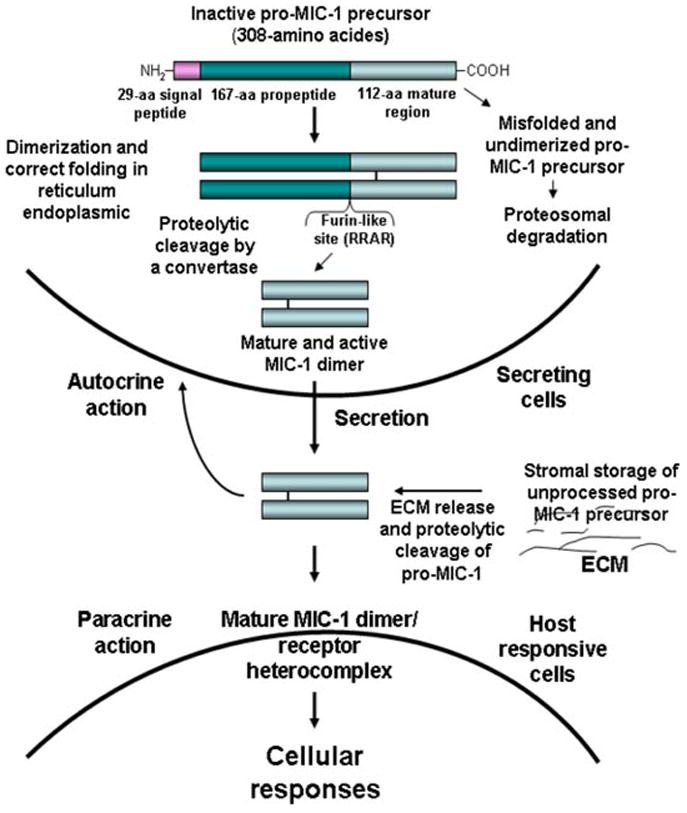
Fig. 1
Fig. 1
Molecular mechanisms associated with the cellular MIC-1 processing, secretion, storage, and its autocrine and paracrine actions. The scheme shows the molecular mechanisms associated with the cellular processing of inactive pro-MIC-1 precursor via the formation of dimeric molecules followed by their proteolytic cleavage at a furin-like site catalyzed by a convertase in reticulum endoplasmic, which results in there lease of N-terminal propeptide and C-terminal fragment constituting the mature and active form. The secretion of dimeric MIC-1 protein into extracellular compartment as well as the storage of unprocessed pro-MIC-1 precursor in extracellular matrix (ECM) is also shown. The potential autocrine or paracrine actions of mature MIC-1 dimer on secreting and neighboring responsive cells are also illustrated. [Color figure can be viewed in the online issue, which is available at www.interscience.wiley.com.]
Fig. 2
Fig. 2
Cellular events and signaling elements involved in the regulation of the MIC-1 expression levels. The increase of MIC-1 expression induced via cellular stress signals, light signal, inflammation, cancer progression, and chemotherapeutic drugs is indicated. The potential cellular signaling elements involved in the regulation of MIC-1 expression as well as the cells expressing high levels of MIC-1, such as activated macrophage, normal cells, cancer cells, and tumor host cells are also shown. The potential to assess the increase of MIC concentration in serum or cerebrospinal fluid as diagnostic and prognostic biomarkers of cancers and the molecular targeting of MIC-1 for improving the current cancer treatment is also indicated. α-DHT, α-dihydrotestosterone; H2O2, hydrogen peroxide; HIF-α1, hypoxia inducible factor-α1; IL, interleukin; MIC-1, macrophage inhibitory cytokine-1; NF-κB, nuclear factor-κB; TGF-β, transforming growth factor-β; TNF-α, tumor necrosis factor-α. [Color figure can be viewed in the online issue, which is available at www.interscience.wiley.com.]
Fig. 3
Fig. 3
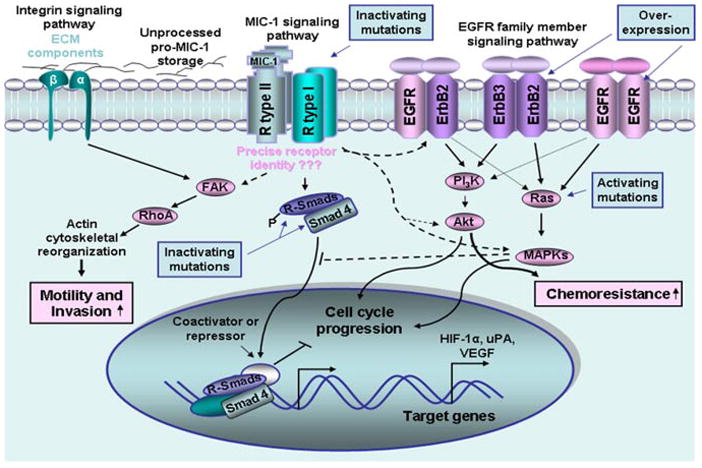
Potential signal transduction mechanisms involved in the mediation of cellular responses induced by secreted MIC-1 cytokine in certain cancer cells. The scheme shows the potential signaling transduction elements mediating the cellular responses induced by MIC-1 in certain cancer cell types and interactive cross-talks with other oncogenic signaling pathways. In analogy with other TGF-β superfamily members, MIC-1 can interact with type I and II receptor serine/threonine kinases, which remain to be identified more precisely in a given cell type. Thereby, MIC-1 can induce the formation of heteromeric receptor complex that, in turn, may stimulate different R-Smad proteins by phosphorylation and their association with their Smad4 co-partner. The R-Smad/Smad4 complexes may translocate to the nucleus, where they may participate in co-operation with other factors, such as co-activators or co-repressors, in the transcriptional regulation of the expression of gene products that mediate specific cellular responses. Moreover, MIC-1 can also induce its cellular effects through the stimulation of other signaling elements and cross-talks with intracellular pathways initiated by distinct growth factors. Particularly, the activation of the EGFR family members, EGFR, ErbB2, and ErbB3 via their phosphorylation which can be induced by MIC-1, is shown. The activation of the FAK/RhoA, PI3K/Akt, and MAPK signaling elements induced by MIC-1, which may contribute to the acquisition of more malignant behavior by cancer cells, including an increase in their migratory and invasive abilities, is also illustrated. In addition, the frequent deregulations in the MIC-1 signaling network that may promote its oncogenic effects are also indicated. Moreover, the cytoprotective effect induced by MIC-1 via the stimulation of the PI3K/Akt survival pathway, which may contribute to the resistance of certain cancer cell types, to current chemotherapeutic treatment is also indicated. EGFR, epidermal growth factor receptor; FAK, focal adhesion kinase; HIF-1α, hypoxia inducible factor-1α; MAPK, mitogen-activated protein kinase; PI3K, phosphatidylinositol 3′ kinase; R-Smads, receptor regulated Smads; VEGF, vascular endothelial growth factor; uPA, urokinase type-plasminogen activator. [Color figure can be viewed in the online issue, which is available at www.interscience.wiley.com.]

References

    1. Ago T, Kuroda J, Pain J, Fu C, Li H, Sadoshima J. Upregulation of Nox4 by hypertrophic stimuli promotes apoptosis and mitochondrial dysfunction in cardiac myocytes. Circ Res. 2010;106:1253–1264. - PMC - PubMed
    1. Akiyama M, Okano K, Fukada Y, Okano T. Macrophage inhibitory cytokine MIC-1 is upregulated by short-wavelength light in cultured normal human dermal fibroblasts. FEBS Lett. 2009;583:933–937. - PubMed
    1. Albertoni M, Shaw PH, Nozaki M, Godard S, Tenan M, Hamou MF, Fairlie DW, Breit SN, Paralkar VM, de Tribolet N, Van Meir EG, Hegi ME. Anoxia induces macrophage inhibitory cytokine-1 (MIC-1) in glioblastoma cells independently of p53 and HIF-1. Oncogene. 2002;21:4212–4219. - PubMed
    1. Baek SJ, Kim KS, Nixon JB, Wilson LC, Eling TE. Cyclooxygenase inhibitors regulate the expression of a TGF-beta superfamily member that has proapoptotic and antitumorigenic activities. Mol Pharmacol. 2001;59:901–908. - PubMed
    1. Baek SJ, Kim JS, Moore SM, Lee SH, Martinez J, Eling TE. Cyclooxygenase inhibitors induce the expression of the tumor suppressor gene EGR-1, which results in the up-regulation of NAG-1, an antitumorigenic protein. Mol Pharmacol. 2005;67:356–364. - PubMed

Publication types

MeSH terms

Substances

LinkOut - more resources