. 2010 Jun 26:9:167.
doi: 10.1186/1476-4598-9-167.

Methylation-mediated silencing and tumour suppressive function of hsa-miR-124 in cervical cancer

Affiliations

Methylation-mediated silencing and tumour suppressive function of hsa-miR-124 in cervical cancer

Saskia M Wilting et al. Mol Cancer. .

Abstract

Background: A substantial number of microRNAs (miRNAs) is subject to epigenetic silencing in cancer. Although epigenetic silencing of tumour suppressor genes is an important feature of cervical cancer, little is known about epigenetic silencing of miRNAs. Since DNA methylation-based silencing of hsa-miR-124 occurs in various human cancers, we studied the frequency and functional effects of hsa-miR-124 methylation in cervical carcinogenesis.

Results: Quantitative MSP analysis of all 3 loci encoding the mature hsa-miR-124 (hsa-miR-124-1/-2/-3) showed methylation in cervical cancer cell lines SiHa, CaSki and HeLa as well as in late passages of human papillomavirus (HPV) type 16 or 18 immortalised keratinocytes. Treatment of SiHa cells with a demethylating agent reduced hsa-miR-124 methylation levels and induced hsa-miR-124 expression. In HPV-immortalised keratinocytes increased methylation levels were related to reduced hsa-miR-124 expression and higher mRNA expression of IGFBP7, a potential hsa-miR-124 target gene. Ectopic hsa-miR-124 expression in SiHa and CaSki cells decreased proliferation rates and migratory capacity. Combined hsa-miR-124-1 and/or hsa-miR-124-2 methylation analysis of 139 cervical tissue specimens showed an increasing methylation frequency from 0% in normal tissues up to 93% in cervical carcinomas. Increased methylation levels of hsa-miR-124-1 and hsa-miR-124-2 were significantly correlated with reduced hsa-miR-124 expression in cervical tissue specimens. Combined hsa-miR-124-1 and/or hsa-miR-124-2 methylation analysis of 43 cervical scrapes of high-risk HPV positive women was predictive of underlying high-grade lesions.

Conclusions: DNA methylation-based silencing of hsa-miR-124 is functionally involved in cervical carcinogenesis and may provide a valuable marker for improved detection of cervical cancer and its high-grade precursor lesions.


Figures
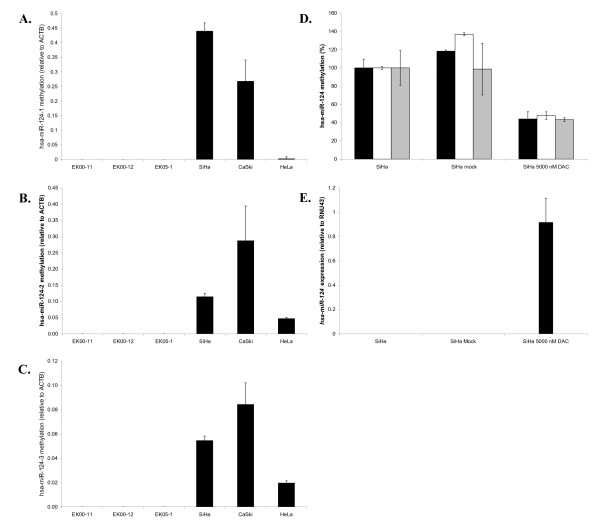
Figure 1
Figure 1
Hsa-miR-124 methylation in primary keratinocytes (EK cells) and cervical cancer cell lines SiHa, CaSki and HeLa. A. hsa-miR-124-1 methylation, B. hsa-miR-124-2 methylation, C. hsa-miR-124-3 methylation. Whereas in primary keratinocytes no methylation was detectable, all cervical cancer cell lines were positive for methylation of hsa-miR-124-1, hsa-miR-124-2 and hsa-miR-124-3. D. In SiHa cells treated with 5000 nM DAC, methylation levels of hsa-miR-124-1 (black), hsa-miR-124-2 (white) and hsa-miR-124-3 (grey) were reduced by more than 50%. Methylation levels of all regions in untreated cells were set to 100%. E. Whereas in untreated and mock (PBS) treated SiHa cells no hsa-miR-124 expression was detectable, SiHa cells treated with 5000 nM DAC showed clear hsa-miR-124 expression.
Figure 2
Figure 2
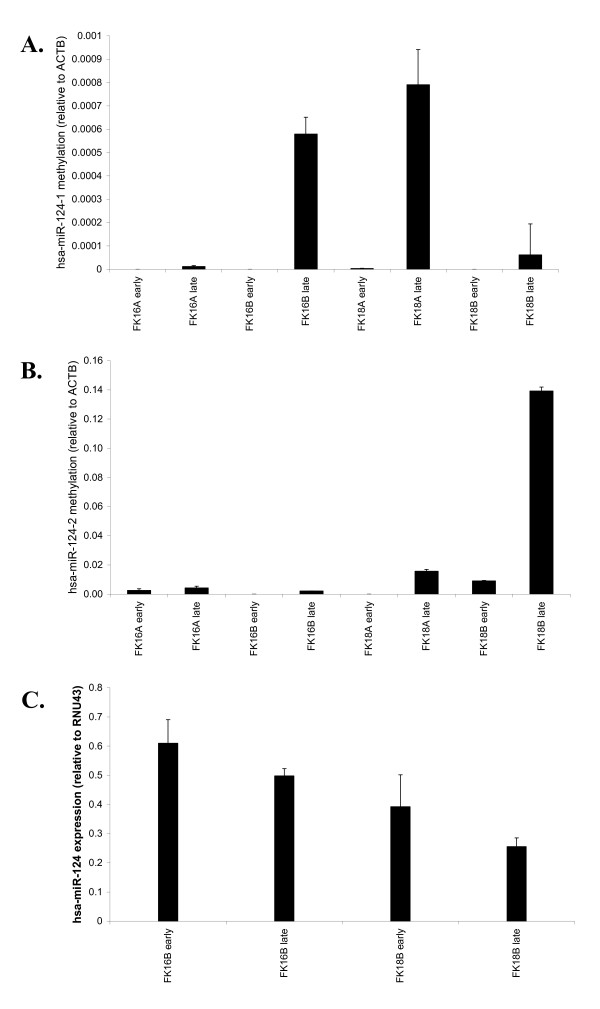
Hsa-miR-124 methylation and expression in early and late passages of HPV16 (FK16A/FK16B) and 18 (FK18A/FK18B) immortalised keratinocytes. A. hsa-miR-124-1, B. hsa-miR-124-2. Both hsa-miR124-1 and hsa-miR-124-2 showed little to no methylation in early passages and increasing levels of methylation in later passages of HPV16 and HPV18 immortalised cells. Note the difference in scales of Figure 2A and 2B. Levels of hsa-miR-124-1 methylation in HPV-immortalised keratinocytes are very low compared to the levels seen in cervical cancer cell lines (Figure 1A). No methylation of hsa-miR-124-3 was found in HPV-immortalised keratinocytes. C. Late passages of FK16B and FK18B cells showed reduced expression of hsa-miR-124 compared to their corresponding earlier passages.
Figure 3
Figure 3
Ectopic expression of hsa-miR-124 in SiHa and CaSki cells. A. Whereas parental cell lines and empty vector control cells (SiHa_ctrl and CaSki_ctrl) showed no detectable expression of hsa-miR-124, cells transduced with hsa-miR-124 (SiHa_miR-124 and CaSki_miR-124) expressed hsa-miR-124. Ectopic hsa-miR-124 expression resulted in decreased proliferation rates of B. SiHa_miR-124 (red) and C. CaSki_miR-124 (red) compared to parental (black) and empty vector control cells (grey). In D. results of wound-healing assays in SiHa_miR-124, SiHa_ctrl and SiHa cells are shown, indicating decreased migratory capacity in cells expressing hsa-miR-124.
Figure 4
Figure 4
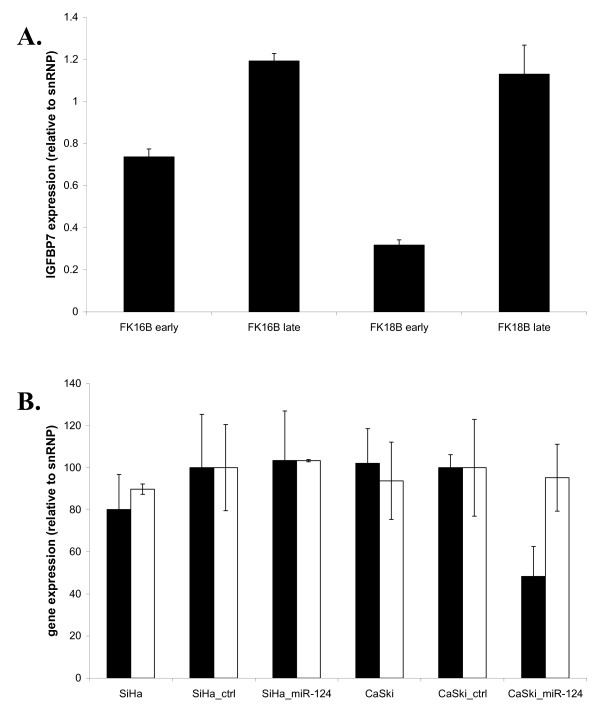
IGFBP7 and SLC25A36 expression in HPV-immortalised cells and cervical cancer cells transduced with hsa-miR-124. A. Expression levels of IGFBP7, a potential target gene of hsa-miR-124, were increased in late passages of FK16B and FK18B cells, also showing increased methylation of hsa-miR-124, compared to their corresponding early passages. B. Effects of ectopic hsa-miR-124 expression on mRNA expression of IGFBP7 (grey bars) in SiHa and CaSki cells. Expression of SLC25A36 (white bars), a gene without an hsa-miR-124 target site, was also determined as a control. Expression in CaSki_ctrl and SiHa_ctrl was set to 100%, respectively. Results from 3 independent experiments showed that IGFBP7 expression was decreased in CaSki_miR-124 but not in SiHa_miR-124 cells compared to their parental and empty vector control cell lines. Expression of SLC25A36 was similar in cells with and without ectopic hsa-miR-124 expression.
Figure 5
Figure 5
Hsa-miR-124 methylation levels in cervical specimens. Dotplots showing the levels of methylation for A. hsa-miR-124-1, B. hsa-miR-124-2 and C. hsa-miR-124-3 in normal cervical specimens, CIN1 lesions, CIN3 lesions, SCCs and AdCAs. Methylation levels in cervical scrapes of women with normal cytology without underlying CIN and women with abnormal cytology with underlying CIN3 lesions are shown in D. for hsa-miR-124-1, E. for hsa-miR-124-2 and F. for hsa-miR-124-3.
Figure 6
Figure 6
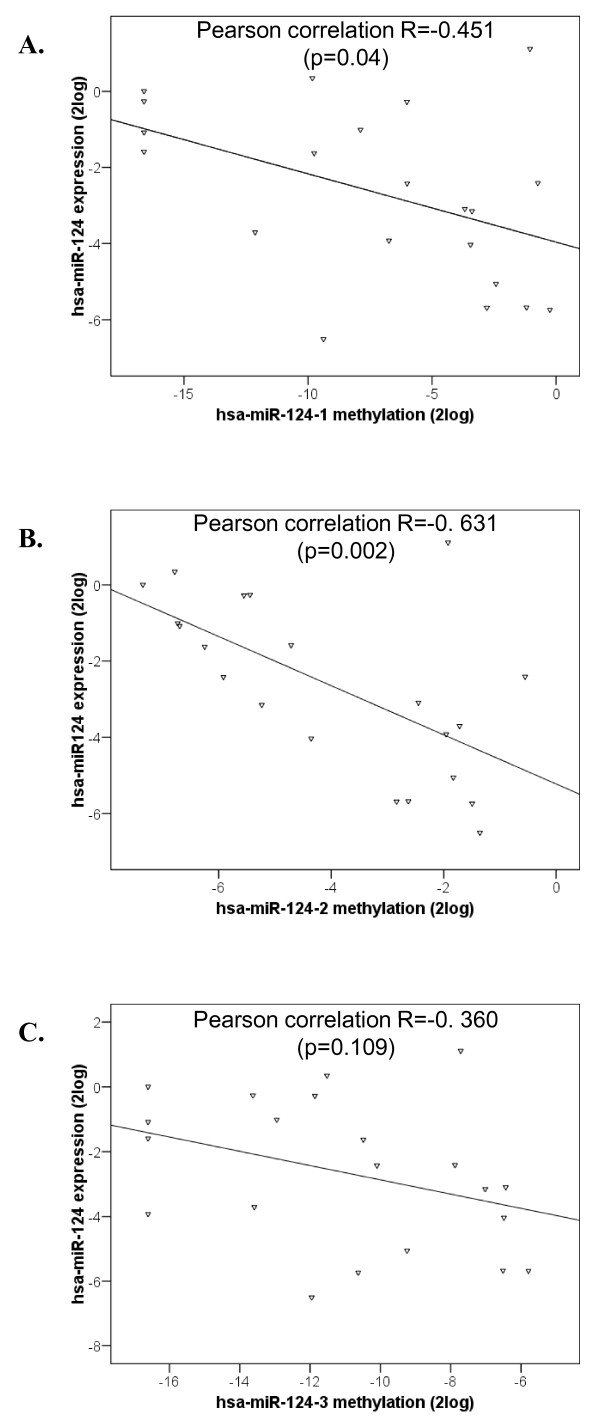
Correlation between hsa-miR-124 methylation and expression in cervical tissue specimens. The overall correlation between A. hsa-miR-124-1, B. hsa-miR-124-2 and C. hsa-miR-124-3 methylation levels and hsa-miR-124 expression in CIN2/3 lesions, SCCs and AdCAs is shown.

References

    1. Fu Y, Reagan J. Pathology of the uterine cervix, vagina and vulva. Philadelphia: W.B. Saunders and Co; 1989. pp. 288–335.
    1. Pisani P, Bray F, Parkin DM. Estimates of the world-wide prevalence of cancer for 25 sites in the adult population. Int J Cancer. 2002;97:72–81. doi: 10.1002/ijc.1571. - DOI - PubMed
    1. Walboomers JM, Jacobs MV, Manos MM, Bosch FX, Kummer JA, Shah KV, Snijders PJ, Peto J, Meijer CJ, Munoz N. Human papillomavirus is a necessary cause of invasive cervical cancer worldwide. J Pathol. 1999;189:12–19. doi: 10.1002/(SICI)1096-9896(199909)189:1<12::AID-PATH431>3.0.CO;2-F. - DOI - PubMed
    1. Garland SM, Hernandez-Avila M, Wheeler CM, Perez G, Harper DM, Leodolter S, Tang GW, Ferris DG, Steben M, Bryan J. Quadrivalent vaccine against human papillomavirus to prevent anogenital diseases. N Engl J Med. 2007;356:1928–1943. doi: 10.1056/NEJMoa061760. - DOI - PubMed
    1. Heideman D, Snijders P, Berkhof J, Verheijen RH, Helmerhorst T, Meijer C. Vaccination against HPV: indications for women and the impact on the cervical screening programme. BJOG. 2008;115:938–946. doi: 10.1111/j.1471-0528.2008.01779.x. - DOI - PubMed

Publication types

Substances