


Cortical gamma-oscillations modulated by visuomotor tasks: Intracranial recording in patients with epilepsy
- PMID: 20580900
- PMCID: PMC2952170
- DOI: 10.1016/j.yebeh.2010.02.015
Cortical gamma-oscillations modulated by visuomotor tasks: Intracranial recording in patients with epilepsy
Abstract
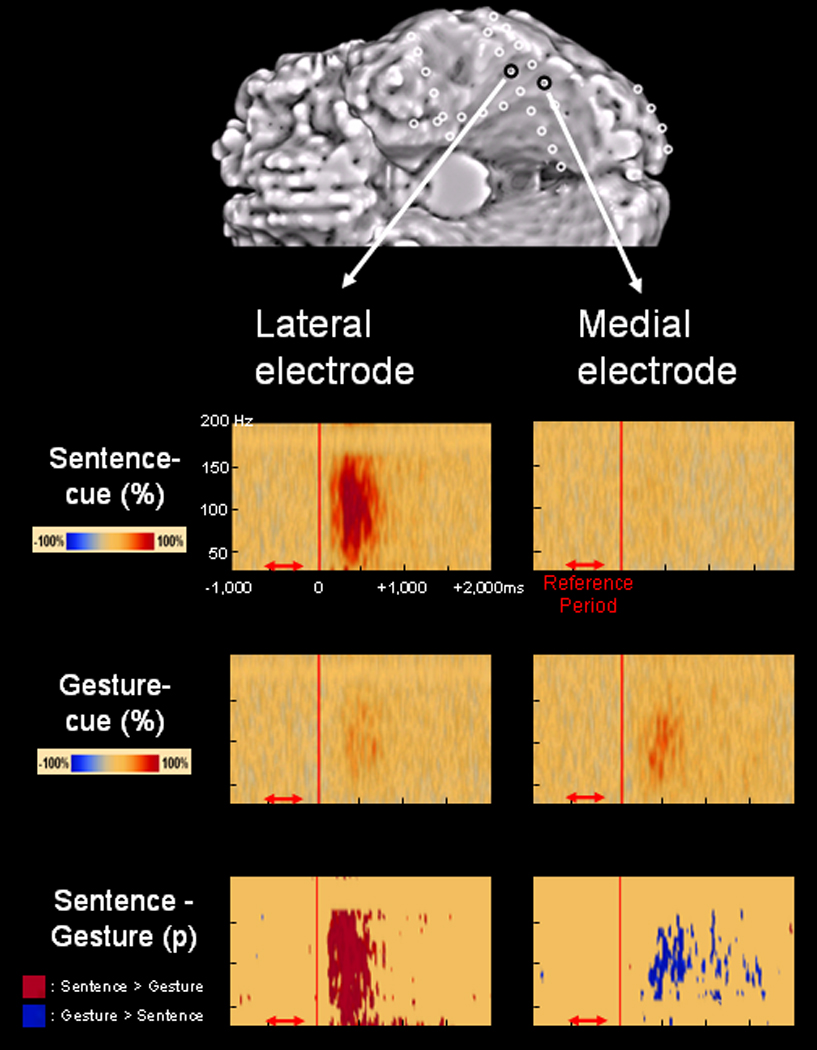
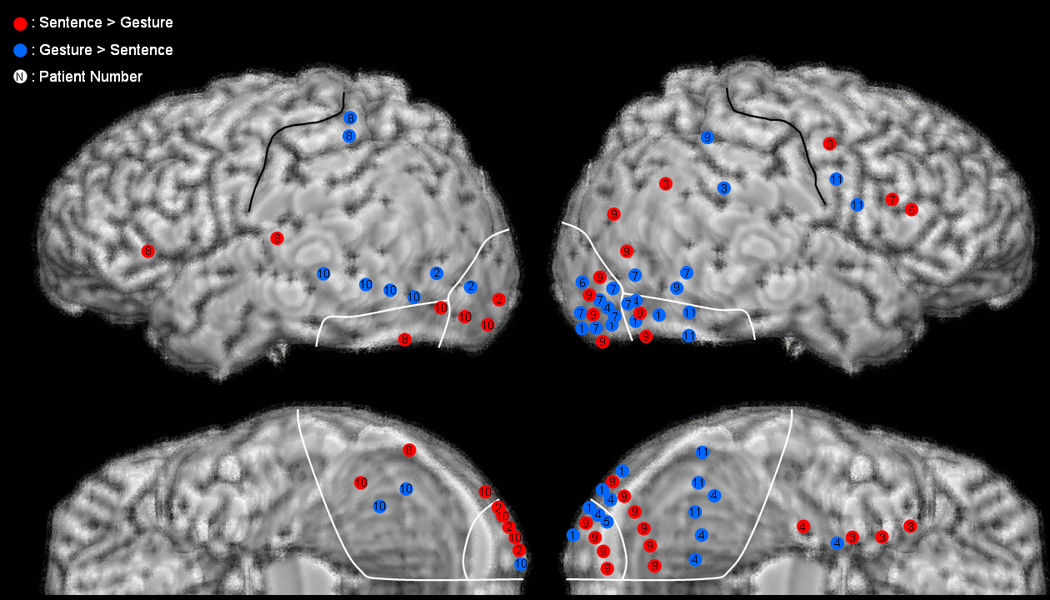
We determined how visuomotor tasks modulated gamma-oscillations on electrocorticography in epileptic patients who underwent epilepsy surgery. Each visual-cue consisted of either a sentence or hand gesture instructing the subject to press or not to press the button. Regardless of the recorded hemisphere, viewing sentence and gesture cues elicited gamma-augmentation sequentially in the lateral-polar occipital and inferior occipital-temporal areas; subsequently, button-press movement elicited gamma-augmentation in the Rolandic area. The magnitudes of gamma-augmentation in the Rolandic and inferior occipital-temporal areas were larger when the hand contralateral to the recorded hemisphere was used for motor responses. A double dissociation was found in the left inferior occipital-temporal cortex in one subject; the lateral portion had greater gamma-augmentation elicited by a sentence-cue, whereas the medial portion had greater gamma-augmentation elicited by a gesture-cue. The present study has increased our understanding of the physiology of the human visuomotor system.
Copyright 2010 Elsevier Inc. All rights reserved.
Figures
References
-
- Crone NE, Miglioretti DL, Gordon B, Lesser RP. Functional mapping of human sensorimotor cortex with electrocorticographic spectral analysis. II. Event-related synchronization in the gamma band. Brain. 1998;121:2301–2315. - PubMed
-
- Aoki F, Fetz EE, Shupe L, Lettich E, Ojemann GA. Increased gamma-range activity in human sensorimotor cortex during performance of visuomotor tasks. Clin Neurophysiol. 1999;110:524–537. - PubMed
-
- Gonzalez SL, Grave de Peralta R, Thut G, Millán Jdel R, Morier P, Landis T. Very high frequency oscillations (VHFO) as a predictor of movement intentions. Neuroimage. 2006;32:170–179. - PubMed
