


Effectiveness of web-based interventions on patient empowerment: a systematic review and meta-analysis
- PMID: 20581001
- PMCID: PMC2956234
- DOI: 10.2196/jmir.1286
Effectiveness of web-based interventions on patient empowerment: a systematic review and meta-analysis
Abstract
Background: Patient empowerment is growing in popularity and application. Due to the increasing possibilities of the Internet and eHealth, many initiatives that are aimed at empowering patients are delivered online.
Objective: Our objective was to evaluate whether Web-based interventions are effective in increasing patient empowerment compared with usual care or face-to-face interventions.
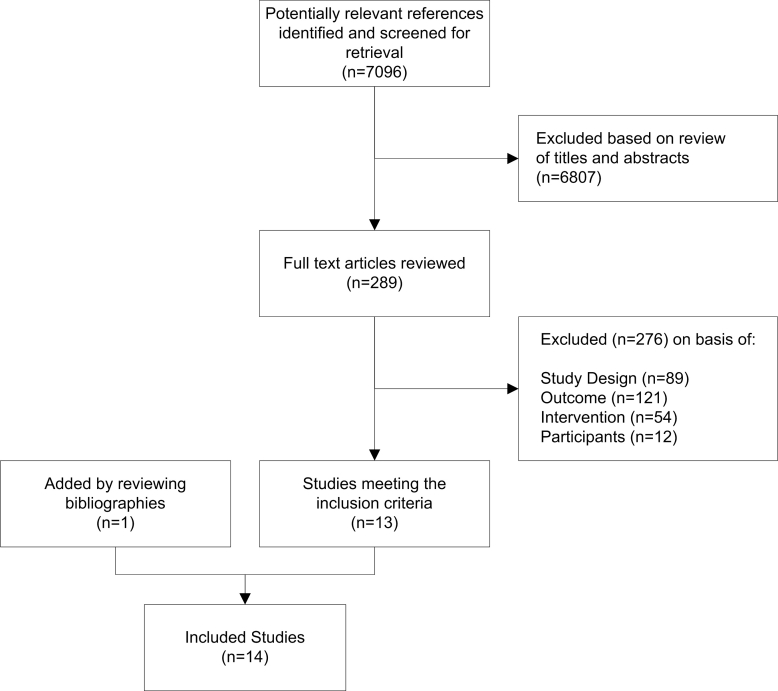
Methods: We performed a systematic review by searching the MEDLINE, EMBASE, and PsycINFO databases from January 1985 to January 2009 for relevant citations. From the 7096 unique citations retrieved from the search strategy, we included 14 randomized controlled trials (RCTs) that met all inclusion criteria. Pairs of review authors assessed the methodological quality of the obtained studies using the Downs and Black checklist. A meta-analysis was performed on studies that measured comparable outcomes. The GRADE approach was used to determine the level of evidence for each outcome.
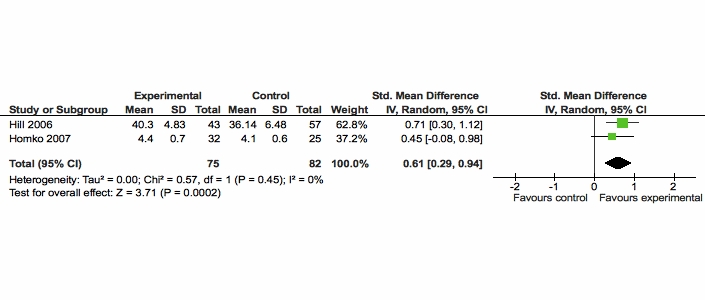
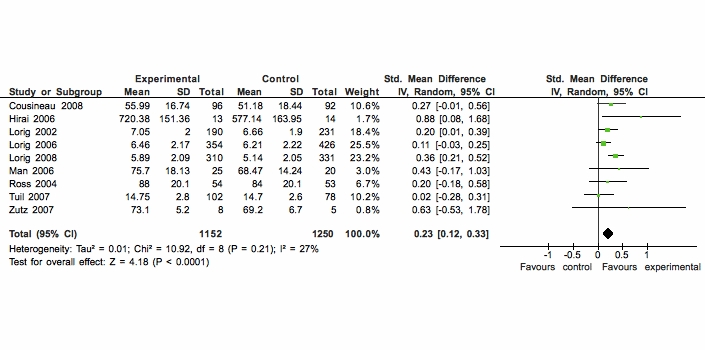
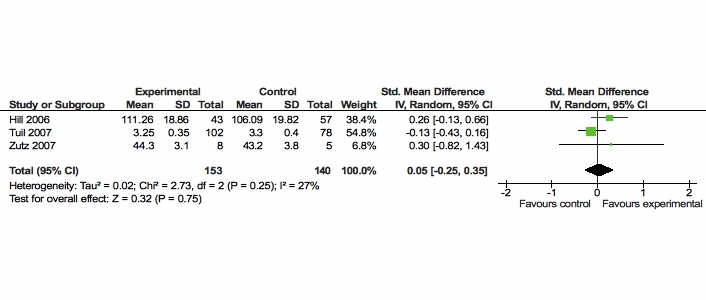
Results: In comparison with usual care or no care, Web-based interventions had a significant positive effect on empowerment measured with the Diabetes Empowerment Scale (2 studies, standardized mean difference [SMD] = 0.61, 95% confidence interval [CI] 0.29 - 0.94]), on self-efficacy measured with disease-specific self-efficacy scales (9 studies, SMD = 0.23, 95% CI 0.12 - 0.33), and on mastery measured with the Pearlin Mastery Scale (1 study, mean difference [MD] = 2.95, 95% CI 1.66 - 4.24). No effects were found for self-efficacy measured with general self-efficacy scales (3 studies, SMD = 0.05, 95% CI -0.25 to 0.35) or for self-esteem measured with the Rosenberg Self-Esteem Scale (1 study, MD = -0.38, 95% CI -2.45 to 1.69). Furthermore, when comparing Web-based interventions with face-to-face deliveries of the same interventions, no significant (beneficial or harmful) effects were found for mastery (1 study, MD = 1.20, 95% CI -1.73 to 4.13) and self-esteem (1 study, MD = -0.10, 95% CI -0.45 to 0.25).
Conclusions: Web-based interventions showed positive effects on empowerment measured with the Diabetes Empowerment Scale, disease-specific self-efficacy scales and the Pearlin Mastery Scale. Because of the low quality of evidence we found, the results should be interpreted with caution. The clinical relevance of the findings can be questioned because the significant effects we found were, in general, small.
Conflict of interest statement
None declared
Figures
References
-
- Bruegel R B. Patient empowerment--a trend that matters. J AHIMA. 1998 Sep;69(8):30–3; quiz 35-6. - PubMed
-
- Harris R, Veinot T. The Empowerment Model and Using E-Health to Distribute Information. Vancouver, BC: Action for Health, Simon Fraser University and the Vancouver Coastal Health Research Institute; 2004.
-
- Neuhauser Duncan. The coming third health care revolution: personal empowerment. Qual Manag Health Care. 2003;12(3):171–84; discussion 185-6. - PubMed
Publication types
MeSH terms
LinkOut - more resources
Full Text Sources
Medical
Miscellaneous
