


Airway epithelial NF-κB activation promotes allergic sensitization to an innocuous inhaled antigen
- PMID: 20581095
- PMCID: PMC3095983
- DOI: 10.1165/rcmb.2010-0106OC
Airway epithelial NF-κB activation promotes allergic sensitization to an innocuous inhaled antigen
Abstract
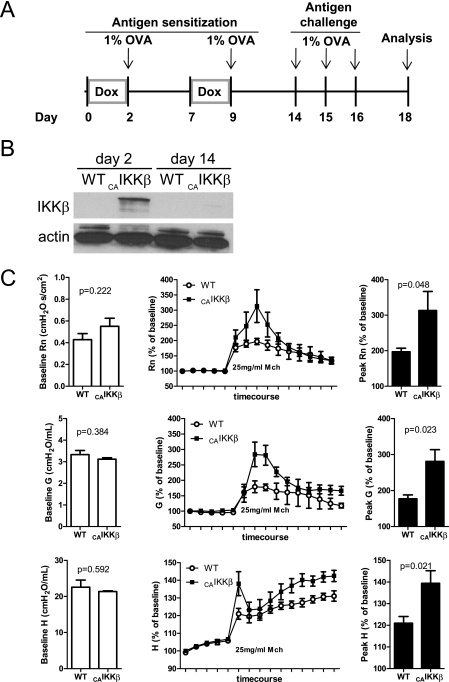
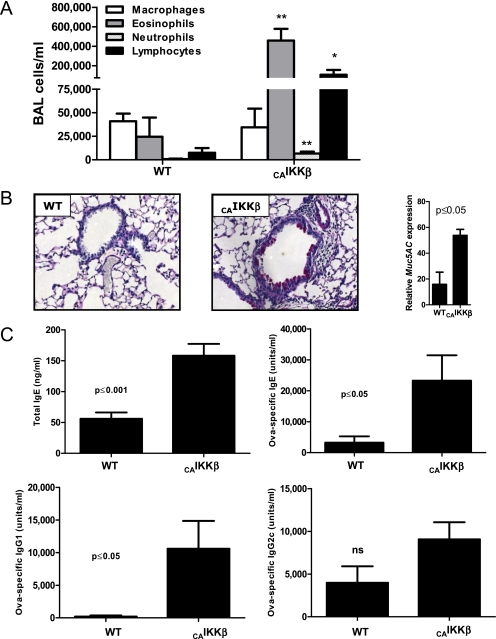
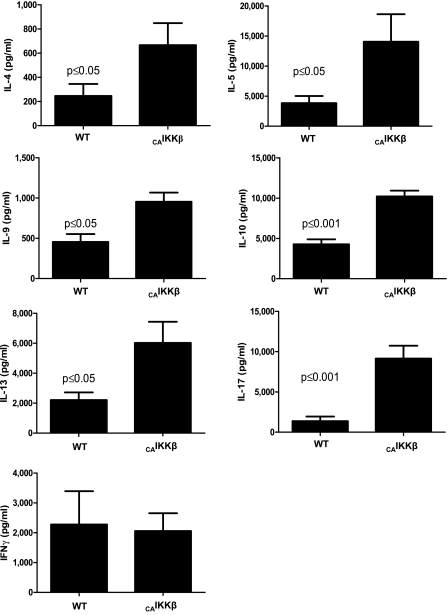
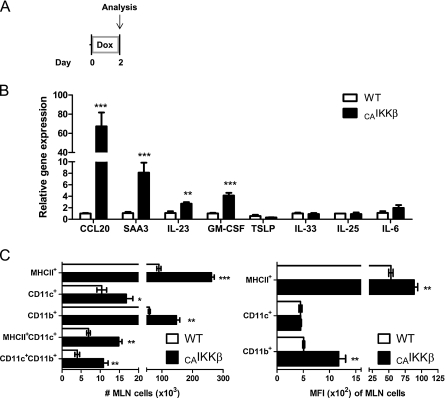
Activation of NF-κB in airway epithelium is observed in allergic asthma and is induced by inhalation of numerous infectious and reactive substances. Many of the substances that activate NF-κB in the airway epithelium are also capable of acting as adjuvants to elicit antigen-specific sensitization to concomitantly inhaled protein, thereby circumventing the inherent bias of the lung to promote tolerance to innocuous antigens. We have used a transgenic mouse inducibly expressing a constitutively active mutant of the inhibitor of nuclear factor κB (IκB) kinase β ((CA)IKKβ) that activates NF-κB only in nonciliated airway epithelial cells to test whether activation of this intracellular signaling pathway in this specific cell type is sufficient to establish a pulmonary environment permissive to the development of allergic sensitization to inhaled protein. When airway epithelial (CA)IKKβ was transiently expressed in antigen-naive mice only during initial inhalation of ovalbumin, the mice became allergically sensitized to the antigen. As a consequence, subsequent inhalation of ovalbumin alone led to an allergic asthma-like response that included airway hyperresponsiveness to methacholine, eosinophilia, mucus expression, elevated serum levels of antigen-specific IgE and IgG1, and splenic CD4(+) T cells that secreted T helper type 2 and type 17 cytokines in response to in vitro antigen restimulation. Furthermore, CD11c(+) cells in the mediastinal lymph nodes (MLN) of (CA)IKKβ-expressing mice displayed significantly elevated levels of activation markers. These data implicate airway epithelial NF-κB activation as a critical modulator of the adaptive immune response to inhaled antigens via the secretion of soluble mediators that affect the capacity of CD11c(+) cells to undergo maturation and promote antigen-specific allergic responses.
Figures
References
-
- Braman SS. The global burden of asthma. Chest 2006;130(1 Suppl):4S–12S. - PubMed
-
- Willart MA, Lambrecht BN. The danger within: endogenous danger signals, atopy and asthma. Clin Exp Allergy 2009;39:12–19. - PubMed
-
- Fanta CH. Asthma. N Engl J Med 2009;360:1002–1014. - PubMed
-
- Shore SA. Airway smooth muscle in asthma—not just more of the same. N Engl J Med 2004;351:531–532. - PubMed
-
- Borger P, Tamm M, Black JL, Roth M. Asthma: is it due to an abnormal airway smooth muscle cell? Am J Respir Crit Care Med 2006;174:367–372. - PubMed
Publication types
MeSH terms
Substances
Grants and funding
LinkOut - more resources
Full Text Sources
Other Literature Sources
Medical
Molecular Biology Databases
Research Materials
