. 2010 Jul;28(7):743-7.
doi: 10.1038/nbt.1639. Epub 2010 Jun 27.

Engineered allosteric activation of kinases in living cells

Affiliations

Engineered allosteric activation of kinases in living cells

Andrei V Karginov et al. Nat Biotechnol. 2010 Jul.

Abstract

Studies of cellular and tissue dynamics benefit greatly from tools that can control protein activity with specificity and precise timing in living systems. Here we describe an approach to confer allosteric regulation specifically on the catalytic activity of protein kinases. A highly conserved portion of the kinase catalytic domain is modified with a small protein insert that inactivates catalytic activity but does not affect other protein functions (Fig. 1a). Catalytic activity is restored by addition of rapamycin or non-immunosuppresive rapamycin analogs. Molecular modeling and mutagenesis indicate that the protein insert reduces activity by increasing the flexibility of the catalytic domain. Drug binding restores activity by increasing rigidity. We demonstrate the approach by specifically activating focal adhesion kinase (FAK) within minutes in living cells and show that FAK is involved in the regulation of membrane dynamics. Successful regulation of Src and p38 by insertion of the rapamycin-responsive element at the same conserved site used in FAK suggests that our strategy will be applicable to other kinases.


Figures
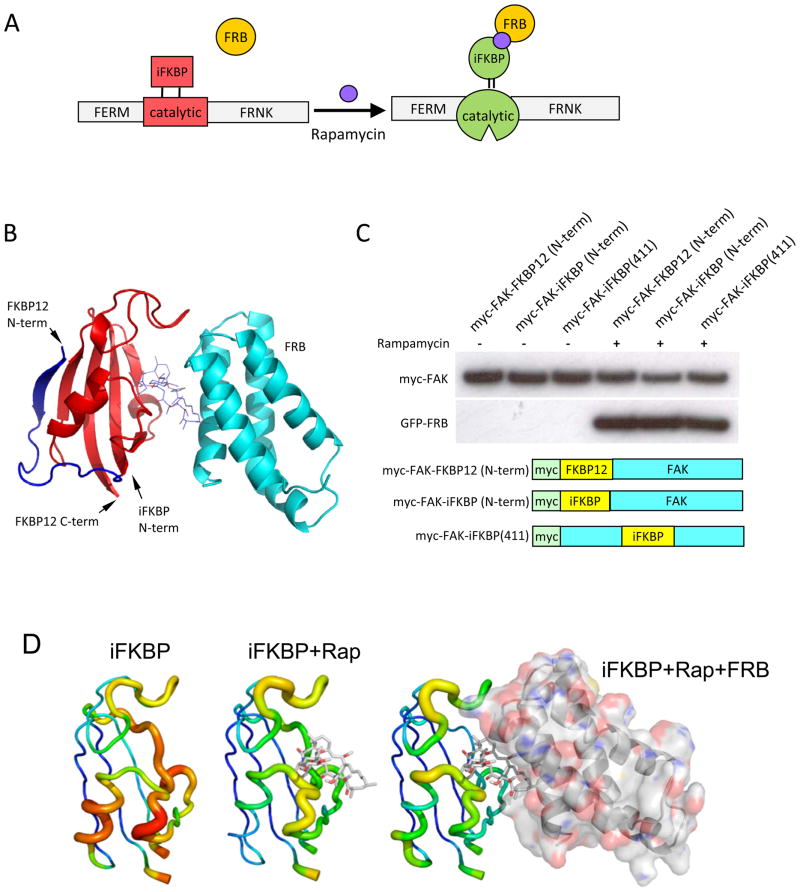
Fig. 1
Fig. 1
Design and generation of RapR-FAK. (A) Schematic representation of the approach used to regulate the catalytic activity of FAK. A fragment of FKBP is inserted at a position in the catalytic domain where it abrogates catalytic activity. Binding to rapamycin and FRB restores activity. (B) The truncated fragment of human FKBP12 (amino acids Thr22 through Glu108) inserted into the kinase domain. Blue and red, full length FKBP12; red, proposed structure of the inserted fragment. The FKBP12 is shown in complex with rapamycin and FRB (cyan). (C)Immunoblot analysis of iFKBP interaction with rapamycin and FRB. Myc-tagged FKBP12 and iFKBP constructs were immunoprecipitated from cells treated for 1 hour with either 200 nMrapamycin or ethanol (solvent control). Co-immunoprecipitation of co-expressed GFP-FRB was detected using anti-GFP antibody. (D) Changes in the molecular dynamics of iFKBP upon binding to rapamycin and FRB. Warmer colors and thicker backbone indicate increasing root mean square fluctuation (RMSF).
Fig. 2
Fig. 2
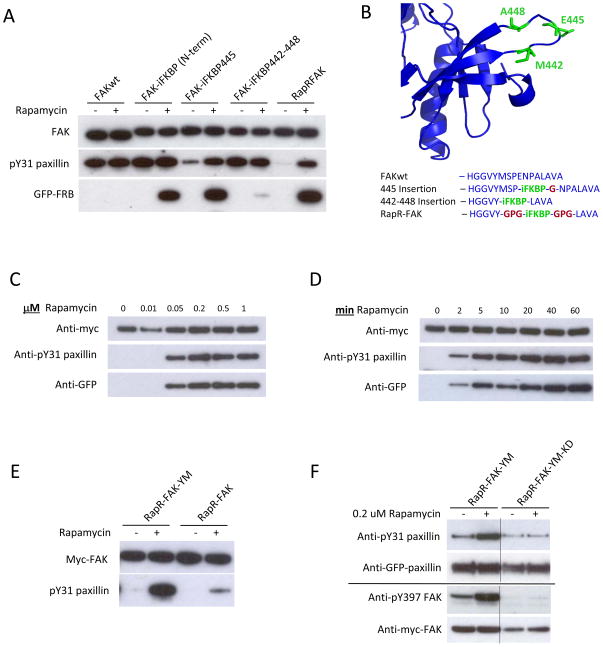
Development and biochemical characterization of RapR-FAK. (A) Rapamycin regulation of FAK variants with iFKBP inserted at different positions. HEK293T cells co-expressing myc-tagged FAK constructs and GFP-FRB were treated for one hour with either 200 nMrapamycin or ethanol (solvent control). The activity of immunoprecipitated FAK variants was tested using the N-terminal fragment of paxillin as a substrate. (B) Sites of iFKBP insertion (green) and connecting linkers (red). (C, D) HEK293T cells co-expressing RapR-FAK and FRB were treated with the indicated amount of rapamycin for 1 hour or with 200 nMrapamycin for the indicated period of time. The kinase was immunoprecipitated and its activity tested as described above. (E) FAK Y180A and M183A mutations were introduced to eliminate autoinhibitory interactions, thereby generating RapR-FAK-YM, which was tested as in A. (F) HEK293T cells co-expressing Cherry-FRB, GFP-paxillin and either myc-tagged RapR-FAK-YM or its kinase-inactive mutant (RapR-FAK-YM-KD) were treated with rapamycin or ethanol (solvent control) for 1 hour. GFP-paxillin was immunoprecipitated and its phosphorylation was assessed using anti-phospho-Tyr31 antibody. Autophosphorylation of FAK on Tyr397 was analyzed using total cell lysate.
Fig. 3
Fig. 3
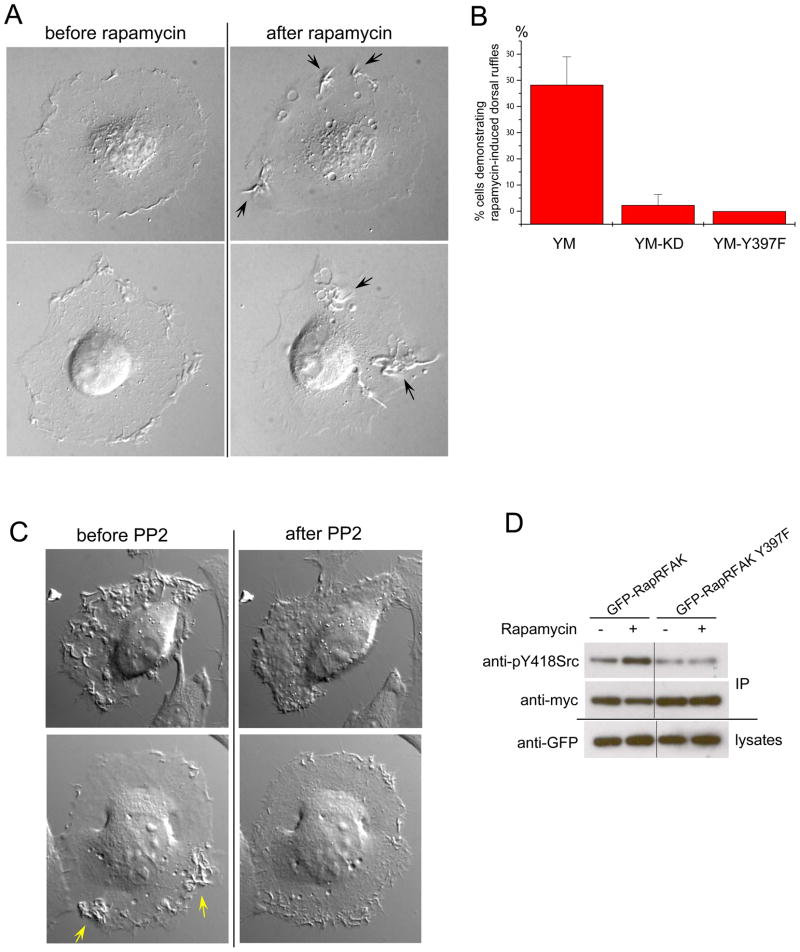
Activation of FAK catalytic activity initiates large dorsal ruffles via the activation of Src. (A)Rapamycin treatment of HeLa cells co-expressing RapR-FAK-YM and FRB caused formation of large dorsal ruffles. (B) HeLa cells expressing either GFP-RapR-FAK-YM (YM, 64 cells), GFP-RapR-FAK kinase-dead mutant (YM-KD, 35 cells) or GFP-tagged Y397F mutant (YM-Y397F, 47 cells) were scored for ruffle induction by rapamycin. No dorsal ruffles were seen before rapamycin addition. (C) Inhibition of Src family kinases eliminated the FAK-induced ruffles. Cells co-expressing GFP-RapR-FAK-YM and Cherry-FRB were treated with rapamycin for 1 hour and imaged before and after addition of Src family kinase inhibitor PP2. PP2 addition stopped dorsal protrusion in all cells analyzed (16 cells). (D) Activation of FAK leads to activation of Src. HeLa cells co-expressing myc-tagged Src, Cherry-FRB and either GFP-RapR-FAK-YM or its Y397F mutant were treated with rapamycin for 1 hour. Src was immunoprecipitated using anti-myc antibody and its phosphorylation on Tyr418 was assessed by immunoblotting.
Fig. 4
Fig. 4
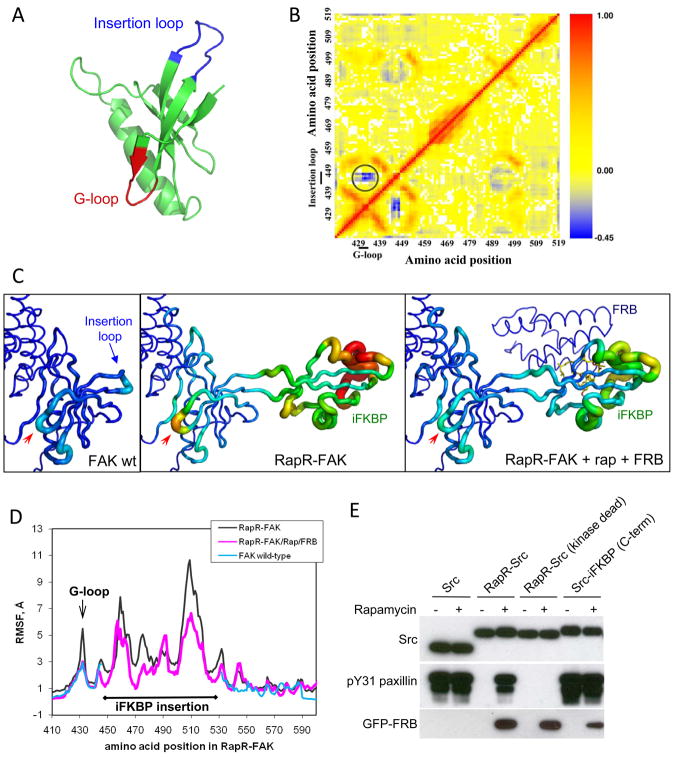
Mechanism of regulation by iFKBP; Src regulation. (A) The portion of the FAK catalytic domain targeted for insertion of iFKBP (blue) and the G-loop (red). (B) Dynamic correlation analysis of the wild type FAK catalytic domain (red, positive correlation; blue, negative correlation). The circled region indicates strong negative correlation between the movement of the insertion loop and the G-loop. (C) Tube representation depicting changes in the dynamics of the FAK catalytic domain’s N-terminal lobe, based on molecular dynamics simulations. Warmer colors and thicker backbone correspond to higher RMSF values, reflecting the degree of free movement within the structure. The red arrows points to the G-loop. (D) Root mean square fluctuation (RMSF) of amino acids in FAK and RapR-FAK(arrow indicates G-loop). The break in the wild type FAK graph corresponds to the iFKBP insert in RapR-FAK. (E) Regulation of Src kinase by insertion of iFKBP. HEK293T cells co-expressing the indicated myc-tagged Src construct and GFP-FRB were treated with either 200 nMrapamycin or ethanol solvent control. The kinase activity of immunoprecipitatedSrc was tested as in 2A.

Comment in

References

    1. Spencer DM, Wandless TJ, Schreiber SL, Crabtree GR. Controlling signal transduction with synthetic ligands. Science. 1993;262:1019–24. - PubMed
    1. Bishop AC, et al. A chemical switch for inhibitor-sensitive alleles of any protein kinase. Nature. 2000;407:395–401. - PubMed
    1. Qiao Y, Molina H, Pandey A, Zhang J, Cole PA. Chemical rescue of a mutant enzyme in living cells. Science. 2006;311:1293–7. - PubMed
    1. Banaszynski LA, Chen LC, Maynard-Smith LA, Ooi AG, Wandless TJ. A rapid, reversible, and tunable method to regulate protein function in living cells using synthetic small molecules. Cell. 2006;126:995–1004. - PMC - PubMed
    1. Tucker CL, Fields S. A yeast sensor of ligand binding. Nat Biotechnol. 2001;19:1042–6. - PubMed

Publication types

Substances