


Renin-angiotensin system blockers and modulation of radiation-induced brain injury
- PMID: 20583976
- PMCID: PMC3068470
- DOI: 10.2174/1389450111009011413
Renin-angiotensin system blockers and modulation of radiation-induced brain injury
Abstract
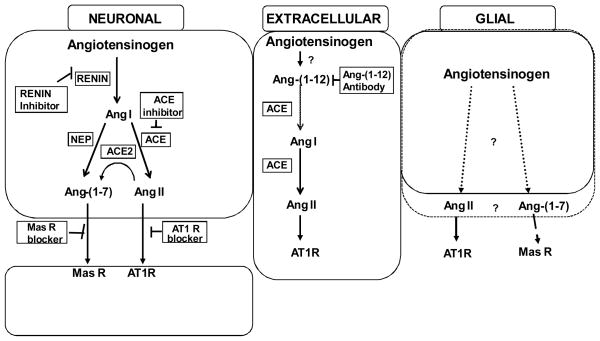
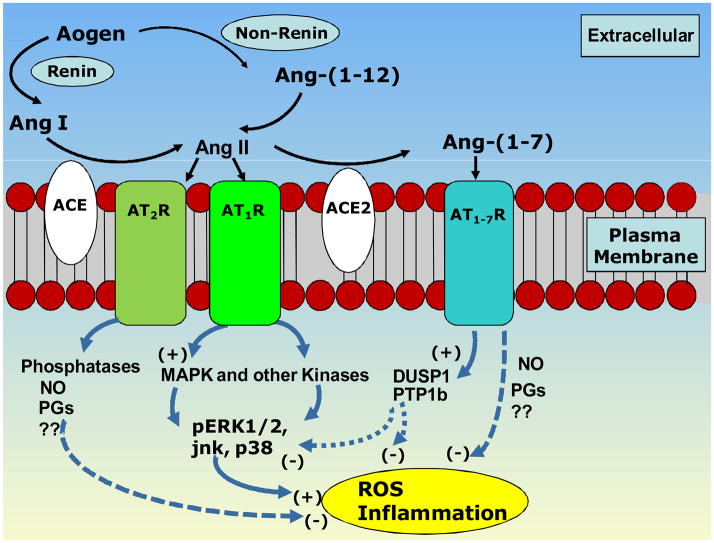
Radiation-induced brain injury remains a major cause of morbidity in cancer patients with primary or metastatic brain tumors. Approximately 200,000 individuals/year are treated with fractionated partial or whole-brain irradiation, and > half will survive long enough (≤6 months) to develop radiation-induced brain injury, including cognitive impairment. Although short-term treatments have shown efficacy, no long-term treatments or preventive approaches are presently available for modulating radiation-induced brain injury. Based on previous preclinical studies clearly demonstrating that renin-angiotensin system (RAS) blockers can modulate radiation-induced late effects in the kidney and lung, we and others hypothesized that RAS blockade would similarly modulate radiation-induced brain injury. Indeed, studies in the last 5 years have shown that both angiotensin-converting enzyme inhibitors (ACEIs) and angiotensin II type 1 receptor antagonists (AT(1)RAs) can prevent/ameliorate radiation-induced brain injury, including cognitive impairment, in the rat. The mechanistic basis for this RAS blocker-mediated effect remains the subject of ongoing investigations. Putative mechanisms include, i] blockade of Ang II/NADPH oxidase-mediated oxidative stress and neuroinflammation, and ii] a change in the balance of angiotensin (Ang) peptides from the pro-inflammatory and pro-oxidative Ang II to the anti-inflammatory and anti-oxidative Ang-1-7). However, given that both ACEIs and AT(1)RAs are 1] well-tolerated drugs routinely prescribed for hypertension, 2] exhibit some antitumor properties, and 3] can prevent/ameliorate radiation-induced brain injury, they appear to be ideal drugs for future clinical trials, offering the promise of improving the quality of life of brain tumor patients receiving brain irradiation.
Figures
References
-
- Jemal A, Siegel R, Ward E, Hao Y, Xu J, Thun MJ. Cancer Statistics, 2009. Ca Cancer J Clin. 2009;59:225–249. - PubMed
-
- Perez C, Brady LW. Principles and practice of radiation oncology. Philadelphia: Lippincott-Raven; 2003.
-
- Coleman CN, Stone HB, Moulder JE, Pellmar TC. Modulation of radiation injury. Science. 2004;304:693–694. - PubMed
-
- Bentzen SM. Preventing or reducing late side effects of radiation therapy: radiobiology meets molecular pathology. Nat Rev Cancer. 2006;6:702–713. - PubMed
-
- Moulder JE, Fish BL, Cohen EP. Treatment of radiation nephropathy with ACE inhibitors and AII type-1 and type-2 receptor antagonists. Curr Pharm Des. 2007;13:1317–1325. - PubMed
Publication types
MeSH terms
Substances
Grants and funding
LinkOut - more resources
Full Text Sources
Miscellaneous