Exercise therapy after corticosteroid injection for moderate to severe shoulder pain: large pragmatic randomised trial
- PMID: 20584793
- PMCID: PMC2893301
- DOI: 10.1136/bmj.c3037
Exercise therapy after corticosteroid injection for moderate to severe shoulder pain: large pragmatic randomised trial
Abstract
Objective: To compare the effectiveness of subacromial corticosteroid injection combined with timely exercise and manual therapy (injection plus exercise) or exercise and manual therapy alone (exercise only) in patients with subacromial impingement syndrome.
Design: Pragmatic randomised clinical trial.
Setting: Primary care based musculoskeletal service. Patients Adults aged 40 or over with subacromial impingement syndrome with moderate or severe shoulder pain.
Interventions: Injection plus exercise or exercise only.
Main outcome measures: Primary outcome was the difference in improvement in the total shoulder pain and disability index at 12 weeks.
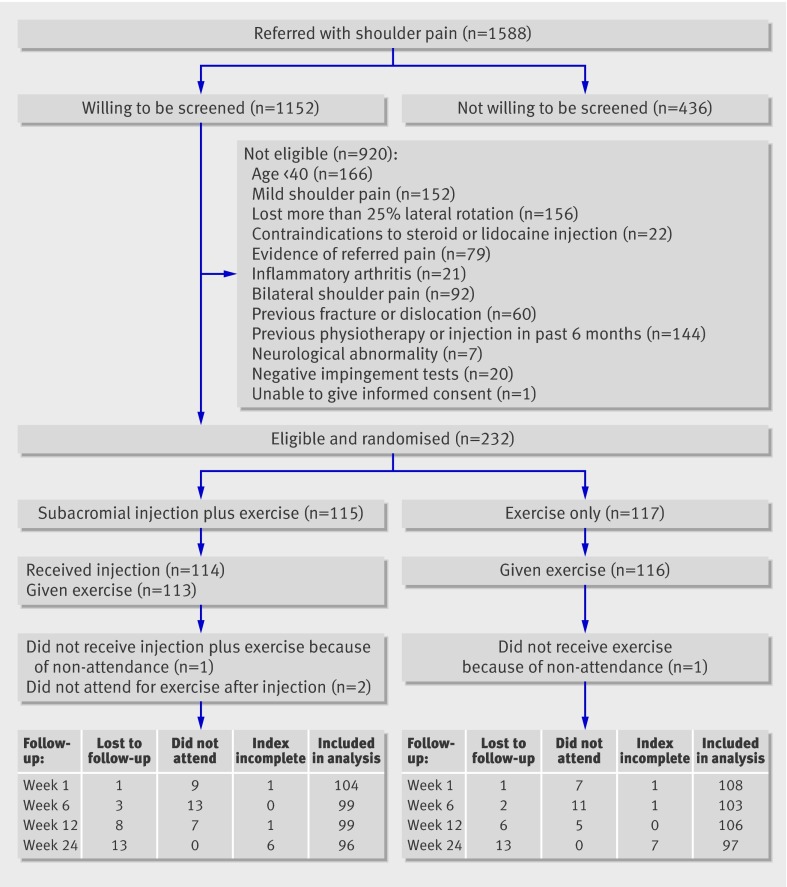
Results: 232 participants were randomised (115 to injection plus exercise, 117 to exercise only). The mean age was 56 (range 40-78), 127 were women, and all had had a median of 16 weeks of shoulder pain (interquartile range 12-28). At week 12 there was no significant difference between the groups in change in total pain and disability index (mean difference between change in groups 3.26 (95% confidence interval -0.81 to 7.34), P=0.116). Improvement was significantly greater in the injection plus exercise group at week 1 (6.56, 4.30 to 8.82) and week 6 (7.37, 4.34 to 10.39) for the total pain and disability index (P<0.001), with no differences at week 24 (-2.26, -6.77 to 2.25, P=0.324).
Conclusions: In the treatment of patients with subacromial impingement syndrome, injection plus exercise and exercise only are similarly effective at 12 weeks. Trial registration ISRCT 25817033; EudraCT No 2005-003628-20.
Conflict of interest statement
Competing interests: All authors have completed the Unified Competing Interest form at
Figures
Comment in
-
ACP Journal Club. Adding steroid injection to exercise and manual mobilization did not reduce shoulder pain and disability over the long term.Ann Intern Med. 2010 Nov 16;153(10):JC5-6. doi: 10.7326/0003-4819-153-10-201011160-02006. Ann Intern Med. 2010. PMID: 21079213 No abstract available.
-
Exercise therapy alone and exercise therapy after corticosteroid injection are equally effective after 12 weeks for moderate to severe shoulder pain.J Physiother. 2010;56(4):278. doi: 10.1016/s1836-9553(10)70013-8. J Physiother. 2010. PMID: 21213944 No abstract available.
-
Combined treatment with corticosteroid injection plus exercise and manual therapy was similar to exercise and manual therapy alone for shoulder pain at 12 weeks.J Bone Joint Surg Am. 2011 May 18;93(10):971. doi: 10.2106/JBJS.9310ebo496. J Bone Joint Surg Am. 2011. PMID: 21593376 No abstract available.
-
Does the addition of a corticosteroid injection to exercise therapy improve outcomes in subacromial impingement syndrome?Clin J Sport Med. 2011 Sep;21(5):463-4. doi: 10.1097/01.jsm.0000405508.08840.0a. Clin J Sport Med. 2011. PMID: 21892023 No abstract available.
References
-
- Linsell L, Dawson J, Zondervan K, Rose P, Randall T, Fitzpatrick R, et al. Prevalence and incidence of adults consulting for shoulder conditions in UK primary care; patterns of diagnosis and referral. Rheumatology (Oxford) 2006;45:215-21. - PubMed
-
- Neer CS 2nd. Impingement lesions. Clin Orthop Relat Res 1983;173:70-7. - PubMed
-
- Ostor AJ, Richards CA, Prevost AT, Speed CA, Hazleman BL. Diagnosis and relation to general health of shoulder disorders presenting to primary care. Rheumatology (Oxford) 2005;44:800-5. - PubMed