


Lipoprotein(a) accelerates atherosclerosis in uremic mice
- PMID: 20584868
- PMCID: PMC2936745
- DOI: 10.1194/jlr.M006742
Lipoprotein(a) accelerates atherosclerosis in uremic mice
Abstract
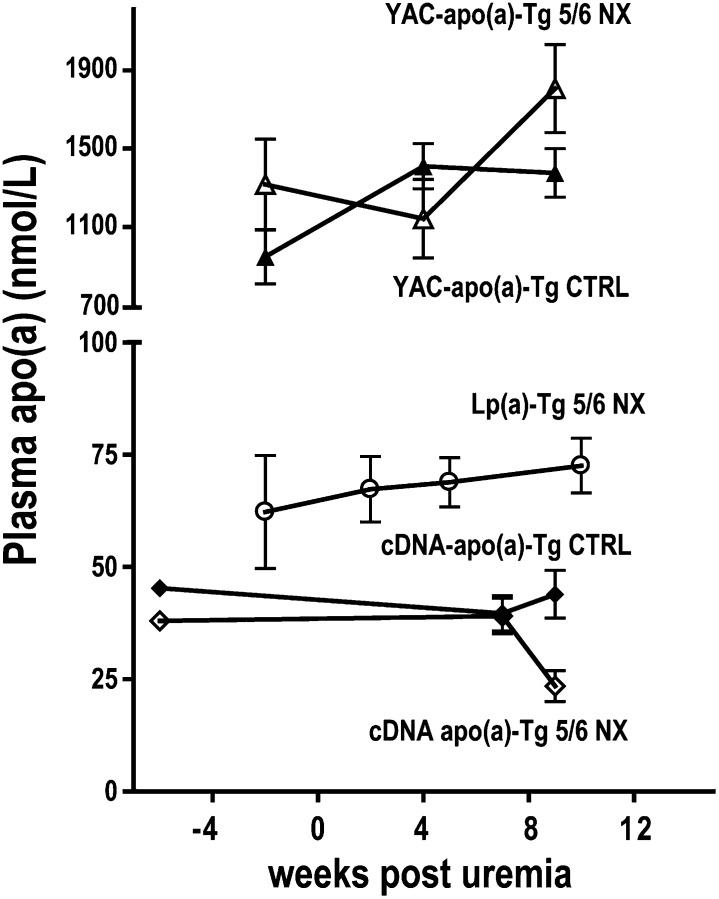
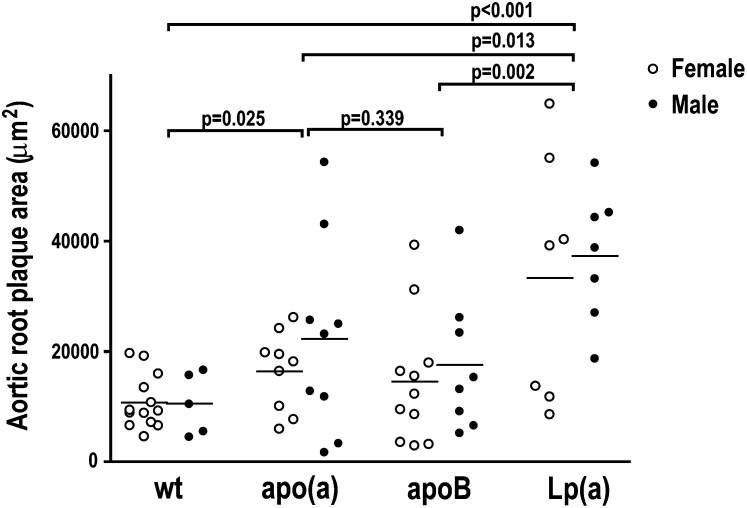
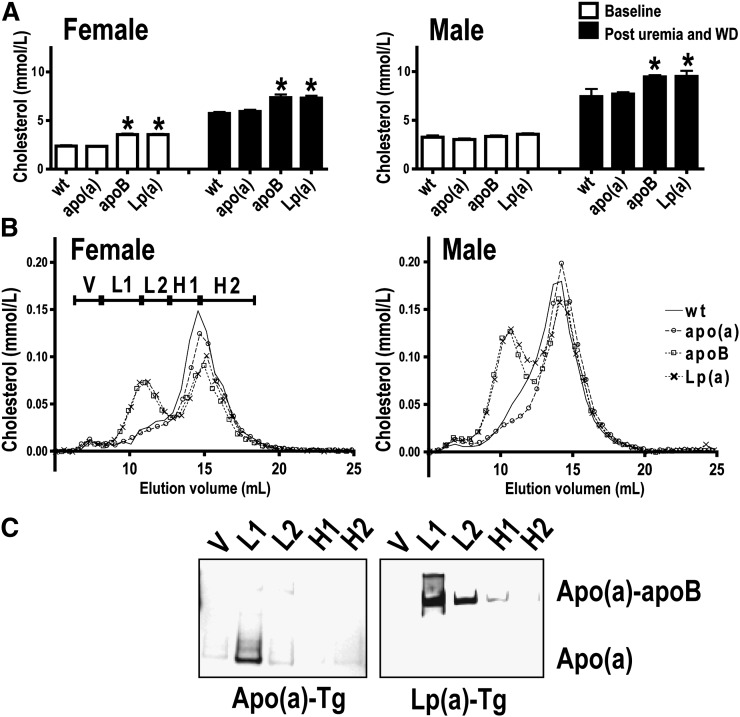
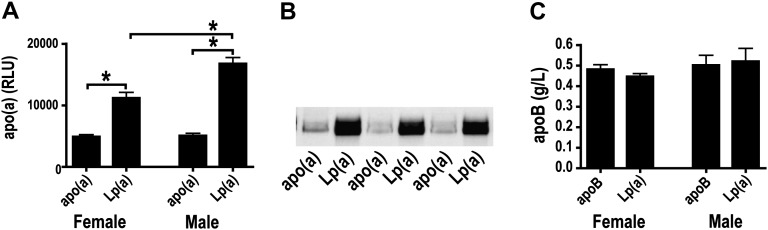
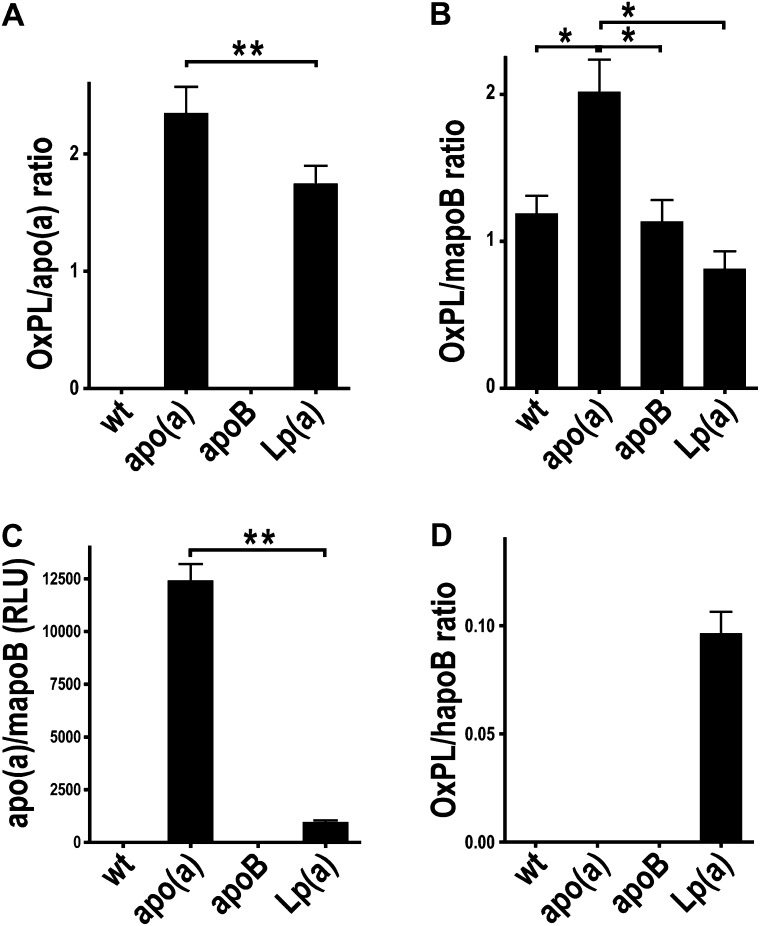
Uremic patients have increased plasma lipoprotein(a) [Lp(a)] levels and elevated risk of cardiovascular disease. Lp(a) is a subfraction of LDL, where apolipoprotein(a) [apo(a)] is disulfide bound to apolipoprotein B-100 (apoB). Lp(a) binds oxidized phospholipids (OxPL), and uremia increases lipoprotein-associated OxPL. Thus, Lp(a) may be particularly atherogenic in a uremic setting. We therefore investigated whether transgenic (Tg) expression of human Lp(a) increases atherosclerosis in uremic mice. Moderate uremia was induced by 5/6 nephrectomy (NX) in Tg mice with expression of human apo(a) (n = 19), human apoB-100 (n = 20), or human apo(a) + human apoB [Lp(a)] (n = 15), and in wild-type (WT) controls (n = 21). The uremic mice received a high-fat diet, and aortic atherosclerosis was examined 35 weeks later. LDL-cholesterol was increased in apoB-Tg and Lp(a)-Tg mice, but it was normal in apo(a)-Tg and WT mice. Uremia did not result in increased plasma apo(a) or Lp(a). Mean atherosclerotic plaque area in the aortic root was increased 1.8-fold in apo(a)-Tg (P = 0.025) and 3.3-fold (P = 0.0001) in Lp(a)-Tg mice compared with WT mice. Plasma OxPL, as detected with the E06 antibody, was associated with both apo(a) and Lp(a). In conclusion, expression of apo(a) or Lp(a) increased uremia-induced atherosclerosis. Binding of OxPL on apo(a) and Lp(a) may contribute to the atherogenicity of Lp(a) in uremia.
Figures
References
-
- Go A. S., Chertow G. M., Fan D., McCulloch C. E., Hsu C. Y. 2004. Chronic kidney disease and the risks of death, cardiovascular events, and hospitalization. N. Engl. J. Med. 351: 1296–1305. - PubMed
-
- Fellstrom B. C., Jardine A. G., Schmieder R. E., Holdaas H., Bannister K., Beutler J., Chae D. W., Chevaile A., Cobbe S. M., Gronhagen-Riska C., et al. 2009. Rosuvastatin and cardiovascular events in patients undergoing hemodialysis. N. Engl. J. Med. 360: 1395–1407. - PubMed
-
- Wanner C., Krane V., Marz W., Olschewski M., Mann J. F., Ruf G., Ritz E. 2005. Atorvastatin in patients with type 2 diabetes mellitus undergoing hemodialysis. N. Engl. J. Med. 353: 238–248. - PubMed
-
- Massy Z. A., Ivanovski O., Nguyen-Khoa T., Angulo J., Szumilak D., Mothu N., Phan O., Daudon M., Lacour B., Drueke T. B., et al. 2005. Uremia accelerates both atherosclerosis and arterial calcification in apolipoprotein E knockout mice. J. Am. Soc. Nephrol. 16: 109–116. - PubMed
-
- Bro S., Bentzon J. F., Falk E., Andersen C. B., Olgaard K., Nielsen L. B. 2003. Chronic renal failure accelerates atherogenesis in apolipoprotein E-deficient mice. J. Am. Soc. Nephrol. 14: 2466–2474. - PubMed
Publication types
MeSH terms
Substances
LinkOut - more resources
Full Text Sources
Medical
Miscellaneous
