


A pathoadaptive deletion in an enteroaggregative Escherichia coli outbreak strain enhances virulence in a Caenorhabditis elegans model
- PMID: 20584976
- PMCID: PMC2937471
- DOI: 10.1128/IAI.00014-10
A pathoadaptive deletion in an enteroaggregative Escherichia coli outbreak strain enhances virulence in a Caenorhabditis elegans model
Abstract
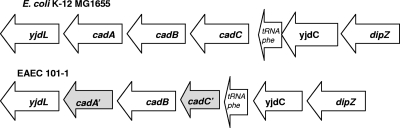
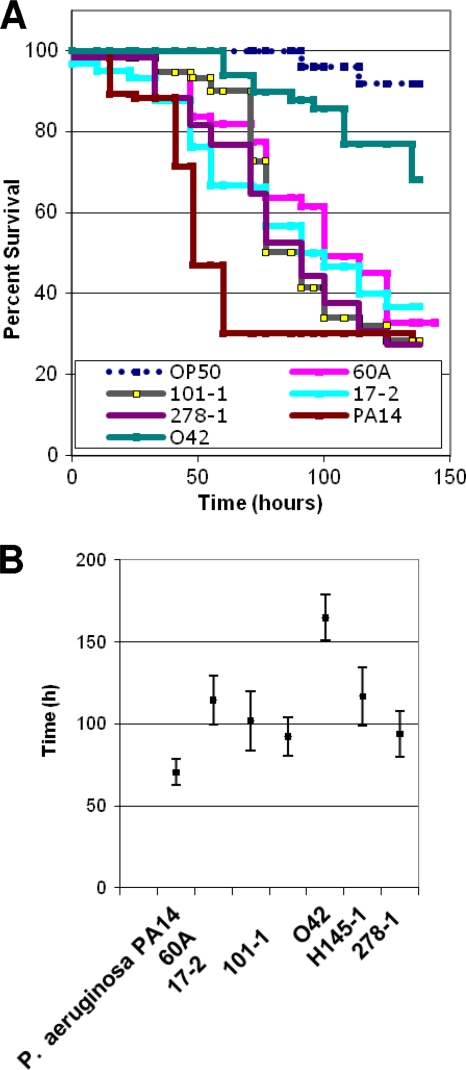
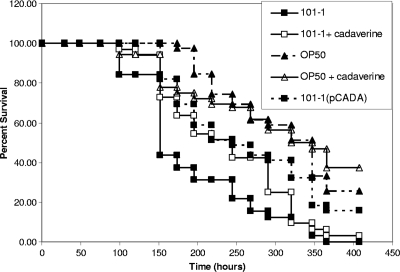
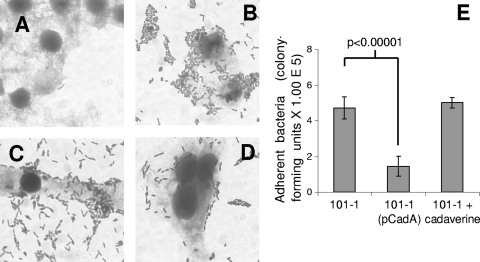
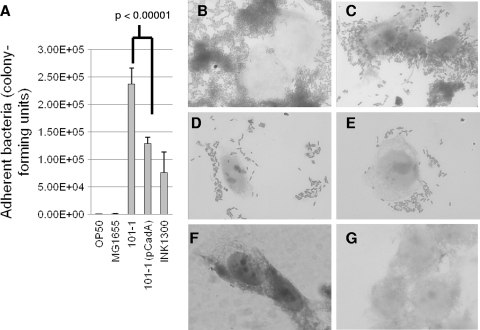
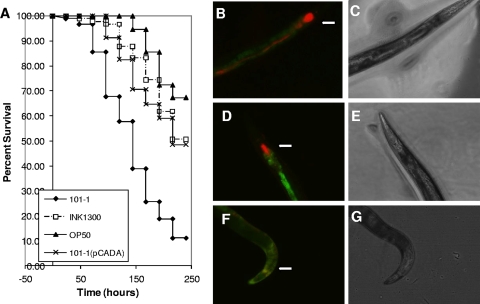
Enteroaggregative Escherichia coli (EAEC) strains are important diarrheal pathogens. EAEC strains are defined by their characteristic stacked-brick pattern of adherence to epithelial cells but show heterogeneous virulence and have different combinations of adhesin and toxin genes. Pathoadaptive deletions in the lysine decarboxylase (cad) genes have been noted among hypervirulent E. coli subtypes of Shigella and enterohemorrhagic E. coli. To test the hypothesis that cad deletions might account for heterogeneity in EAEC virulence, we developed a Caenorhabditis elegans pathogenesis model. Well-characterized EAEC strains were shown to colonize and kill C. elegans, and differences in virulence could be measured quantitatively. Of 49 EAEC strains screened for lysine decarboxylase activity, 3 tested negative. Most notable is isolate 101-1, which was recovered in Japan, from the largest documented EAEC outbreak. EAEC strain 101-1 was unable to decarboxylate lysine in vitro due to deletions in cadA and cadC, which, respectively, encode lysine decarboxylase and a transcriptional activator of the cadAB genes. Strain 101-1 was significantly more lethal to C. elegans than control strain OP50. Lethality was attenuated when the lysine decarboxylase defect was complemented from a multicopy plasmid and in single copy. In addition, restoring lysine decarboxylase function produced derivatives of 101-1 deficient in aggregative adherence to cultured human epithelial cells. Lysine decarboxylase inactivation is pathoadapative in an important EAEC outbreak strain, and deletion of cad genes could produce hypervirulent EAEC lineages in the future. These results suggest that loss, as well as gain, of genetic material can account for heterogeneous virulence among EAEC strains.
Figures
References
-
- Aballay, A., and F. M. Ausubel. 2002. Caenorhabditis elegans as a host for the study of host-pathogen interactions. Curr. Opin. Microbiol. 5:97-101. - PubMed
-
- Aballay, A., P. Yorgey, and F. M. Ausubel. 2000. Salmonella typhimurium proliferates and establishes a persistent infection in the intestine of Caenorhabditis elegans. Curr. Biol. 10:1539-1542. - PubMed
-
- Alegado, R. A., M. C. Campbell, W. C. Chen, S. S. Slutz, and M. W. Tan. 2003. Characterization of mediators of microbial virulence and innate immunity using the Caenorhabditis elegans host-pathogen model. Cell. Microbiol. 5:435-444. - PubMed
-
- Bhan, M. K., P. Raj, M. M. Levine, J. B. Kaper, N. Bhandari, R. Srivastava, R. Kumar, and S. Sazawal. 1989. Enteroaggregative Escherichia coli associated with persistent diarrhea in a cohort of rural children in India. J. Infect. Dis. 159:1061-1064. - PubMed
Publication types
MeSH terms
Substances
Grants and funding
LinkOut - more resources
Full Text Sources
Miscellaneous
