


Infant feeding practices among HIV-positive women in Dar es Salaam, Tanzania, indicate a need for more intensive infant feeding counselling
- PMID: 20587116
- PMCID: PMC3289716
- DOI: 10.1017/S1368980010001539
Infant feeding practices among HIV-positive women in Dar es Salaam, Tanzania, indicate a need for more intensive infant feeding counselling
Abstract
Objective: To assess feeding practices of infants born to HIV-positive women in Dar es Salaam, Tanzania. These data then served as a proxy to evaluate the adequacy of current infant feeding counselling.
Design: A cross-sectional survey of infant feeding behaviours.
Setting: Four clinics in greater Dar es Salaam in early 2008.
Subjects: A total of 196 HIV-positive mothers of children aged 6-10 months recruited from HIV clinics.
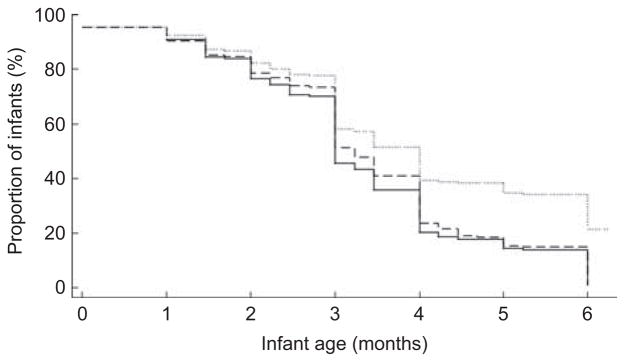
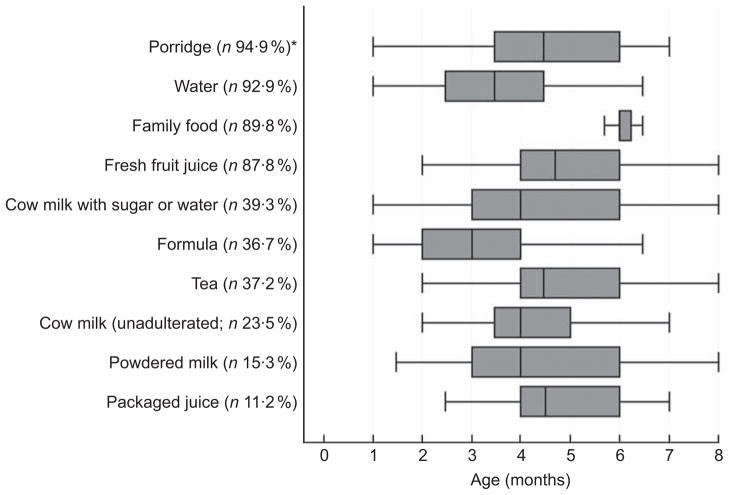
Results: Initiation of breast-feeding was reported by 95·4 % of survey participants. In the entire sample, 80·1 %, 34·2 % and 13·3 % of women reported exclusive breast-feeding (EBF) up to 2, 4 and 6 months, respectively. Median duration of EBF among women who ever breast-fed was 3 (interquartile range (IQR): 2·1, 4·0) months. Most non-breast-milk foods fed to infants were low in nutrient density. Complete cessation of breast-feeding occurred within 14 d of the introduction of non-breast-milk foods among 138 of the 187 children (73·8 %) who had ever received any breast milk. Of the 187 infants in the study who ever received breast milk, 19·4 % received neither human milk nor any replacement milks for 1 week or more (median duration of no milk was 14 (IQR: 7, 152) d).
Conclusions: Infant feeding practices among these HIV-positive mothers resulted in infants receiving far less breast milk and more mixed complementary feeds than recommended, thus placing them at greater risk of both malnutrition and HIV infection. An environment that better enables mothers to follow national guidelines is urgently needed. More intensive infant feeding counselling programmes would very likely increase rates of optimal infant feeding.
Conflict of interest statement
None of the authors had any conflicts of interest.
Figures
References
-
- Bhandari N, Bahl R, Mazumdar S, et al. Effect of community-based promotion of exclusive breastfeeding on diarrhoeal illness and growth: a cluster randomised controlled trial. Lancet. 2003;361:1418–1423. - PubMed
-
- Victora C, Smith P, Vaughan J, et al. Evidence for protection by breast-feeding against infant deaths from infectious diseases in Brazil. Lancet. 1987;2:319–322. - PubMed
-
- WHO Collaborative Study Team. Effect of breast-feeding on infant and child mortality due to infectious diseases in less developed countries: a pooled analysis. WHO Collaborative Study Team on the Role of Breastfeeding on the Prevention of Infant Mortality. Lancet. 2000;355:451–455. - PubMed
-
- Coovadia HM, Rollins NC, Bland RM, et al. Mother-to-child transmission of HIV-1 infection during exclusive breastfeeding in the first 6 months of life: an intervention cohort study. Lancet. 2007;369:1107–1116. - PubMed
-
- Becquet R, Ekouevi D, Menan H, et al. Early mixed feeding and breastfeeding beyond 6 months increase the risk of postnatal HIV transmission: ANRS 1201/1202 Ditrame Plus, Abidjan, Cote d’Ivoire. Prev Med. 2008;47:27–33. - PubMed
