


Evaluation of hydration and nutritional gels as supportive care after total-body irradiation in mice (Mus musculus)
- PMID: 20587164
- PMCID: PMC2877305
Evaluation of hydration and nutritional gels as supportive care after total-body irradiation in mice (Mus musculus)
Abstract
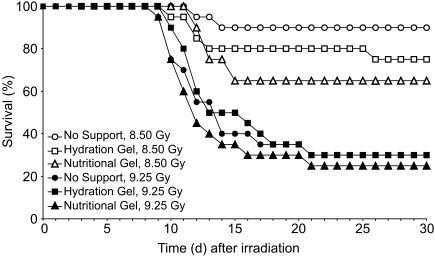
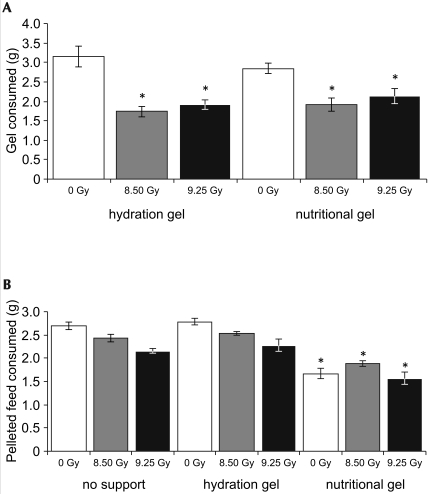
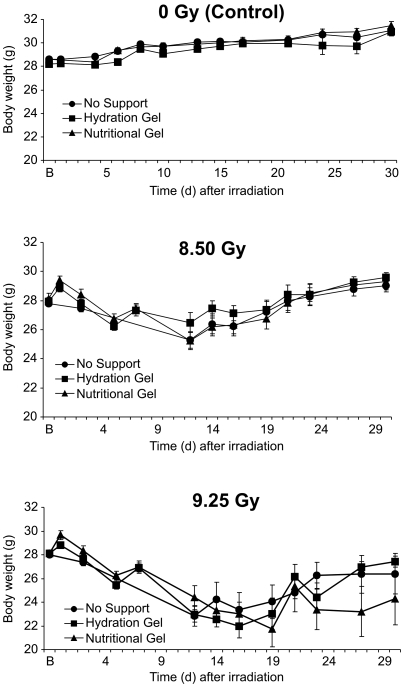
Concern regarding the potential for radiation exposure from accidents or nuclear and radiologic terrorism is increasing. The purpose of this study was to determine whether the addition of minimal supportive care consisting of hydration or nutritional gels could be used to reduce mortality in mice exposed to (60)Co gamma-radiation. Male CD2F1 mice received 0, 8.50, or 9.25 Gy (60)Co at a dose rate of 0.6 Gy/min. These groups were further divided into 3 treatment groups that-in addition to pelleted food and water-received no supportive care, hydration gel, or nutritional gel. Overall survival, mean survival time, consumption of pelleted food and gel, and body weight were recorded for 30 d. Radiation caused dose-dependent decreases in overall survival, consumption of pelleted food and supplemental gel, and body weight. However, at each radiation dose (0, 8.50, 9.25 Gy), the type of supportive care did not modify overall survival, mean survival time, or changes in body weight. These results demonstrate that hydration and nutritional gels were not effective methods of supportive care after high-dose total body irradiation in mice.
Figures
References
-
- Archambeau JO, Stryckmanns P, Brenneis H. 1968. The effect of food and water deprivation on the peripheral blood parameters of the mouse. Radiat Res 36:396–409 - PubMed
-
- Bing FC, Mendel LB. 1931. The relationship between food and water intake in mice. Am J sPhysiol 98:169–179
-
- Brook I, Elliott TB. 1991. Quinolone therapy in the prevention of mortality after irradiation. Radiat Res 128:100–103 - PubMed
MeSH terms
Substances
LinkOut - more resources
Full Text Sources
Medical