


A spoonful of sugar helps the medicine go down: a novel technique to improve oral gavage in mice
- PMID: 20587165
- PMCID: PMC2877306
A spoonful of sugar helps the medicine go down: a novel technique to improve oral gavage in mice
Abstract
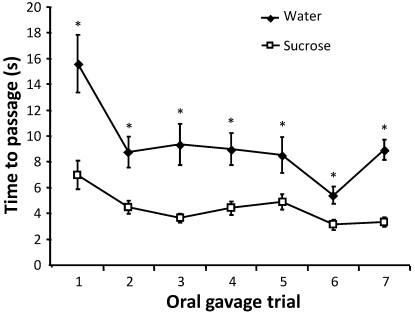
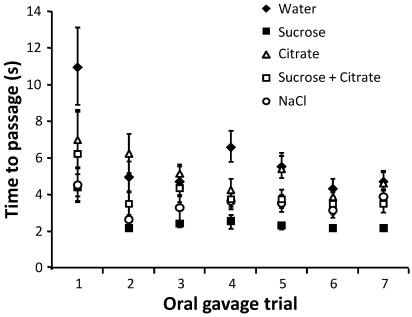
Oral gavage is a common route of precise oral dosing for studies in rodents. Complications including tracheal administration, esophageal trauma, and aspiration are common and usually related to animal resistance to the procedure, and the stress induced by oral gavage can be a confounding variable in many studies. The taste of sucrose conveys a pacifying and analgesic effect in newborns, whereas sour solutions can induce the swallow reflex in humans that are dysphagic. We hypothesized that precoating a gavage needle with sucrose or citrate (or both) would pacify mice and induce them to swallow, reducing the stress and complications associated with the technique. To validate this hypothesis, we quantitated time to passage, stress-related behavioral reactions to the procedure, and plasma corticosterone levels in mice after precoating gavage needles with water, sucrose, citrate, sucrose and citrate, or sodium chloride prior to oral gavage. Precoating needles with sucrose reduced the time to passage, decreased observable stress-related reactions to the procedure, and maintained plasma corticosterone levels similar to those in ungavaged control mice. Coating needles with water, sucrose and citrate, or citrate had no beneficial effects on these parameters. Our findings describe a novel, validated technique that measurably decreases signs of stress and thereby improves animal welfare during oral gavage. Furthermore, the use of sucrose may be a valuable tool to refine other minor or nonsurgical procedures in the field of laboratory animal research.
Figures

References
-
- American Association of Laboratory Animal Science [Internet]. Working with the laboratory mouse, chapter 12: oral gavage, 2005update [cited 21 Nov 2009]. Available at https://www.aalaslearninglibrary.org/demo/course2.asp?strKeyID=DCEBB092-...
-
- Anseloni VC, Ren K, Dubner R, Ennis M. 2005. A brainstem substrate for analgesia elicited by intraoral sucrose. Neuroscience 133:231–243 - PubMed
-
- Anseloni VC, Weng HR, Terayama R, Letizia D, Davis BJ, Ren K, Dubner R, Ennis M. 2002. Age-dependency of analgesia elicited by intraoral sucrose in acute and persistent pain models. Pain 97:93–103 - PubMed
-
- Barr RG, Pantel MS, Young SN, Wright JH, Hendricks LA, Gravel R. 1999. The response of crying newborns to sucrose: is it a ‘sweetness’ effect? Physiol Behav 66:409–417 - PubMed
-
- Barr RG, Quek VS, Cousineau D, Oberlander TF, Brian JA, Young SN. 1994. Effects of intraoral sucrose on crying, mouthing, and hand–mouth contact in newborn and 6-wk-old infants. Dev Med Child Neurol 36:608–618 - PubMed
Publication types
MeSH terms
Substances
Grants and funding
LinkOut - more resources
Full Text Sources