


Population structure of East African relapsing fever Borrelia spp
- PMID: 20587177
- PMCID: PMC3321891
- DOI: 10.3201/eid1607.091085
Population structure of East African relapsing fever Borrelia spp
Abstract
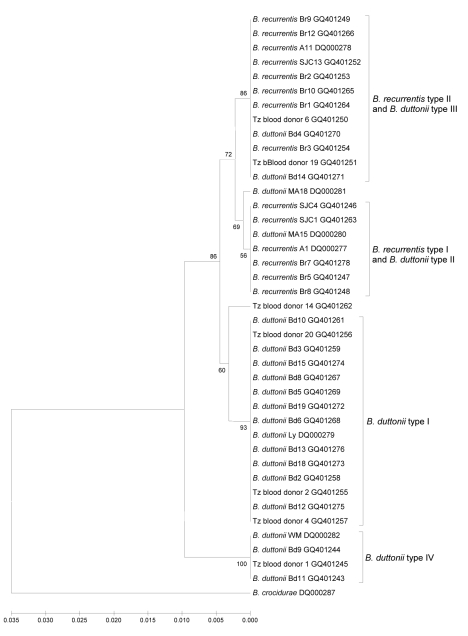
Differentiation of endemic East African tick-borne relapsing fever Borrelia duttonii spirochetes from epidemic louse-borne relapsing fever (LBRF) B. recurrentis spirochetes into different species has been questioned. We assessed a noncoding intragenic spacer (IGS) region to compare genotypes found in clinical samples from relapsing fever patients. Although IGS typing was highly discriminatory and resolved 4 East African tick-borne relapsing fever groups from a disease-endemic region in Tanzania, 2 IGS clades were found among LBRF patients in Ethiopia. The 2 IGS sequence types for B. recurrentis overlapped with 2 of the 4 groups found among B. duttonii. All cultivable isolates of B. duttonii fell into a single IGS cluster, which suggests their analysis might introduce selective bias. We provide further support that B. recurrentis is a subset of B. duttonii and represents an ecotype rather than a species. These observations have disease control implications and suggest LBRF Borrelia spp. could reemerge from its tick-borne reservoirs where vectors coexist.
Figures
References
-
- Cutler SJ, Scott JC, Wright DJ. Phylogenetic origins of Borrelia recurrentis. Int J Med Microbiol. 2008;298(Suppl 1):193–202. 10.1016/j.ijmm.2007.11.011 - DOI
MeSH terms
Substances
LinkOut - more resources
Full Text Sources
Miscellaneous