


Case Reports
doi: 10.3201/eid1607.091907.
Septicemia caused by tick-borne bacterial pathogen Candidatus Neoehrlichia mikurensis
Affiliations
- PMID: 20587186
- PMCID: PMC3358111
- DOI: 10.3201/eid1607.091907
Item in Clipboard
Case Reports
Septicemia caused by tick-borne bacterial pathogen Candidatus Neoehrlichia mikurensis
Emerg Infect Dis.
2010 Jul.
Abstract
We have repeatedly detected Candidatus Neoehrlichia mikurensis, a bacterium first described in Rattus norvegicus rats and Ixodes ovatus ticks in Japan in 2004 in the blood of a 61-year-old man with signs of septicemia by 16S rRNA and groEL gene PCR. After 6 weeks of therapy with doxycycline and rifampin, the patient recovered.
Figures
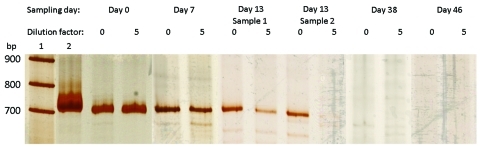
Polyacrylamide gel electrophoresis (SDS-PAGE) analysis of broad range 16S rRNA gene PCR products obtained from blood samples. Lane 1, marker, 100 bp DNA ladder (Roche DNA Marker XIV); lane 2, positive control, Escherichia coli; following lanes, PCR products obtained from blood specimens arranged by date of collection. For each specimen PCR products are shown obtained with undiluted (0) and 5×-diluted (5) DNA extracts. The 2 last negative samples are not shown.
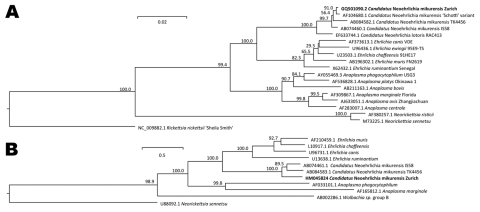
A) Phylogenetic tree based on the 16S rRNA gene sequences of Candidatus Neoehrlichia mikurensis GQ501090.2 (our patient’s isolate, herein termed Zurich and indicated in boldface) and related organisms. The number at nodes indicates percentages of bootstrap support based on 10,000 replicates. Scale bar indicates 0.02 substitutions per nucleotide position. B) Phylogenetic tree based on the groEL sequences. Scale bars indicate 0.05 substitutions per nucleotide position.
References
-
- Kawahara M, Rikihisa Y, Isogai E, Takahashi M, Misumi H, Suto C, et al. Ultrastructure and phylogenetic analysis of ‘Candidatus Neoehrlichia mikurensis’ in the family Anaplasmataceae, isolated from wild rats and found in Ixodes ovatus ticks. Int J Syst Evol Microbiol. 2004;54:1837–43. 10.1099/ijs.0.63260-0 - DOI - PubMed
Publication types
MeSH terms
LinkOut - more resources
Full Text Sources
Molecular Biology Databases
Research Materials