. 2010 Sep;38(16):e161.
doi: 10.1093/nar/gkq572. Epub 2010 Jun 28.

Road blocks on paleogenomes--polymerase extension profiling reveals the frequency of blocking lesions in ancient DNA

Affiliations

Road blocks on paleogenomes--polymerase extension profiling reveals the frequency of blocking lesions in ancient DNA

Patricia Heyn et al. Nucleic Acids Res. 2010 Sep.

Abstract

Although the last few years have seen great progress in DNA sequence retrieval from fossil specimens, some of the characteristics of ancient DNA remain poorly understood. This is particularly true for blocking lesions, i.e. chemical alterations that cannot be bypassed by DNA polymerases and thus prevent amplification and subsequent sequencing of affected molecules. Some studies have concluded that the vast majority of ancient DNA molecules carry blocking lesions, suggesting that the removal, repair or bypass of blocking lesions might dramatically increase both the time depth and geographical range of specimens available for ancient DNA analysis. However, previous studies used very indirect detection methods that did not provide conclusive estimates on the frequency of blocking lesions in endogenous ancient DNA. We developed a new method, polymerase extension profiling (PEP), that directly reveals occurrences of polymerase stalling on DNA templates. By sequencing thousands of single primer extension products using PEP methodology, we have for the first time directly identified blocking lesions in ancient DNA on a single molecule level. Although we found clear evidence for blocking lesions in three out of four ancient samples, no more than 40% of the molecules were affected in any of the samples, indicating that such modifications are far less frequent in ancient DNA than previously thought.


Figures
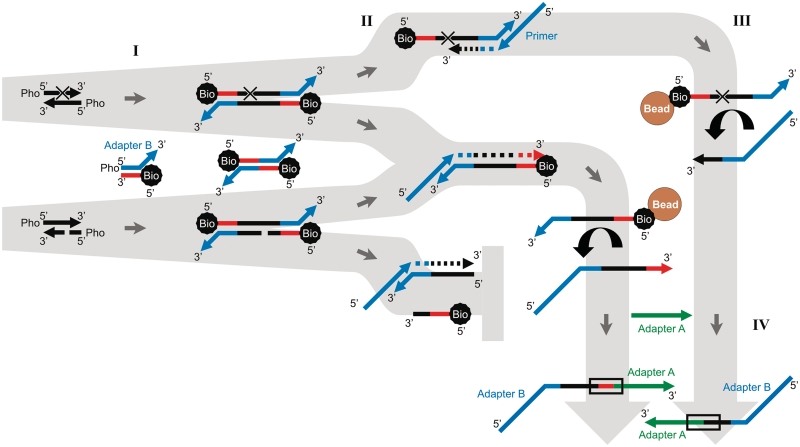
Figure 1.
Figure 1.
Workflow of PEP. Double-stranded template DNA is blunt-end repaired using T4 DNA polymerase and T4 polynucleotide kinase (not depicted). (I) Using T4 DNA ligase, biotinylated adapters are attached to both ends of the template molecules. The blunt end ligation reaction also produces adapter dimers, which are subsequently removed by size selective purification. (II) 5′-tailed primers carrying the 454 ‘B’ sequence (shown in blue) are hybridized to the overhanging 3′-ends of the adapters. Primer extension is carried out under reaction conditions optimal for the assayed polymerase. Unless second-strand synthesis stops prematurely, due to a blocking lesion, a nick or random polymerase stalling, the flanking adapter sequence (shown in red) is copied. (III) Primer extension products are captured on streptavidine beads to remove excess primers and extension products from nicked template strands. Extension products are released by heat denaturation. (IV) A 454 sequencing library is created by attaching single-stranded adapters with the 454 ‘A’ sequence (shown in green) to the 3′-ends. The sequencing library is converted to double-stranded form (not depicted) to allow for efficient removal of excess A-adapters. The 454 sequencing is initiated from the A-adapter. If primer extensions were complete, sequences will start with an 8-bp adapter sequence, which serves as the end-of-template recognition sequence (framed by rectangles).
Figure 2.
Figure 2.
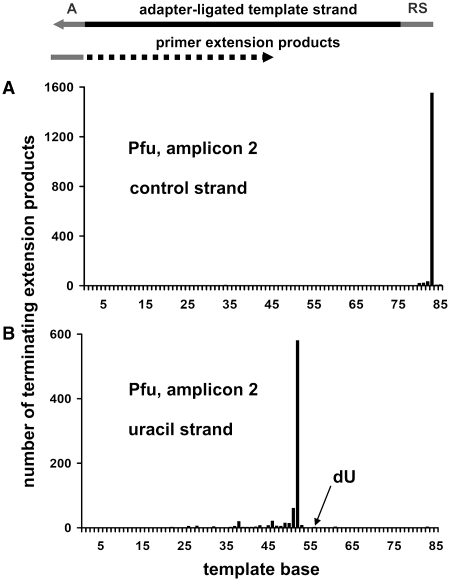
Exemplary extension termination patterns on artificial templates. Shown are the numbers of template bases that were copied before Pfu polymerase terminated primer extension on (A) a non-modified and (B) a uracil-containing template strand. The template strands were 83 bases in length (75 bases PCR product plus 8 bases recognition sequence). Extension was severely inhibited by uracil.
Figure 3.
Figure 3.
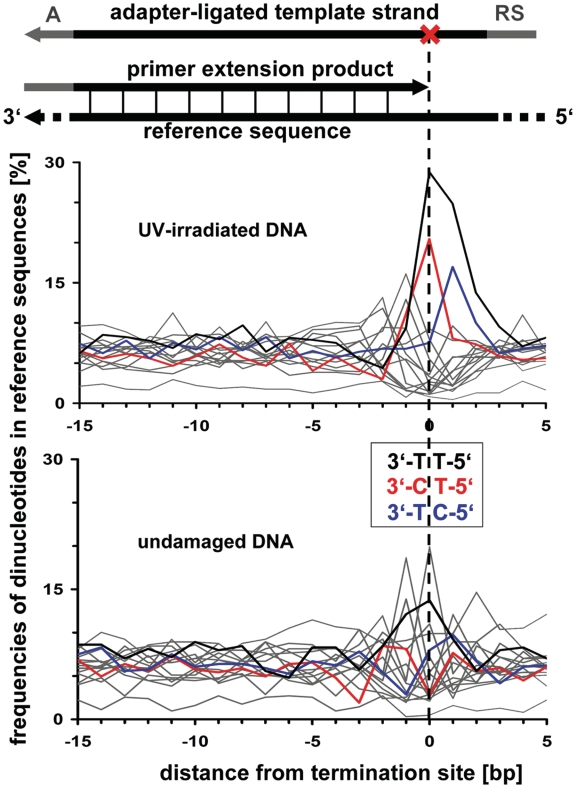
Sequence motifs of blocking lesions in UV-irradiated DNA. Shown is the overall base composition of the horse reference sequence around extension termination sites (in a dinucleotide window and 3′→5′ orientation), as inferred by aligning all sequences without the recognition sequence (RS) against the horse genome. In UV-irradiated DNA, termination is strongly elevated around three pyrimidine dinucleotides (highlighted in black, red and blue; all other 13 dinucleotides are shown in gray). This pattern is absent in undamaged DNA.

References

    1. Miller W, Drautz DI, Ratan A, Pusey B, Qi J, Lesk AM, Tomsho LP, Packard MD, Zhao F, Sher A, et al. Sequencing the nuclear genome of the extinct woolly mammoth. Nature. 2008;456:387–390. - PubMed
    1. Rasmussen M, Li Y, Lindgreen S, Pedersen JS, Albrechtsen A, Moltke I, Metspalu M, Metspalu E, Kivisild T, Gupta R, et al. Ancient human genome sequence of an extinct Palaeo-Eskimo. Nature. 2010;463:757–762. - PMC - PubMed
    1. Green RE, Krause J, Briggs AW, Maricic T, Stenzel U, Kircher M, Patterson N, Li H, Zhai W, Fritz MH, et al. A draft sequence of the Neandertal genome. Science. 2010;328:710–722. - PMC - PubMed
    1. Briggs AW, Good JM, Green RE, Krause J, Maricic T, Stenzel U, Lalueza-Fox C, Rudan P, Brajkovic D, Kucan Z, et al. Targeted retrieval and analysis of five Neandertal mtDNA genomes. Science. 2009;325:318–321. - PubMed
    1. Stiller M, Knapp M, Stenzel U, Hofreiter M, Meyer M. Direct multiplex sequencing (DMPS)—a novel method for targeted high-throughput sequencing of ancient and highly degraded DNA. Genome Res. 2009;19:1843–1848. - PMC - PubMed

Publication types

Substances