


The harmful role of c5a on innate immunity in sepsis
- PMID: 20588003
- PMCID: PMC2968761
- DOI: 10.1159/000317194
The harmful role of c5a on innate immunity in sepsis
Abstract
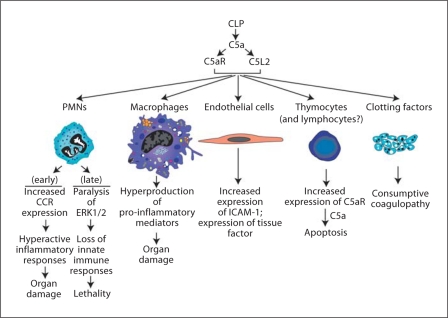
There is accumulating evidence in humans and in experimental sepsis that robust activation of the complement system occurs along with development of defects in the innate immune system. In this report we review evidence that the complement activation product, C5a, appears in the plasma of rodents following cecal ligation and puncture (CLP). C5a interacts with its receptors (C5aR, C5L2) on phagocytes (polymorphonuclear neutrophils, PMNs, macrophages), ultimately paralyzing the ERK1/2 pathway of the mitogen-activated protein kinase signaling pathway. C5a is also interactive with its receptors on a variety of other cell types in various organs. Interaction of C5a with receptors on PMNs results in compromised innate immunity, with intense suppression of phagocytosis, chemotaxis and the respiratory burst. Endothelial cells acquire a pro-inflammatory phenotype (increased ICAM-1 and tissue factor expression), while macrophages are primed and produce large amounts of cytokines/chemokines. All of these outcomes are C5a and C5a receptor dependent. CLP also unleashes activation of clotting (and fibrinolytic) factors in a C5a-dependent manner. Finally, thymocytes upregulate C5aR and react with C5a, resulting in apoptosis via the intrinsic (mitochondrial) pathway. Collectively, these findings suggest that interception of C5a in sepsis preserves innate immune functions and may be a strategy for treatment of septic humans.
2010 S. Karger AG, Basel.
Figures
References
-
- Dellinger RP, Levy MM, Carlet JM, Bion J, Parker MM, Jaeschke R, Reinhart K, Angus DC, Brun-Buisson C, Beale R, Calandra T, Dhainaut JF, Gerlach H, Harvey M, Marini JJ, Marshall J, Ranieri M, Ramsay G, Sevransky J, Thompson BT, Townsend S, Vender JS, Zimmerman JL, Vincent JL. Surviving Sepsis Campaign: international guidelines for management of severe sepsis and septic shock. Intensive Care Med. 2008;34:17–60. - PMC - PubMed
-
- Solomkin JS, Jenkins MK, Nelson RD, Chenoweth D, Simmons RL. Neutrophil dysfunction in sepsis. II. Evidence for the role of complement activation products in cellular deactivation. Surgery. 1981;90:319–327. - PubMed
-
- Goya T, Morisaki T, Torisu M. Immunologic assessment of host defense impairment in patients with septic multiple organ failure: relationship between complement activation and changes in neutrophil function. Surgery. 1994;115:145–155. - PubMed
-
- Huber-Lang MS, Younkin EM, Sarma JV, McGuire SR, Lu KT, Guo RF, Padgaonkar VA, Curnutte JT, Erickson R, Ward PA. Complement-induced impairment of innate immunity during sepsis. J Immunol. 2002;169:3223–3231. - PubMed
-
- Hangen DH, Stevens JH, Satoh PS, Hall EW, O'Hanley PT, Raffin TA. Complement levels in septic primates treated with anti-C5a antibodies. J Surg Res. 1989;46:195–199. - PubMed
Publication types
MeSH terms
Substances
Grants and funding
LinkOut - more resources
Full Text Sources
Other Literature Sources
Medical
Miscellaneous
