Three-dimensional culture systems for the expansion of pluripotent embryonic stem cells
- PMID: 20589846
- PMCID: PMC3580883
- DOI: 10.1002/bit.22850
Three-dimensional culture systems for the expansion of pluripotent embryonic stem cells
Abstract
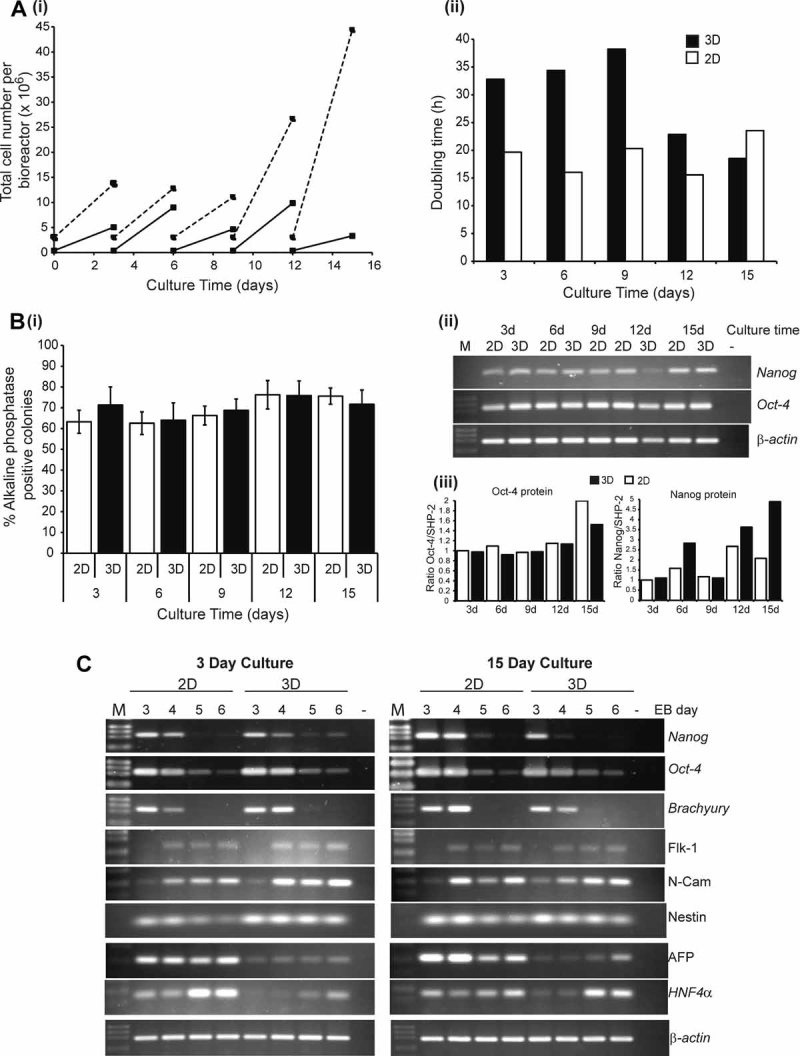
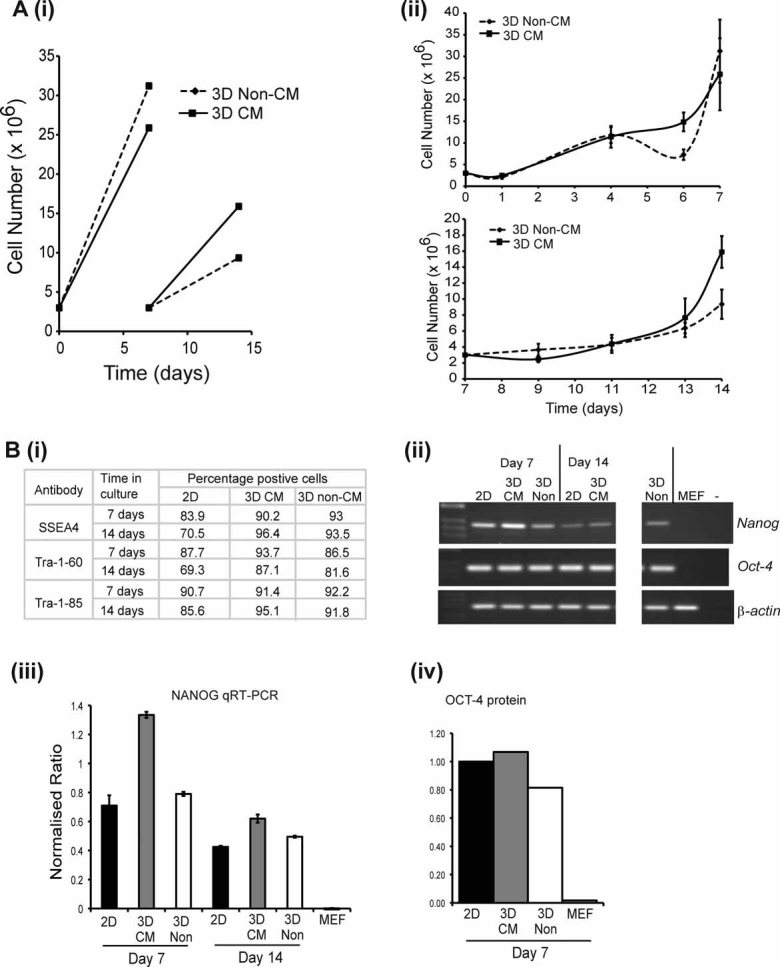
Mouse embryonic stem cell (ESC) lines, and more recently human ESC lines, have become valuable tools for studying early mammalian development. Increasing interest in ESCs and their differentiated progeny in drug discovery and as potential therapeutic agents has highlighted the fact that current two-dimensional (2D) static culturing techniques are inadequate for large-scale production. The culture of mammalian cells in three-dimensional (3D) agitated systems has been shown to overcome many of the restrictions of 2D and is therefore likely to be effective for ESC proliferation. Using murine ESCs as our initial model, we investigated the effectiveness of different 3D culture environments for the expansion of pluripotent ESCs. Solohill Collagen, Solohill FACT, and Cultispher-S microcarriers were employed and used in conjunction with stirred bioreactors. Initial seeding parameters, including cell number and agitation conditions, were found to be critical in promoting attachment to microcarriers and minimizing the size of aggregates formed. While all microcarriers supported the growth of undifferentiated mESCs, Cultispher-S out-performed the Solohill microcarriers. When cultured for successive passages on Cultispher-S microcarriers, mESCs maintained their pluripotency, demonstrated by self-renewal, expression of pluripotency markers and the ability to undergo multi-lineage differentiation. When these optimized conditions were applied to unweaned human ESCs, Cultispher-S microcarriers supported the growth of hESCs that retained expression of pluripotency markers including SSEA4, Tra-1-60, NANOG, and OCT-4. Our study highlights the importance of optimization of initial seeding parameters and provides proof-of-concept data demonstrating the utility of microcarriers and bioreactors for the expansion of hESCs.
© 2010 Wiley Periodicals, Inc.
Figures
References
-
- Abranches E, Bekman E, Henrique D, Cabral JM. Expansion of mouse embryonic stem cells on microcarriers. Biotechnol Bioeng. 2007;96(6):1211–1221. - PubMed
-
- Cormier JT, zur Nieden NI, Rancourt DE, Kallos MS. Expansion of undifferentiated murine embryonic stem cells as aggregates in suspension culture bioreactors. Tissue Eng. 2006;12(11):3233–3245. - PubMed
-
- Dang SM, Gerecht-Nir S, Chen J, Itskovitz-Eldor J, Zandstra PW. Controlled, scalable embryonic stem cell differentiation culture. Stem Cells. 2004;22(3):275–282. - PubMed
-
- Draper JS, Smith K, Gokhale P, Moore HD, Maltby E, Johnson J, Meisner L, Zwaka TP, Thomson JA, Andrews PW. Recurrent gain of chromosomes 17q and 12 in cultured human embryonic stem cells. Nat Biotechnol. 2004;22(1):53–54. - PubMed
Publication types
MeSH terms
Grants and funding
LinkOut - more resources
Full Text Sources
Research Materials