


Neural tube defects induced by folate deficiency in mutant curly tail (Grhl3) embryos are associated with alteration in folate one-carbon metabolism but are unlikely to result from diminished methylation
- PMID: 20589880
- PMCID: PMC3634156
- DOI: 10.1002/bdra.20690
Neural tube defects induced by folate deficiency in mutant curly tail (Grhl3) embryos are associated with alteration in folate one-carbon metabolism but are unlikely to result from diminished methylation
Abstract
Background: Folate one-carbon metabolism has been implicated as a determinant of susceptibility to neural tube defects (NTDs), owing to the preventive effect of maternal folic acid supplementation and the higher risk associated with markers of diminished folate status.
Methods: Folate one-carbon metabolism was compared in curly tail (ct/ct) and genetically matched congenic (+(ct)/+(ct)) mouse strains using the deoxyuridine suppression test in embryonic fibroblast cells and by quantifying s-adenosylmethionine (SAM) and s-adenosylhomocysteine (SAH) in embryos using liquid chromatography tandem mass spectrometry. A possible genetic interaction between curly tail and a null allele of 5,10-methylenetetrahydrofolate reductase (MTHFR) was investigated by generation of compound mutant embryos.
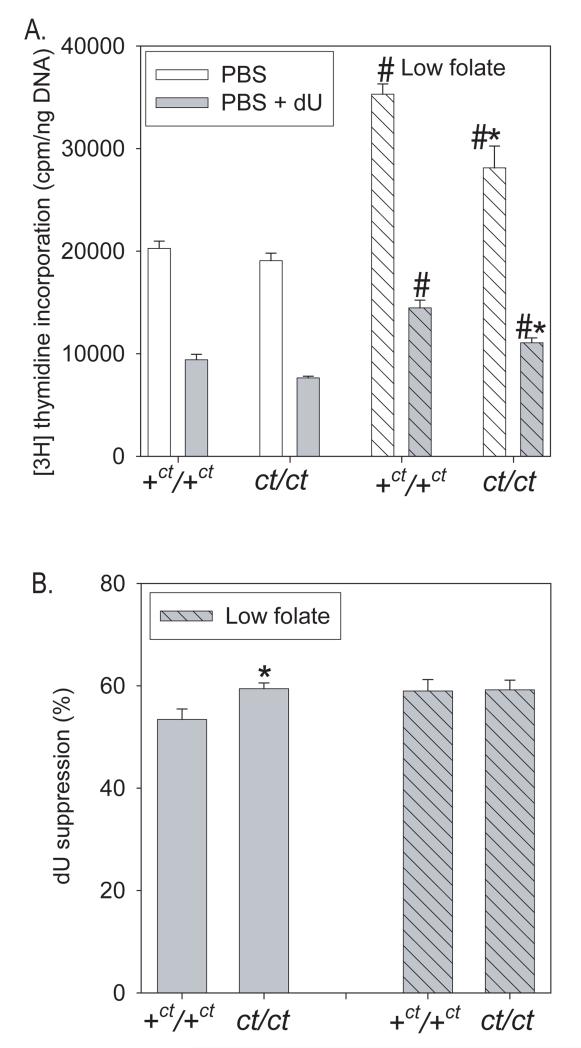
Results: There was no deficit in thymidylate biosynthesis in ct/ct cells, but incorporation of exogenous thymidine was lower than in +(ct)/+(ct) cells. In +(ct)/+(ct) embryos the SAM/SAH ratio was diminished by dietary folate deficiency and normalized by folic acid or myo-inositol treatment, in association with prevention of NTDs. In contrast, folate deficiency caused a significant increase in the SAM/SAH ratio in ct/ct embryos. Loss of MTHFR function in curly tail embryos significantly reduced the SAM/SAH ratio but did not cause cranial NTDs or alter the frequency of caudal NTDs.
Conclusions: Curly tail fibroblasts and embryos, in which Grhl3 expression is reduced, display alterations in one-carbon metabolism, particularly in the response to folate deficiency, compared to genetically matched congenic controls in which Grhl3 is unaffected. However, unlike folate deficiency, diminished methylation potential appears to be insufficient to cause cranial NTDs in the curly tail strain, nor does it increase the frequency of caudal NTDs.
Figures
References
-
- Afman LA, Blom HJ, Drittij MJ, et al. Inhibition of transmethylation disturbs neurulation in chick embryos. Brain Res Dev Brain Res. 2005;158:1–2. 59–65. - PubMed
-
- Amorim MR, Lima MA, Castilla EE, et al. Non-Latin European descent could be a requirement for association of NTDs and MTHFR variant 677C > T: a meta-analysis. Am J Med Genet A. 2007;143A(15):1726–1732. - PubMed
-
- Burgoon JM, Selhub J, Nadeau M, et al. Investigation of the effects of folate deficiency on embryonic development through the establishment of a folate deficient mouse model. Teratology. 2002;65:219–227. - PubMed
Publication types
MeSH terms
Substances
Grants and funding
LinkOut - more resources
Full Text Sources
Medical
