Review
. 2010 Jun;20(2):026102.
doi: 10.1063/1.3455183.

A systems-biology approach to modular genetic complexity

Affiliations
Review

A systems-biology approach to modular genetic complexity

Gregory W Carter et al. Chaos. 2010 Jun.

Abstract

Multiple high-throughput genetic interaction studies have provided substantial evidence of modularity in genetic interaction networks. However, the correspondence between these network modules and specific pathways of information flow is often ambiguous. Genetic interaction and molecular interaction analyses have not generated large-scale maps comprising multiple clearly delineated linear pathways. We seek to clarify the situation by discerning the difference between genetic modules and classical pathways. We review a method to optimize the discovery of biologically meaningful genetic modules based on a previously described context-dependent information measure to obtain maximally informative networks. We compare the results of this method with the established measures of network clustering and find that it balances global and local clustering information in networks. We further discuss the consequences for genetic interaction networks and propose a framework for the analysis of genetic modularity.


Figures

Figure 1
Figure 1
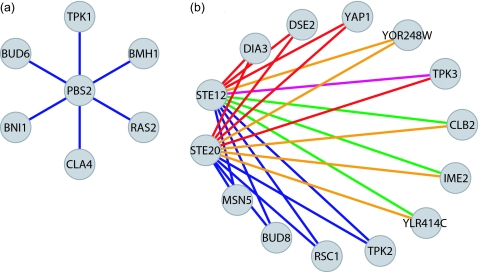
Examples of biological information in genetic interaction networks. (a) A biological statement showing the interactions of a gene deletion (PBS2) with perturbations of genes with a common function (signal transduction) via a common interaction rule (blue edges). (b) Mutually informative gene perturbations of STE12 and STE20 show large-scale patterns of genetic interaction. Both panels adapted from Drees et al. (Ref. 2).
Figure 2
Figure 2
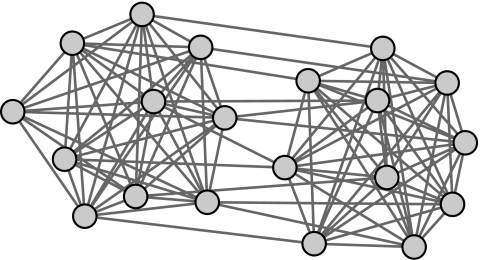
The maximally informative undirected, unweighted graph with N=20.
Figure 3
Figure 3
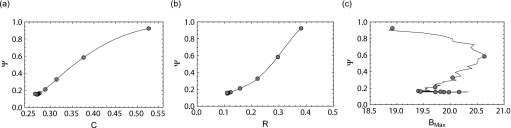
Set complexity vs (a) global clustering coefficient, (b) local modularity, and (c) maximum betweenness centrality for a sequence of 20-node networks ranging a random network to the maximum-Psi network with the number of edges fixed. Results have been averaged over 200 paths, and dots represent every tenth network configuration.
Figure 4
Figure 4
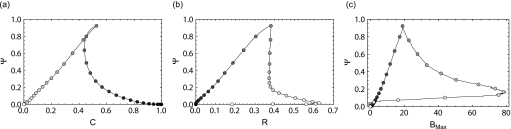
Set complexity vs (a) global clustering coefficient, (b) local modularity, and (c) maximum betweenness centrality for a sequence of 20-node networks ranging from an empty network to a complete network, averaged over 200 paths that traverse the maximum-Psi network. Dots represent every tenth network configuration and are shaded according to network density ranging from an empty network (white) to a complete network (black).
Figure 5
Figure 5
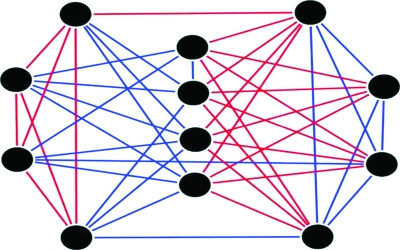
The maximally informative graph with 12 nodes and 3 edge types (red, blue, and no edge). The graph layout is chosen to illustrate edge monochromaticity between node sets.
Figure 6
Figure 6
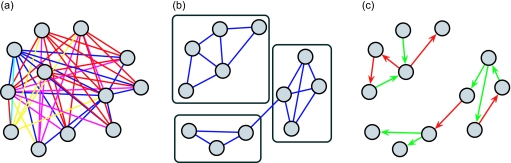
Modular analysis of a hypothetical genetic interaction network. (a) Multimodal network representing pairwise genetic interactions. (b) Reduced network of gene pairs with significant mutual information and the resulting modular structure. (c) Network of gene-gene information flow paths derived from further analysis based on the modular network (b).

References

    1. Tong A. H., Lesage G., Bader G. D., Ding H., Xu H., Xin X., Young J., Berriz G. F., Brost R. L., Chang M., Chen Y., Cheng X., Chua G., Friesen H., Goldberg D. S., Haynes J., Humphries C., He G., Hussein S., Ke L., Krogan N., Li Z., Levinson J. N., Lu H., Ménard P., Munyana C., Parsons A. B., Ryan O., Tonikian R., Roberts T., Sdicu A. -M., Shapiro J., Sheikh B., Suter B., Wong S. L., Zhang L. V., Zhu H., Burd C. G., Munro S., Sander C., Rine J., Greenblatt J., Peter M., Bretscher A., Bell G., Roth F. P., Brown G. W., Andrews B., Bussey H., and Boone C., Science SCIEAS 303, 808 (2004).10.1126/science.1091317 - DOI - PubMed
    1. Drees B. L., Thorsson V., Carter G. W., Rives A. W., Raymond M. Z., Avila-Campillo I., Shannon P., and Galitski T., Genome Biol. ZZZZZZ 6, R38 (2005).10.1186/gb-2005-6-4-r38 - DOI - PMC - PubMed
    1. Pan X., Ye P., Yuan D. S., Wang X., Bader J. S., and Boeke J. D., Cell CELLB5 124, 1069 (2006).10.1016/j.cell.2005.12.036 - DOI - PubMed
    1. St. Onge R. P., Mani R., Oh J., Proctor M., Fung E., Davis R. W., Nislow C., Roth F. P., and Giaever G., Nat. Genet. NGENEC 39, 199 (2007).10.1038/ng1948 - DOI - PMC - PubMed
    1. Decourty L., Saveanu C., Zemam K., Hantraye F., Frachon E., Rousselle J. -C., Fromont-Racine M., and Jacquier A., Proc. Natl. Acad. Sci. U.S.A. PNASA6 105, 5821 (2008).10.1073/pnas.0710533105 - DOI - PMC - PubMed

Publication types