Review
. 2010:26:689-719.
doi: 10.1146/annurev-cellbio-100109-104113.

Stochastic mechanisms of cell fate specification that yield random or robust outcomes

Affiliations
Review

Stochastic mechanisms of cell fate specification that yield random or robust outcomes

Robert J Johnston Jr et al. Annu Rev Cell Dev Biol. 2010.

Abstract

Although cell fate specification is tightly controlled to yield highly reproducible results and avoid extreme variation, developmental programs often incorporate stochastic mechanisms to diversify cell types. Stochastic specification phenomena are observed in a wide range of species and an assorted set of developmental contexts. In bacteria, stochastic mechanisms are utilized to generate transient subpopulations capable of surviving adverse environmental conditions. In vertebrate, insect, and worm nervous systems, stochastic fate choices are used to increase the repertoire of sensory and motor neuron subtypes. Random fate choices are also integrated into developmental programs controlling organogenesis. Although stochastic decisions can be maintained to produce a mosaic of fates within a population of cells, they can also be compensated for or directed to yield robust and reproducible outcomes.


Figures
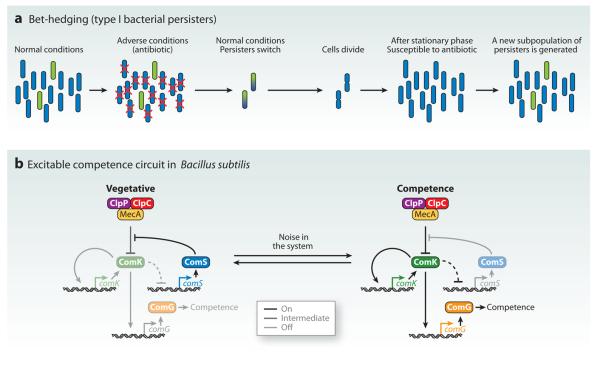
Figure 1
Figure 1
Stochastic bet-hedging in bacteria generates population diversity. (a) Type I bacterial persisters. A small, stochastic subpopulation of dormant persisters survive adverse conditions. Upon return to normal growth conditions, these cells divide and reestablish the population. Finally, a new persister subpopulation is determined. (b) The DNA uptake competence cycle in Bacillus subtilis. Noise within the system drives the transition from the vegetative state to the competent state.
Figure 2
Figure 2
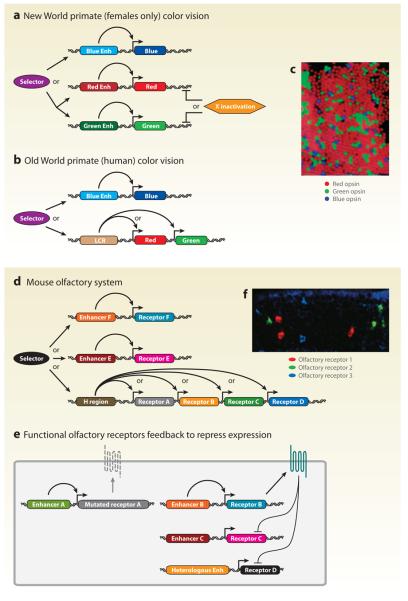
The primate color vision and mouse olfactory systems utilize stochastic locus selection and locus control region (LCR)-mediated mechanisms. (a) Stochastic photopigment selection in New World primates requires locus selection and X inactivation. (b) Stochastic photopigment selection in Old World primates requires locus selection and LCR-mediated exclusive activation. (c) Stochastic expression of blue, red, and green photopigments in humans (adapted from Roorda & Williams 1999). (d) Stochastic olfactory receptor selection in mice requires locus selection and H region/LCR-mediated activation. (e) Functional olfactory receptors feed back to repress expression of other olfactory receptor gene alleles. (f) Stochastic expression of olfactory receptors in mice (courtesy of T. Ishii and P. Mombaerts, The Rockefeller University). Enh, enhancer.
Figure 3
Figure 3
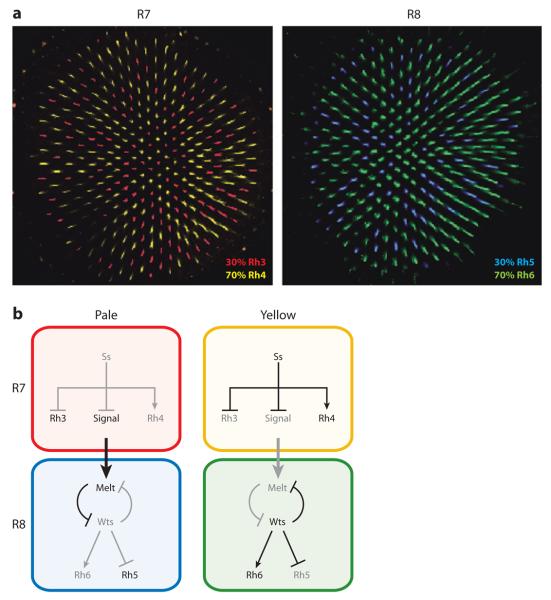
The fly eye is a stochastic mosaic of two ommatidial subtypes. (a) Rhodopsin (Rh)3 and Rh4 are stochastically distributed in R7 neurons. Rh5 and Rh6 are stochastically and exclusively distributed in R8 neurons, and their expression is coupled to R7 subtype specification. (b) The yellow subtype is determined by the stochastic expression of the Spineless (Ss) transcription factor in R7s. Pale subtype fate is signaled from R7 to R8. Wts, Warts; Melt, Melted.
Figure 4
Figure 4
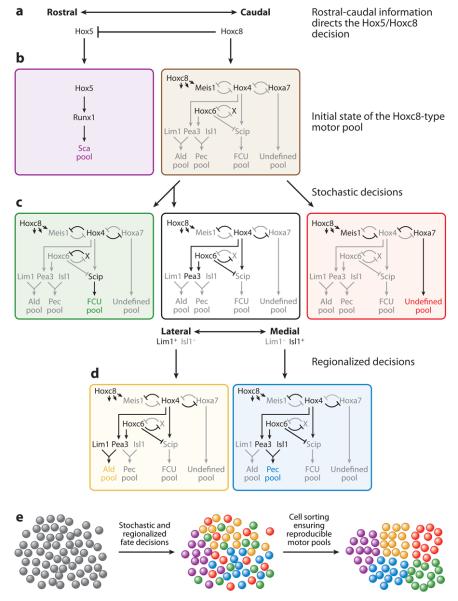
Neuronal migration compensates for stochastic cell fate specification mechanisms to yield robust motor pools. (a) Rostral/caudal gradients of retinoic acid, fibroblast growth factor (FGF), and Gdf11 (a TGFβ family member) determine expression of Hox5 rostrally and Hoxc8 caudally. (b) Hox5 determines the scapulohumeralis posterior (Sca) muscle motor pool (purple). Hoxc8-expressing cells coexpress several Hox genes before undergoing additional stochastic and directional specification steps (brown). (c) The Hoxc8-expressing cells stochastically choose between expression of Hox4 or Meis1/Hoxa7. Hox4-expressing cells undergo a second stochastic decision to express Hoxc6 or not. Hox4+ Hoxc6 cells are specified as the flexor carpi ulnaris (FCU) pool (green). Hox4+ Hoxc6+ cells undergo an additional directed specification step (black). Meis1/Hoxa7-expressing cells determine an undefined motor pool (red). (d) Directed regionalization mechanisms determine Lim1 or Isl1 expression in Hox4+ Hoxc6+ cells. Lim1-expressing cells are specified as the anterior latissimus dorsi (Ald) motor pool (yellow). Isl1-expressing cells are specified as the pectoralis muscle (Pec) motor pool (blue). (e) Stochastic cell fate specification is compensated for via neuronal migration into coherent motor pools.
Figure 5
Figure 5
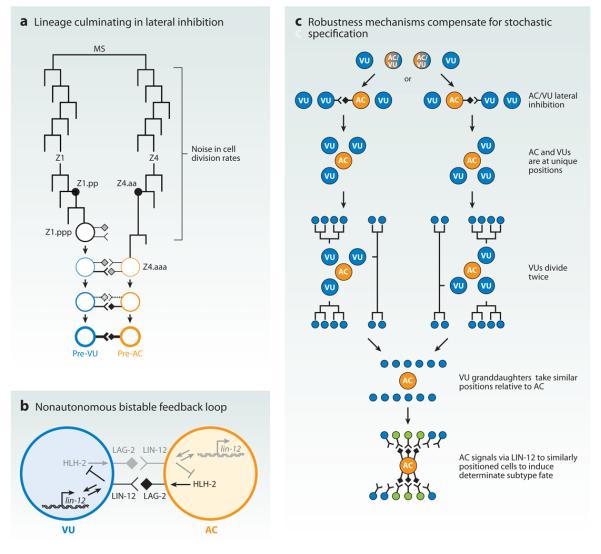
Cell positioning and signaling compensate for stochastic lateral inhibition in the worm vulval developmental pathway. (a) The precursor cells of the anchor cell (AC, orange) and the ventral uterine precursor (VU, blue) have similar lineage origins. Variability (i.e., noise) in cell division rates results in stochastic precursor birth order. The first-born precursor cell has higher LIN-12/Notch activity that biases lateral inhibition. The cell with high LIN-12/Notch takes on the VU fate, whereas the cell with low LIN-12/Notch activity takes on the AC fate. The first division at the MS cell stage has been inverted for illustration purposes (adapted from Karp & Greenwald 2003). (b) LIN-12 lateral inhibition generates two exclusive fates via a nonautonomous bistable feedback loop (adapted from Karp & Greenwald 2003). The bHLH transcription factor, HLH-2, mediates this feedback loop. (c) Robustness mechanisms, including reproducible cell positioning and directional LIN-12 signaling, compensate for the stochastic AC/VU decision.
Figure 6
Figure 6
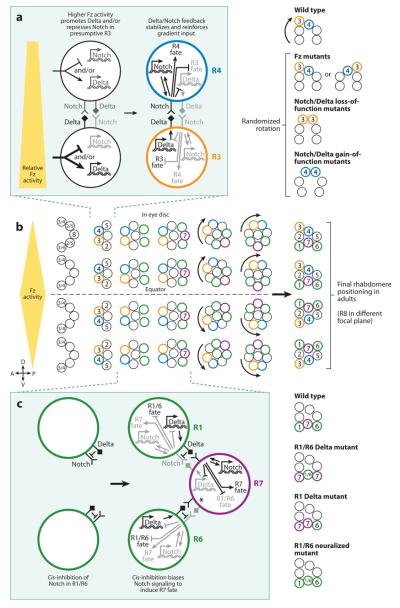
A gradient of Frizzled (Fz) activity and cis-inhibition directs stochastic Notch signaling in the fly eye. (a) A gradient of Fz activity biases Notch activity such that R3 has high Notch activity and R4 has low Notch activity. As in the AC/VU example, feedback loops reinforce the fate decisions. (b) Development of the fly retina. A 5-cell precluster is determined followed by specification of R3 or R4 fate via Fz-directed Notch signaling. R1 and R6 are recruited to the cluster and then signal via Notch to induce R7 fate (completing photoreceptor recruitment). The clusters of cells rotate to their final position. (c) Cis-inhibition of Notch activity by Delta in R1/R6 cells induces directional Notch signaling to specify R7 fate. As in the AC/VU example, feedback loops reinforce the fate decisions. For simplicity, * indicates the Notch-mediated inputs via signaling from R6.
Figure 7
Figure 7
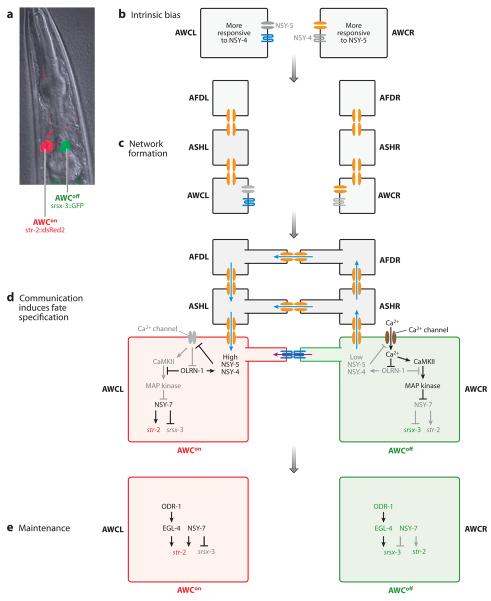
A gap junction–mediated mechanism of lateral inhibition controls stochastic lateral olfactory neuronal fate in worms. (a) The AWC on the left side (AWCL) and the AWC on the right side (AWCR) stochastically and exclusively choose the AWCon or AWCoff fate. AWCon is marked by expression of str-2::dsRed2 whereas AWCoff is marked by expression of srsx-3::green fluorescent protein (GFP). Image from Lesch et al. (2009). (b) AWCL is intrinsically biased to be more responsive to NSY-4 activity whereas AWCR is intrinsically biased to be more responsive to NSY-5 activity. Both cells pursue AWCon fate but via different mechanisms. (c) A gap junction network mediated by NSY-5 forms between ipsilateral AFD, ASH, and AWC neurons in embryonic stages. (d) The network is completed when bilateral neuronal pairs create gap junctions. The AWC pair generates gap junctions via the NSY-5 innexin protein. Signaling through gap junctions is stochastically directed to an AWC cell (e.g., AWCL). Directionality of signaling is reinforced by upregulation of NSY-4 and NSY-5, which represses Ca2+ influx and prevents activation of the MAP kinase (MAPK) cascade. NSY-7 is active in the absence of MAPK activity, which leads to AWCon fate (red). The cell with lower NSY-4 and NSY-5 activity allows Ca2+ influx. Ca2+ activates CAMKII and the MAPK cascade. The MAPK pathway represses NSY-7, which leads to AWCoff fate (green). (e)AWCon fate is maintained by NSY-7. ODR-1 and EGL-4 are generally required for maintenance of both AWCon and AWCoff fates.

References

    1. Balaban NQ, Merrin J, Chait R, Kowalik L, Leibler S. Bacterial persistence as a phenotypic switch. Science. 2004;305:1622–25. - PubMed
    1. Bauer Huang SL, Saheki Y, VanHoven MK, Torayama I, Ishihara T, et al. Left-right olfactory asymmetry results from antagonistic functions of voltage-activated calcium channels and the Raw repeat protein OLRN-1 in C. elegans. Neural. Dev. 2007;2:24. - PMC - PubMed
    1. Bell ML, Earl JB, Britt SG. Two types of Drosophila R7 photoreceptor cells are arranged randomly: a model for stochastic cell-fate determination. J. Comp. Neurol. 2007;502:75–85. - PubMed
    1. Bigger JW. The bactericidal action of penicillin on Staphylococcus pyogenes. Irish J. Med. Sci. 1944a;227:553–68.
    1. Bigger JW. Treatment of staphylococcal infections with penicillin by intermittent sterilisation. Lancet. 1944b:497–500.

Publication types

LinkOut - more resources