. 2010 Jun;160(4):941-57.
doi: 10.1111/j.1476-5381.2010.00704.x.

A monobromobimane-based assay to measure the pharmacokinetic profile of reactive sulphide species in blood

Affiliations

A monobromobimane-based assay to measure the pharmacokinetic profile of reactive sulphide species in blood

Edward A Wintner et al. Br J Pharmacol. 2010 Jun.

Abstract

Background and purpose: Hydrogen sulphide (H(2)S) is a labile, endogenous metabolite of cysteine, with multiple biological roles. The development of sulphide-based therapies for human diseases will benefit from a reliable method of quantifying H(2)S in blood and tissues.

Experimental approach: Concentrations of reactive sulphide in saline and freshly drawn whole blood were quantified by reaction with the thio-specific derivatization agent monobromobimane, followed by reversed-phase fluorescence HPLC and/or mass spectrometry. In pharmacokinetic studies, male rats were exposed either to intravenous infusions of sodium sulphide or to H(2)S gas inhalation, and levels of available blood sulphide were measured. Levels of dissolved H(2)S/HS(-) were concomitantly measured using an amperometric sensor.

Key results: Monobromobimane was found to rapidly and quantitatively derivatize sulphide in saline or whole blood to yield the stable small molecule sulphide dibimane. Extraction and quantification of this bis-bimane derivative were validated via reversed-phase HPLC separation coupled to fluorescence detection, and also by mass spectrometry. Baseline levels of sulphide in blood were in the range of 0.4-0.9 microM. Intravenous administration of sodium sulphide solution (2-20 mg x kg(-1) x h(-1)) or inhalation of H(2)S gas (50-400 ppm) elevated reactive sulphide in blood in a dose-dependent manner. Each 1 mg x kg(-1) x h(-1) of sodium sulphide infusion into rats was found to be pharmacokinetically equivalent to approximately 30 ppm of H(2)S gas inhalation.

Conclusions and implications: The monobromobimane derivatization method is a sensitive and reliable means to measure reactive sulphide species in whole blood. Using this method, we have established a bioequivalence between infused sodium sulphide and inhaled H(2)S gas.


Figures
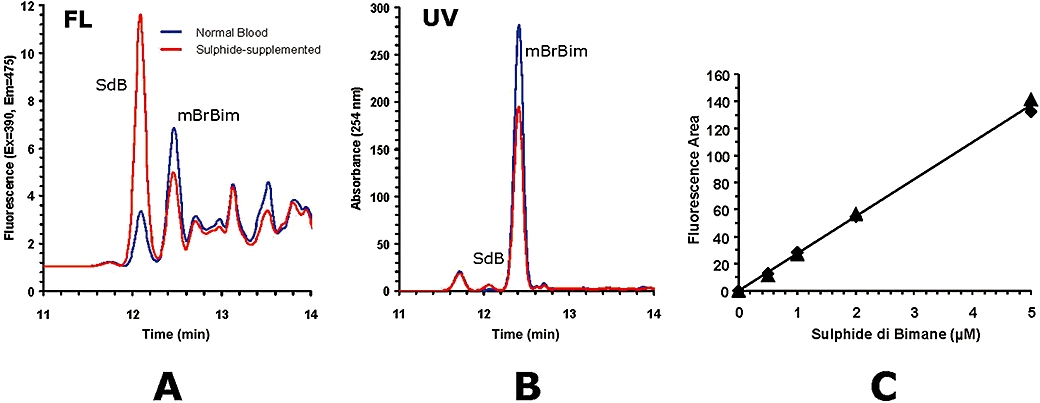
Figure 2
Figure 2
Typical chromatograms of monobromobimane derivatized and ethyl acetate-extracted blood samples. (A) Fluorescence trace (λex= 390 nm, λem= 475 nm) resulting from assay of naïve rat blood (solid line) and assay of rat blood supplemented with 5 µM sulphide (dotted line) (SdB, sulphide dibimane; mBrBim, monobromobimane). (B) Absorbance trace (λabs= 254 nm) of same samples. Sulphide concentration in the sample is calculated from the fluorescence area under the sulphide dibimane (SdB) peak at 12.1 min. (C) Linear response relationship between the fluorescence area of HPLC chromatograms as function of sulphide dibimane concentration, injecting 7 µL of standard sulphide dibimane solutions in acetonitrile. The specific fluorescence of the sulphide dibimane solution in acetonitrile is 2.77 FAU·pmol−1 sulphide dibimane.
Figure 1
Figure 1
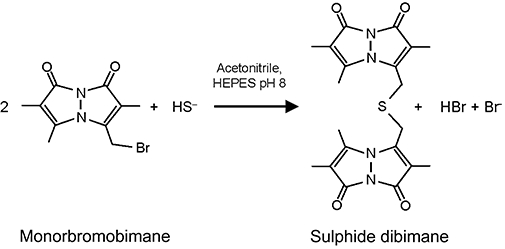
Reaction scheme for the derivatization of sulphide with monobromobimane to form sulphide dibimane.
Figure 3
Figure 3
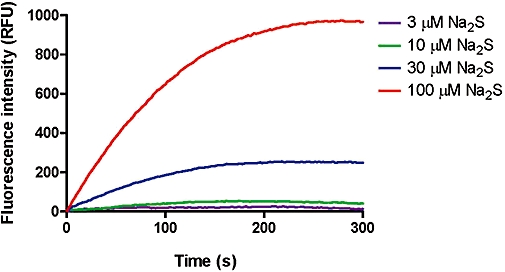
Kinetic analysis of the monobromobimane reaction. Sulphide concentrations between 3 and 100 µM were reacted with 1 mM monobromobimane in acetonitrile/HEPES buffer, and the subsequent formation of sulphide dibimane was followed by fluorescence (λex= 390 nm, λem= 475 nm). The reaction is first order relative to the substrate hydrosulphide, with a rate constant k= 0.01 ± 0.0016 s−1. Fluorescence was calibrated against standards of sulphide dibimane, and sulphide reacted completely with an excess of monobromobimane. Data show representative curves from three independent experiments.
Figure 4
Figure 4
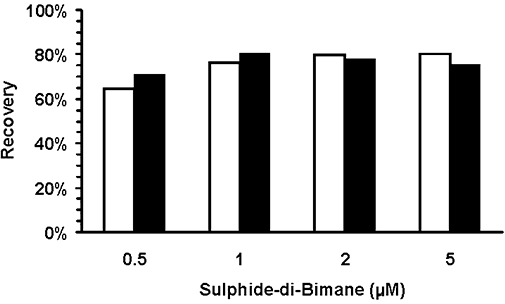
Recovery of sulphide dibimane from whole rat blood as a function of sulphide dibimane concentration. Duplicate blood samples were supplemented with sulphide dibimane, were processed via ethyl acetate extraction as prescribed above and were then analysed via HPLC. Average recovery of sulphide dibimane for the assay was 76%, and this recovery was shown to be independent of sulphide dibimane concentration. White and black bars show data from two independent experiments.
Figure 5
Figure 5
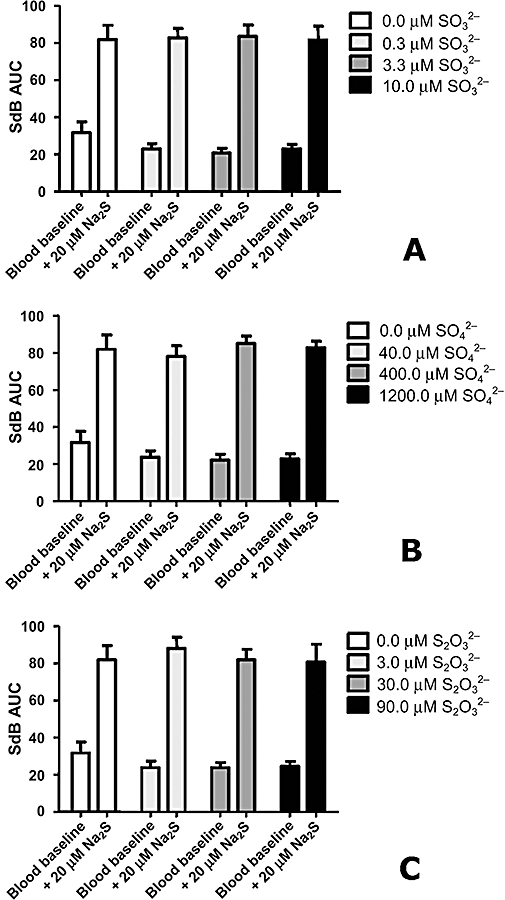
The major oxidation products of sulphide do not interfere with sulphide quantitation. Control rat blood or rat blood with added sodium sulphide was derivatized with monobromobimane in the presence of physiological concentrations of (A) sulphite (SO32–), (B) sulphate (SO42−) and (C) thiosulphate (S2O32−). No effect on measured sulphide levels was observed up to 10 µM sulphite, 1200 µM sulphate and 90 µM thiosulphate. Data represent mean ± SEM for three replicates.
Figure 6
Figure 6
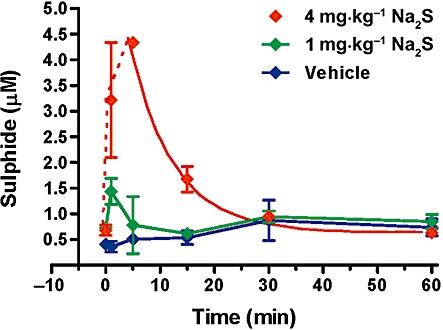
Measurement of blood levels of sulphide after a single intravenous bolus injection of sodium sulphide in rats. The dose of 1 mg·kg−1 sodium sulphide induced a transient elevation of blood sulphide levels at 1 min, while the dose of 4 mg·kg−1 sulphide produced an elevation for 30 min after the injection, with a calculated half-life of approximately 5.7 min. Data represent mean ± SEM values from n= 4 animals for each time-point.
Figure 8
Figure 8
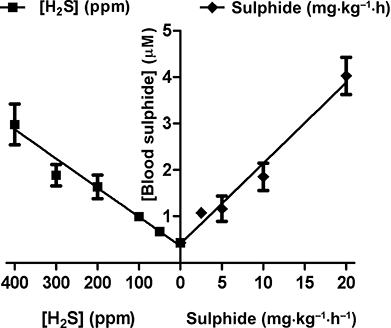
Correlation between levels of monobromobimane-reactive blood sulphide in rats after 2 h of either inhalation of H2S gas or constant infusion of sodium sulphide solution. Graph is a re-plotting of the 2 h data presented in Figure 7A and B, shown as mean ± SD; n= 3 for each group.
Figure 7
Figure 7
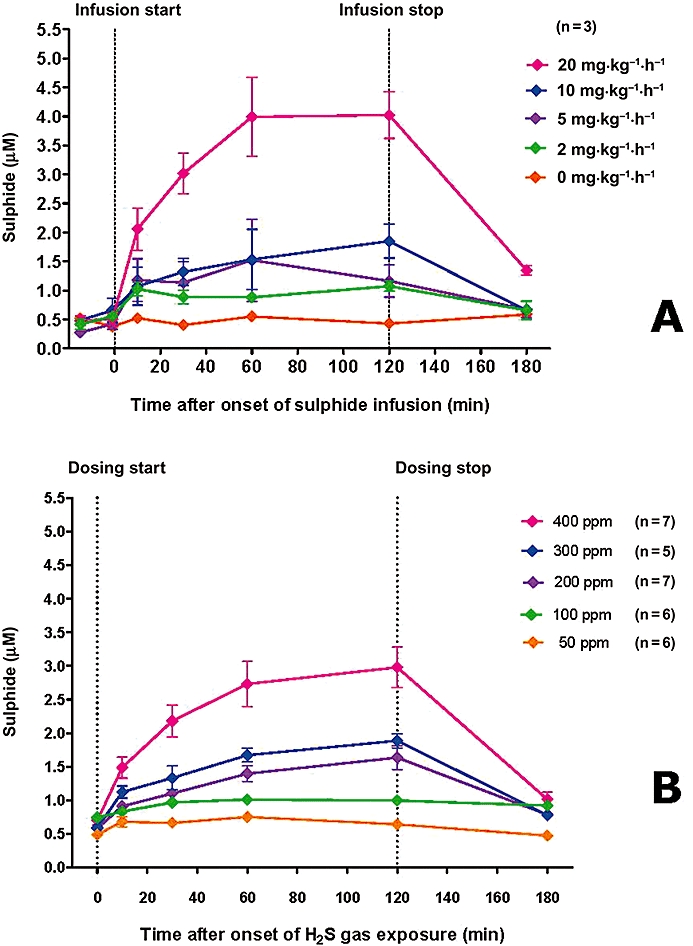
(A) Blood sulphide levels after exposure of rats to continuous intravenous infusions of sodium sulphide solution (2, 5, 10 or 20 mg·kg−1·h−1). (B) Blood sulphide levels after exposure of rats to air atmospheres containing varying concentrations of H2S gas (50, 100, 200, 300, 400 ppm). Data represent mean ± SD; n= 3 for each group. Exposures of 2 h for both infusion and inhalation experiments.
Figure 9
Figure 9
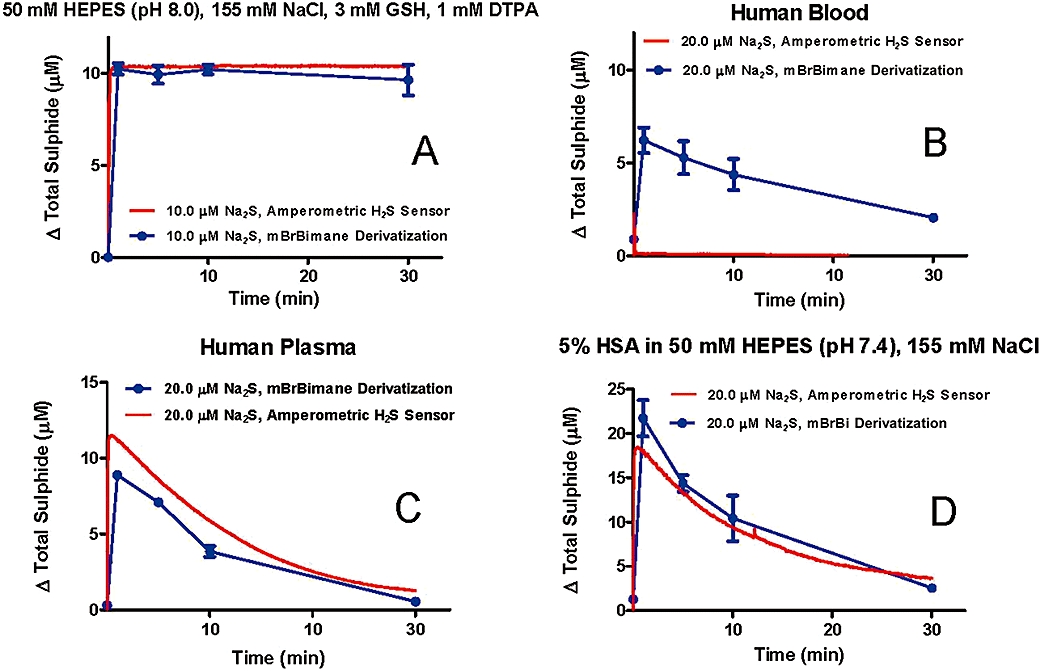
(A) Comparison of amperometric sensor and monobromobimane-based sulphide measurements after addition of 10 µM sodium sulphide to an oxygen-depleted buffered saline solution. Data represent mean ± SD of n= 3 replicates. (B) Comparison of amperometric sensor and monobromobimane-based sulphide measurements after addition of 20 µM sodium sulphide to human blood. (C) Comparison of amperometric sensor and monobromobimane-based sulphide measurements after addition of 20 µM sodium sulphide to human plasma. (D) Comparison of amperometric sensor and monobromobimane-based sulphide measurements after addition of 20 µM sodium sulphide to a solution containing 5% human serum albumin in 50 mM HEPES and 155 mM NaCl. Data represent mean ± SD of three replicates.
Figure 10
Figure 10
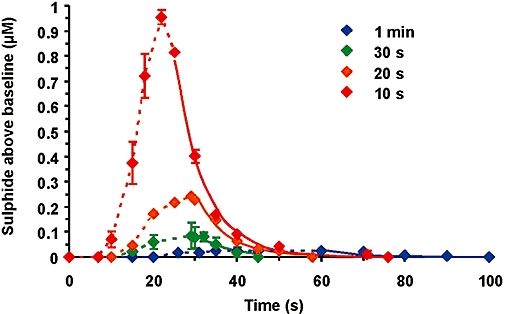
Measurement of sulphide in the vena cava of rats following intravenous injection of 1 mg·kg−1 sodium sulphide over 10, 20, 30 or 60 s, and detecting dissolved H2S using an amperometric sensor. Data represent mean ± SEM; n= 3.
Figure 11
Figure 11
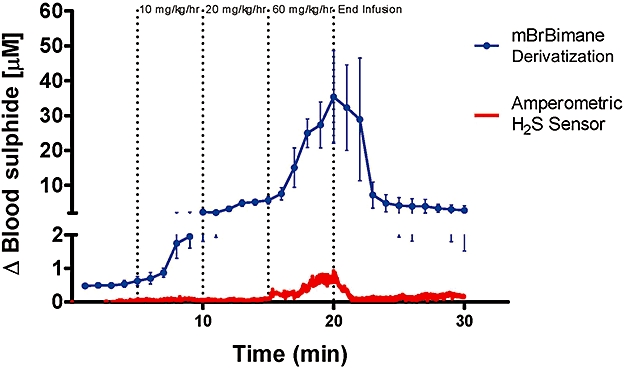
In vivo comparison of amperometric sensor and monobromobimane (mBrBimane)-based blood sulphide measurements in rats during stepwise elevations of sodium sulphide infusion at rates of 10, 20 and 60 mg·kg−1·h−1, each for 5 min. Data represent mean ± SEM; n= 3.
Figure 12
Figure 12
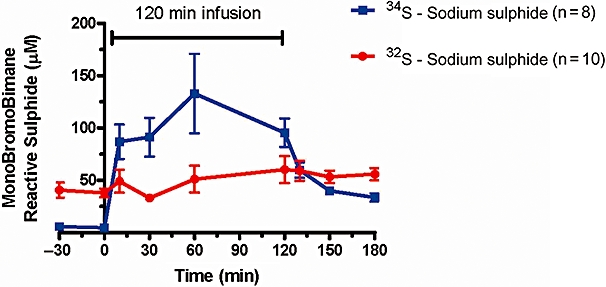
Measurement via derivatization with monobromobimane of 34S-sulphide and 32S-sulphide in rat blood during dosing with 34S-sodium sulphide. Rats received continuous intravenous infusions of 34S-sulphide over 120 min at 10 mg·kg−1·h−1. Blood concentrations of 34S-sulphide increased in a dose-dependent manner, while 32S-sulphide blood concentrations remained unchanged. Data represent mean ± SEM; n= 8–10.
Figure 13
Figure 13
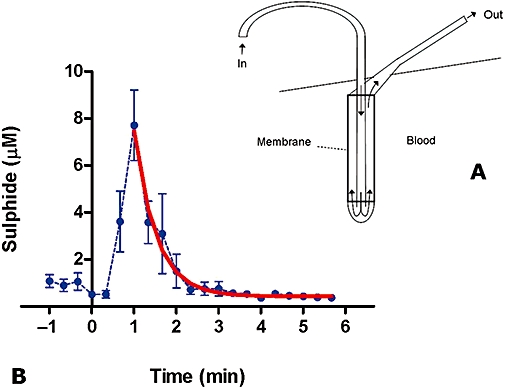
Concentrations of available sulphide in the venous blood of rats after an intravenous bolus injection of 3 mg·kg−1 sodium sulphide, as measured in the microdialysate via the monobromobimane assay. Values after the peak were analysed by non-linear regression and fitted to a curve (thick red line), yielding a half-life of 22 s. Data shown are means ± SEM; n= 4.

References

    1. Benavides GA, Squadrito GL, Mills RW, Patel HD, Isbell TS, Patel RP, et al. Hydrogen sulfide mediates the vasoactivity of garlic. Proc Natl Acad Sci U S A. 2007;104:17977–17982. - PMC - PubMed
    1. Bhatia M, Sidhapuriwala JN, Sparatore A, Moore PK. Treatment with H2S-releasing diclofenac protects mice against acute pancreatitis-associated lung injury. Shock. 2008;29:84–88. - PubMed
    1. Doeller JE, Isbell TS, Benavides G, Koenitzer J, Patel H, Patel RP, et al. Polarographic measurement of hydrogen sulfide production and consumption by mammalian tissues. Anal Biochem. 2005;341:40–51. - PubMed
    1. Elrod JW, Calvert JW, Morrison J, Doeller JE, Kraus DW, Tao L, et al. Hydrogen sulfide attenuates myocardial ischemia–reperfusion injury by preservation of mitochondrial function. Proc Natl Acad Sci U S A. 2007;104:15560–15565. - PMC - PubMed
    1. Esechie A, Kiss L, Olah G, Horvath EM, Hawkins HK, Szabo C, et al. Protective effect of hydrogen sulfide in a murine model of combined burn and smoke inhalation-induced acute lung injury. Clin Sci. 2008;115:91–97. - PubMed

MeSH terms